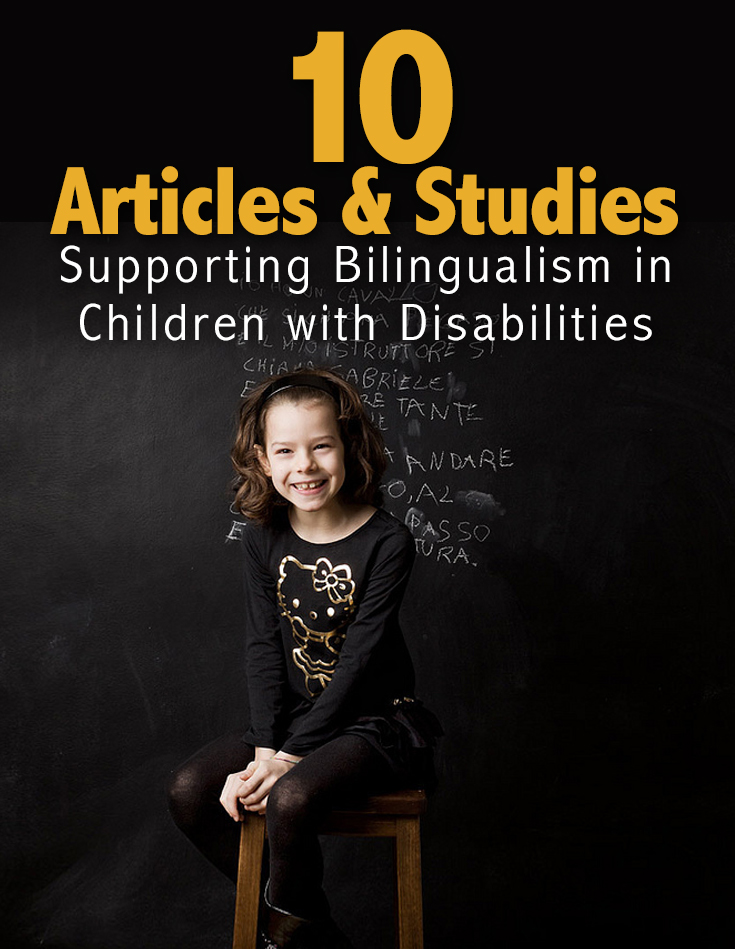
It’s a common misconception that for children with cognitive or developmental disabilities learning two or more languages can further negatively affect their language development. This belief is even shared by many physicians, therapists and special education teachers who regularly advice parents of children with disabilities to speak to them only in English. This advice goes against the findings of an increasing amount of scientific evidence based studies which have discovered something that many bilingual families already knew: that bilingualism is not harmful for children with developmental delays or language impairments.
 photo credit: rent-a-moose via photopin cc
In families where a language other than English is spoken at home or for whom speaking two or more languages is useful and/or important, restricting the child’s exposure to only one language can have many negative implications.
I believe, based on my own experience raising a bilingual child with a language impairment and from what I have read on countless studies, that bilingualism is not only possible for children with disabilities but also, for many, an invaluable part of their lives. But don’t take my word for it, here are my favorite articles and studies supporting bilingualism for children with language impairments.
Articles Supporting Bilingualism in Children with Disabilities
1) Can children with language impairments learn two languages? by Lauren Lowry, a Certified Speech-Language Pathologist. This great Article from the Hanen Center: We actually used the Hanen program with my daughter and it helped us find ways to support her and increase her language skills. The results where truly amazing and we did it in both languages.
2) Parenting Tips for Special Needs Children Learning Two Languages. This article from Early Intervention Support provides practical ideas for parents of children with Special Needs who are learning two languages.
3) Cognition and behavior: Bilingualism doesn’t hinder language. This article from The Simmons Foundation Autism Research Initiative describes two different studies that conclude that “bilingualism is not harmful to children with autism, and that clinicians should not advise bilingual parents to teach their children with autism only one language.”
4) How to Raise Bilingual Kids With Special Needs is a great article in SpanglishBaby by my friend Eliana Tardio who shares her first hand experience raising two bilingual children who have Down Syndrome.
5) Video from LinguaHealth with Dr. Brenda Gorman a speech-language pathologist. In this video she talks about the misconception many people have that a child with language impairments should only communicate in one language.
I might be a little biased on these next two as I wrote them but I think I make good points in them and included background information as well as my own theory on the subject. 🙂
6) Autism and Bilingualism: Our Family’s Journey. I wrote this article about our experience with my daughter who has autism and how being bilingual is important for her development and communication and has been beneficial for her to the point of improving her language skills.
Evidence Based Proof
In recent years there have been some studies that disproof the notion that children with developmental disabilities or speech impairments should stop using their home language and focus only on one language. There still is a lot of research that needs to be done but this is a good start.
8) Study: To Be or Not to Be Bilingual: Autistic Children from Multilungual Families by Tamar Kremer-Sadlik from the University of California, Los Angeles. This study states that there is not sufficient support to claim that multilingualism further harms language acquisition of language impaired/delayed children. Additionally it goes on to say that it is very important for children with ASD to speak the home language.
9) Study: Bilingual Children with specific language impairment: Thoretical and applied issues by Johannes Paradis from the University of Alberta. This study’s findings disprove the widespread belief that children with language impairments should not be learning two languages.
10) Study: Does simultaneous bilingualism aggravate children’s specific language problems? by Korkoman M, et al. This study concludes that “simultaneous bilingualism does not aggravate specific language problems but may result in a slower development of vocabulary both in children with and without specific language problems.” However slower development of vocabulary is part of the typical development of all children who are learning two languages at the same time.
For an constantly updated and more extensive list of articles and studies regarding bilingualism and disabilities please visit Growing Up Bilingual’s resources page HERE.
Do you think a child with disabilities or language impairment can be bilingual?

Paula studied architecture and now makes a living as a freelance writer,traveler and amateur photographer.She started her writing & publishing career as the editor of Bebé y Mamá, the first parenting magazine in Guatemala.She is the founder of www.GrowingUpBilingual.com and www.365thingsswfl.com and writes articles in Spanish and English for both magazines and the web on travel,food and bicultural and bilingual parenting .
When she is not on a plane or road trip she likes to create recipes inspired in the flavors of her native Guatemala.
- Guatemalan Dulce de Chilacayote Recipe (Crystalized Chilacayote Candy) - February 26, 2024
- Guatemalan Naranjas en Miel Recipe (Candied Oranges Recipe) - February 25, 2024
- Traditional Guatemalan Candy - February 25, 2024


Thanks for sharing all the information about introducing a second language in children with disabilities. I want my children to be bilingual. I wish I spoke another language so it would be easier.
Thank you for posting this list. It is very informative!
I can totally relate having three major languages spoken with my children and I sometimes inject two more when I can. Kids, with disabilities or not, I believe can very well learn upto 5 languages…that sometimes I think, they don’t have disabilities at all….great article. Thanks for sharing!
This
“simultaneous bilingualism does not aggravate specific language problems but may result in a slower development of vocabulary both in children with and without specific language problems.”
is definitely true. My daughter is one good example. My daughter now 4 years old turning 5 this year still has to speak a language clearly. She is really trying to catch up, mix and match and ending up using words the wrong way since she is mixing up 4 languages at the same time. At home we try to speak English with our children but speaking our native tongue(Bisaya) is unavoidable especially when one gets mad. LOL! Then we speak our National dialect(Tagalog) when visitors come or meeting other Filipinos, and lastly every time we go out of the house Thai is the language we hear and try our best to use. ^_^
Thank you for all this information.. I love your blog.
I love your article! My DD7 has Selective Mutism (not a learning disability but does make her delayed in some things) and we have her in grade 2 now in a French Immersion school. It has done nothing but enhance her learning and broadens how she is able to learn as it activates other areas of the brain that she might not use is she was only learning one language. The next languages to learn will be Arabic & Mandarin!
Thank you so much for the links to this research! I see this at the school I work at where the children who are struggling in middle school aren’t required to take Spanish like the other students who are not struggling. I didn’t realize that being bilingual has so many great benefits for students with disabilities. Will definitely be keeping this in mind in future parent/teacher conferences.
I love your positive attitude and wealth of information on this subject.This wonderful and so inspiring.I myself wish that I could have learned more than one language too.It would be such an asset to a diabled child or anyone for that matter.
Thank you for this informative article. Have a lovely day.
thank you so much for this informative article.
My son was born in 1990 with Down Syndrome and I followed my own instincts in his early years, ignoring well-intentioned but mis-informed advice such as not to breastfeed and to speak to him in one language only (ie French, and not our home language, English). At home he was immersed in English with a diet of child-directed speech, lots of interaction via talk, story reading, rhymes, songs, play and physical activities all scaffolded as required. This was complemented by similar activities in French at the local crèche which also added a social dimension as he played and developed alongside other children.
He is now 25 and bilingual and speaking two languages is so much part of his personality and identity!
Thanks so much for sharing. I had no idea of the importance behind speaking multiple languages when it comes to children with disabilities, however, it definitely makes sense to start children early and to start them regardless of whatever society based disability! Great post!
Thank you for writing this article and for listing some important articles about this topic. I know that it is possible for children with disabilities to grow up with multiple languages. When I was a child I had a friend with Down Syndrome who learned other languages just like everyone else. I never thought it would be a problem. As for other disabilities, I learned later on that it is not a problem either, or let’s be more precise: the problem are not the children, it’s the system or the adults who don’t know how to adjust to the learner. As a Language Consultant I have seen many children with all kinds of disabilities, succeed: understand, speak, read and write other languages. The main issue are the parents and adults around them, who have unrealistic expectations when it comes to the language goal (language fluency) and the time it takes to learn the language.
Children who are exposed to other languages since a very early age have a more natural approach to the other language though. I wish more teachers and health practitioners would read your post.