
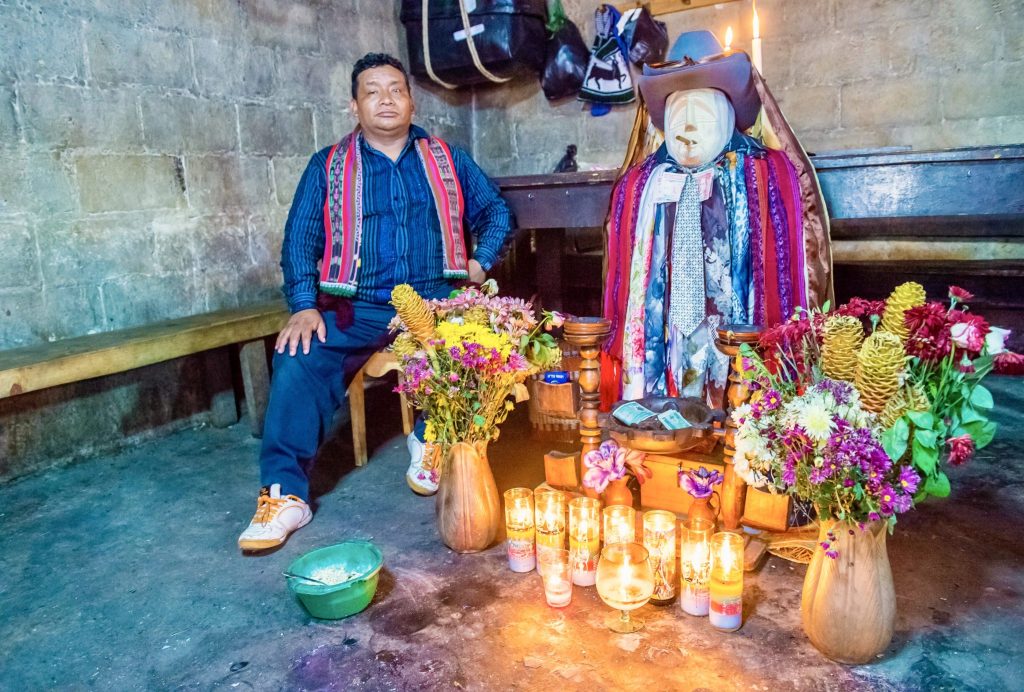
He wears a black hat, layers of colorful silk scarves piled around his neck, and has a hole carved into his wooden lips so a lit cigar can rest between them permanently. Half-empty bottles of Indita — the cheap Guatemalan aguardiente he favors — tend to accumulate around him. People kneel before him with real petitions, and the cofrades who care for him pour liquor directly into his carved mouth as an offering.
I grew up in Guatemala with Maximón as a presence I could never quite pin down. My mother collected art and kept a small sculpture of him at home — this strange figure I was always curious about but never quite understood. I heard stories, saw photographs, knew his face. But the stories were the most interesting part. I remember asking our cook, who was from Alta Verapaz, whether there was a Maximón in her town. She said her uncle kept one at home and that people came from the area to see him — and that he actually smoked the cigars and perhaps even drank the Indita. My father and I looked at each other. We had a pretty good theory about who was drinking the Indita. But the fact that the story was told so matter-of-factly, with complete conviction, told me everything I needed to know about how alive Maximón is in Guatemalan culture.
It wasn’t until I was older that I really dug into who he is and what he represents. And no amount of reading prepared me for seeing him in person. More on that in a moment.
Who Is Maximón? Names, Faces, and What Makes Him Unique
Maximón is a Tz’utujil Maya spiritual figure whose most important home is Santiago Atitlán, a village on the southern shore of Lake Atitlán. But versions of Maximón or San Simón in Guatemala exist in communities across the highlands — in Chimaltenango, Quetzaltenango, Sololá, and beyond. There are formal chapels dedicated to him, and there are private homes like that uncle in Alta Verapaz where a family keeps their own figure and neighbors come to make petitions.
He goes by several names:
- Rilaj Mam — his Tz’utujil name, meaning Great Elder or Great Grandfather
- Gran Abuelo — Great Grandfather in Spanish
- San Simón — the name used in many communities outside Santiago Atitlán
- Maximón — the name most travelers know, likely from the Tz’utujil word max (tobacco) combined with Simón
The two most well-known versions are Maximón in Santiago Atitlán — the original, most ancient, and spiritually complex form — and Maximón in San Andrés Itzapa, near Chimaltenango, which draws visitors from across Guatemala including large numbers from Guatemala City. Beyond these two, you will find him in Zunil near Quetzaltenango, in various communities in Sololá and the western highlands, and quietly, in private homes like that one in Alta Verapaz, tended by families who have their own relationship with the Gran Abuelo.
What makes him completely unique — in Guatemala and in the world — is the combination of what he is and what he accepts. He is not simply good. He is not simply bad. He is powerful, and that power can be directed in any direction. He will hear petitions that the Catholic saints would turn away. He will not judge you for what you ask. He sits and smokes and drinks and receives, and he has been doing this — in one form or another — for centuries.
The Personality of Maximón: Trickster, Healer, and Everything In Between
Before you visit, it helps to understand what kind of figure you are dealing with.
The Tz’utujil oral tradition tells that Maximón was created by the village shamans to protect the community from evil. He was built from the sacred tz’ajte’ tree, his body assembled from pieces tied together with ceremonial knots by his attending priest, the telinel — which is why one interpretation of his name is the bound one or the tied one. Within his wooden body, some say, there is concealed a stone or gold idol that holds his true power.
He did his job well. Too well, in fact. The stories describe him seducing the wives of every man in the village while they worked in the fields, and then turning his attention to the men when the women were away. The shamans eventually had to intervene — they twisted his head backwards and broke his legs to limit his reach. He was contained, not destroyed. Weakened enough to be manageable, powerful enough to still be useful.
This is the duality that makes Maximón so unlike anything in the Catholic tradition. He is simultaneously a healer and a trickster. A protector of couples and a notorious womanizer. A figure of genuine spiritual authority and a source of real unease. People in Guatemala do not approach him casually. Even people who have prayed to him their whole lives speak about him with a respect that has an edge of nervousness to it.
He accepts petitions for:
- Healing and health
- Love and relationships
- Business success and money
- Protection from enemies
- Revenge
- Things that are too complicated, too dark, or too morally ambiguous for the Catholic saints
The Catholic Church, for its part, tried for centuries to suppress him. When that failed, they attempted to absorb him by identifying him with Judas Iscariot. The Tz’utujil people accepted the label and turned it inside out — he became not the betrayer but the patron of the betrayed. The Church gave him a chapel on the side of the church in Santiago Atitlán. He had previously been hanging inside the church itself, next to Jesus. When the priests found out and demanded he be removed, the community first moved him to the doorway. Then to a side chapel. He did not go far.
What It Feels Like to Be in the Room With Maximón
You know how when you walk into a cathedral, even if you are not religious, something shifts? The scale, the silence, the light through the windows — you feel a kind of weight that is hard to name. Something in the space demands that you slow down.
Visiting Maximón in Santiago Atitlán produces a completely different feeling, but with the same quality of reality.
The room is small and dark. The air is thick with copal incense and cigar smoke layered over something older and harder to identify. Candles burn on every surface. The marimba plays — sometimes live, sometimes recorded — and the music fills the space in a way that makes it feel both festive and deeply serious at the same time. There are cofrades — members of the brotherhood that cares for him — drinking alongside the effigy, pouring offerings, receiving visitors. Local people come and go, kneeling briefly, speaking quietly, leaving something behind.
And there he is in the center of all of it. About a meter tall. Black hat. Layers of colorful silk scarves piled up around his neck. A cigar between his carved lips. Bottles around him. The carved wooden face with its particular expression — not benevolent exactly, not threatening exactly, but watchful in a way that is difficult to look away from.
The first time I sat in that room, I found myself doing something I had not planned to do: I got quiet. Not out of performance or politeness but because the room demanded it. There is an energy in there that I cannot fully explain, and I am not sure I need to. The people who have been coming to this figure with their real problems and real hope for generations have put something into that space that you can feel. Whether you believe in Maximón or not almost does not matter. The belief of everyone who came before you is already in the room.
Give yourself time in there. Do not rush it.
Visiting Maximón in Santiago Atitlán
Maximón Santiago Atitlán is the original — the most ancient, most layered, and most worth visiting if you want to understand who he really is.
His location changes every year. The effigy spends each year in the home of a different member of the Cofradía Santa Cruz — the traditional brotherhood that has cared for him for centuries. Hosting him for a year is considered one of the highest honors in the community. Because he moves, there is no fixed address to look up. You have to find him, which is part of how it works.
How to find him:
Take a lancha to Santiago Atitlán — about 25 to 35 minutes from Panajachel, Q25 to Q35. Walk up from the dock through the crafts market and say “Maximón” to any tuk-tuk driver near the dock. They will take you there for a few quetzales. You can also ask any local on the street. Everyone knows.
For a richer experience, hire a local guide in advance. Atitlán Living lists trusted guides including Dolores Ratzan, a member of the Cofradía Santa Cruz who speaks English, and Miguel Pablo Sicay. A good guide means you will understand what you are seeing, be able to ask questions, and potentially participate in a ceremony or receive a blessing.
What to bring:
- A small cash donation (Q5 to Q10 minimum) — this funds the cofradía’s ceremonies
- An offering if you like: a pack of cigarettes, veladoras (pillar candles), flowers, or a small bottle of aguardiente
- Modest clothing — covered shoulders, no shorts
- Patience — give yourself at least an hour
Photography: Ask first, always. There is typically a small fee around Q5. Do not photograph people without their permission.
When to go: As early as possible. The first or second lancha of the morning puts you in the village before the day-trip crowds from Panajachel. The experience of visiting Maximón with a room full of local devotees is completely different from visiting with a room full of tourists.
Maximón in San Andrés Itzapa: The Other Major Version
The version of Maximón in San Andrés Itzapa, in the department of Chimaltenango, is the most visited in Guatemala after Santiago Atitlán — and it is much more accessible from Antigua, about 30 to 40 minutes by car.
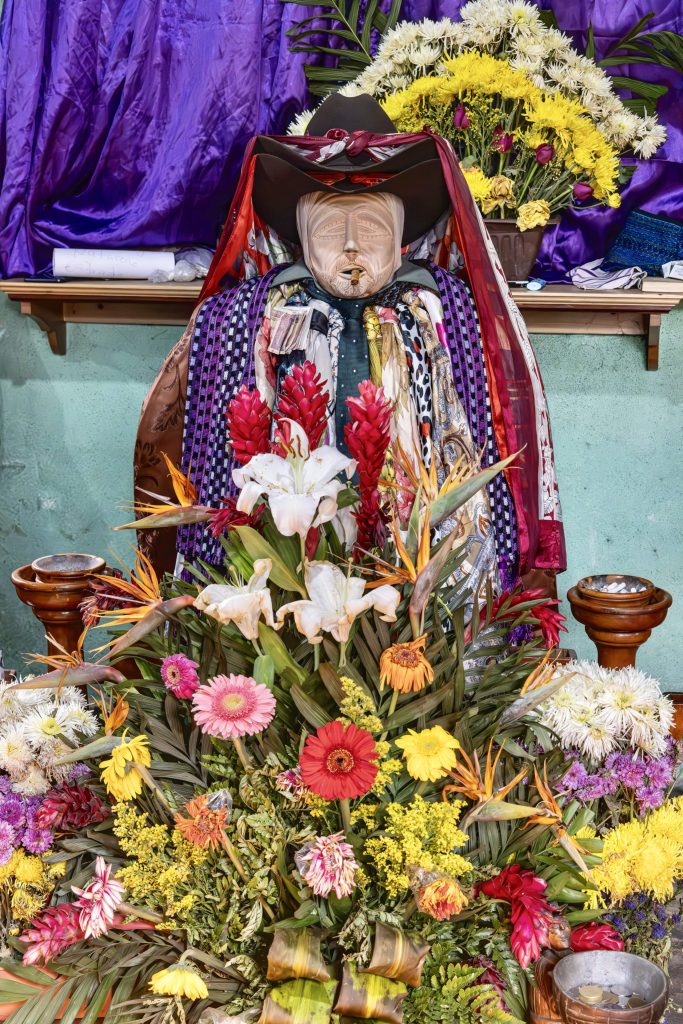
Here he is known as San Simón and looks noticeably different from his Santiago Atitlán counterpart: dark suit, tie, and sunglasses rather than traditional Tz’utujil traje. The chapel is a permanent structure, open year-round, and draws an enormous number of visitors — Guatemalans from all walks of life, particularly from the capital, come to San Andrés Itzapa to make petitions.
The atmosphere is different from Santiago. It is more organized, more openly welcoming to first-time visitors, and in some ways easier to navigate. But the devotion is real and the petitions are real, and if you cannot get to Lake Atitlán, this is absolutely worth visiting.
Practical details for San Andrés Itzapa:
- Open daily; mornings tend to be quieter
- Small entrance fee at the chapel
- Similar offerings: cigarettes, alcohol, candles, flowers
- Take a tuk-tuk from the main road and ask for the capilla de San Simón
- Combine with a half-day trip from Antigua
San Simón in Guatemala: Other Versions to Know About
Beyond Santiago Atitlán and San Andrés Itzapa, San Simón or Maximón in Guatemala appears in communities across the western highlands. In Zunil, near Quetzaltenango, there is a well-visited version worth including if you are already in that area. Various communities in Sololá keep their own versions with their own local traditions.
And then there are the private versions — like the one in that house in Alta Verapaz — where a family keeps a figure and neighbors come to make petitions. These are not tourist destinations and are not meant to be found by outsiders. But they tell you something important about how Maximón lives in Guatemalan culture: not just in formal chapels and famous shrines, but in ordinary households, in ordinary towns, cared for by families who have maintained that relationship quietly for generations.
Maximón During Semana Santa: The Most Extraordinary Time to Visit
If you can time your visit to coincide with Holy Week in Santiago Atitlán, do it. Semana Santa is when Maximón’s role becomes most visible — and the ceremonies that unfold across the week are unlike anything else in Guatemala.
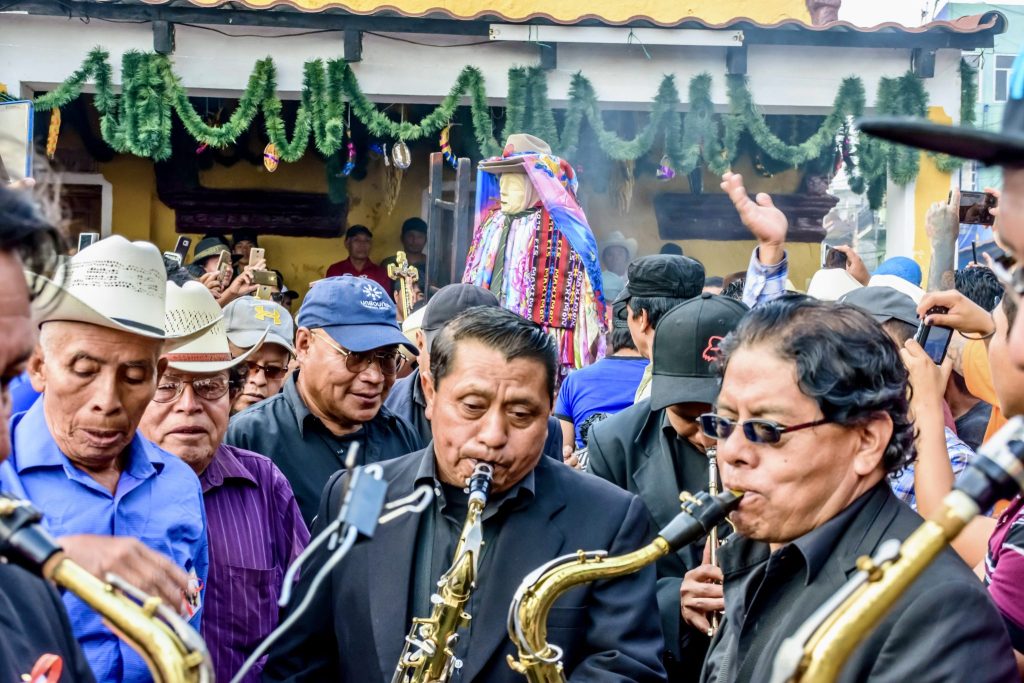
On Holy Monday, his garments are carried to the lake and washed in a quiet evening ceremony. On Holy Wednesday, he processes through the village streets from the cofradía to his chapel beside the church plaza — marimba playing, women elders leading with candles, the whole village watching. On Holy Thursday, he is in his chapel all day receiving visitors — this is actually the best day for a personal visit, before the Good Friday crowds arrive. On Good Friday, the telinel carries him on his back and joins the Catholic procession of the Señor Sepultado from behind, two completely different spiritual traditions moving through the same streets together.
Holy Thursday is the insider tip here. Most visitors aim for Good Friday without realizing that Thursday gives you Maximón in his chapel at his most accessible — quieter, more personal, with the cofrades in a conversational mood.
For the full week-by-week breakdown, see Semana Santa in Santiago Atitlán: A Complete Guide to Holy Week].
Getting to Santiago Atitlán
From Panajachel: Lancha from the public dock, roughly every 30 minutes. About 25 to 35 minutes crossing, Q25 to Q35. Lanchas run 6:30 AM to 7:30 PM. For everything about navigating the lake, see our Complete Guide to Lake Atitlán Boat Services].
From other lake villages: Short lanchas connect San Pedro La Laguna and other villages to Santiago. Ask at your hotel or dock.

From Antigua: Shuttle to Panajachel (about 2.5 hours), then lancha to Santiago. Most hotels in Antigua can arrange this.
By road: Via the Pan-American Highway, south at Godínez. About 2.5 to 3 hours from Antigua by car.
Where to Stay in Santiago Atitlán
Staying overnight means you get the village before anyone else arrives.
Hotel y Restaurante Bambu — the most consistently well-reviewed, with lake views, pool, hot tub, sauna, and restaurant. Beautiful gardens. About a 15-minute walk or short tuk-tuk from the village center.
Hotel Tiosh Abaj — private beach area, pool, great views. Strong with families.
Casa Josefa Hotel — smaller, more central, excellent breakfasts, local feel.
Airbnb in Santiago also turns up private houses with lake views at good value, especially for groups or families.
Quick Tips Before You Go
- Go on the first or second lancha of the morning — village before 9 AM is incomparably better
- Weekdays are quieter than Fridays and Sundays
- Bring cash — no reliable ATMs; bring more than you think you need
- Hire a local guide if you want real context — it is worth every quetzal
- Dress modestly everywhere in Santiago — covered shoulders, no shorts
- Bring an offering — cigarettes, candles, flowers, or aguardiente
- Ask before photographing anyone, and pay the small fee
- During Semana Santa, do not attempt Maximón as a quick day trip — give it at least two full days
One More Thing
Maximón is sometimes described in travel writing as a quirky folk saint, the cigar-smoking curiosity, the exotic highlight of a Guatemala itinerary. That framing does not do him justice.
He is a living expression of a people’s spiritual survival through colonization, forced conversion, and centuries of pressure to become something they were not. The cofradía system that cares for him is one of the few intact structures of indigenous self-governance left in highland Guatemala. The fact that visitors are welcomed at all is something to be honored, not consumed.
Come with real curiosity. Follow the lead of the cofrades. Leave something behind — not just a photo, but an actual offering. And give yourself enough time to feel what is in that room.
Also in this series: [LINK: Semana Santa in Santiago Atitlán: A Complete Guide] | [LINK: Holy Week at Lake Atitlán] | [LINK: Complete Guide to Visiting Lake Atitlán] | [LINK: Complete Guide to Lake Atitlán Boat Services] | [LINK: Best Things to Do with Kids at Lake Atitlán] | [LINK: Visiting San Antonio Palopó]

Paula studied architecture and now makes a living as a freelance writer,traveler and amateur photographer.She started her writing & publishing career as the editor of Bebé y Mamá, the first parenting magazine in Guatemala.She is the founder of www.GrowingUpBilingual.com and www.365thingsswfl.com and writes articles in Spanish and English for both magazines and the web on travel,food and bicultural and bilingual parenting .
When she is not on a plane or road trip she likes to create recipes inspired in the flavors of her native Guatemala.
- Maximón, Guatemala’s Most Mysterious Figure: Everything You Need to Know Before You Visit - February 20, 2026
- Semana Santa in Santiago Atitlán: A Complete Guide to the Holy Week Traditions - February 20, 2026
- Rappeling in Guatemala at Finca El Barretal - January 30, 2026

