I’ve done this route more times than I can count — first in the back seat of my parents’ car as a kid, then as a college student rediscovering Guatemala on my own, then watching my own children get to know Guatemala summer after summer. Each version taught me something new. After living in the United States for over 15 years and visiting Guatemala every summer I’m back living here, and Guatemala keeps surprising me with new experiences and hidden gems.
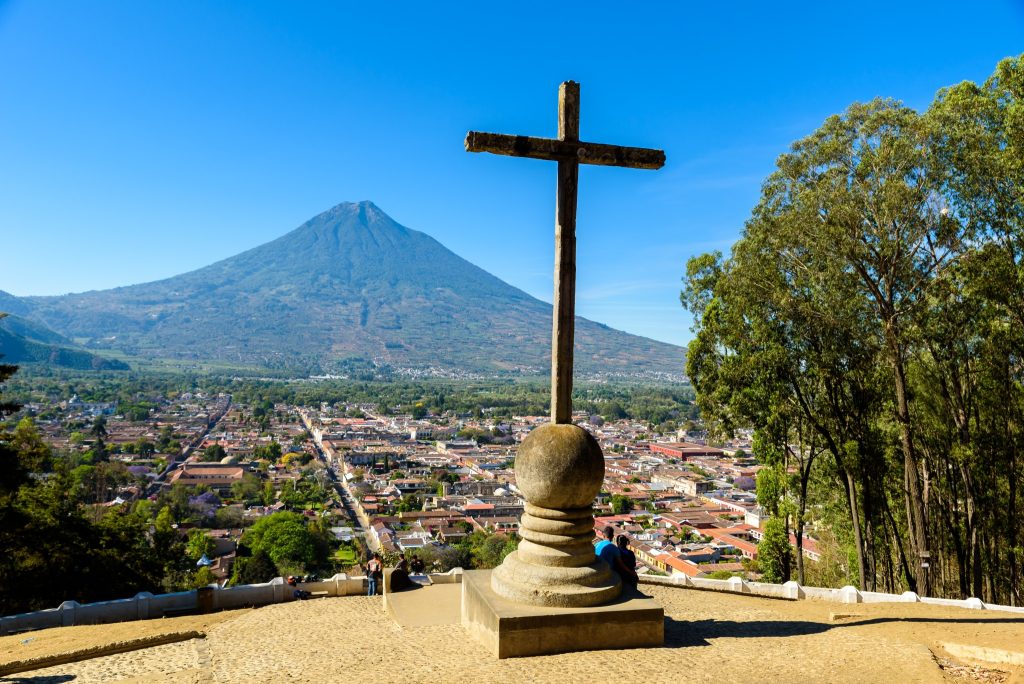
Cerro de la Cruz view point in Antigua Guatemala.
Search “7 days in Guatemala” and you’ll find the same loop everywhere: Antigua, Chichicastenango market, Lake Atitlán, Tikal. Some of that advice is genuinely good. A lot of it — the overhyped stops, the tour company shortcuts, the hotels that coast on their reputation — I’ve learned to skip after decades of guiding friends, family and clients through this country.
This Guatemala itinerary is the version I wish had existed when I started helping people plan their trips. The one that tells you what to skip, where tour operators cut corners, which hotels are worth it, and which experiences will make you feel like you found something nobody else knows about.
I grew up in Guatemala. I lived in the United States for many years. I’ve experienced this country both as a local and as a tourist, and I’m now back home — that double perspective is what I’m giving you here.
This itinerary is for
✓ Curious, active travelers ✓ Couples & solo adventurers ✓ Families with older kids
✓ Gen X & Millennials who want depth, not just destinations ✓ Anyone ready to spend wisely on real experiences
Before We Start
What I Don’t Recommend (That Everyone Else Does)
Part of being a useful Guatemala travel guide is knowing when to say no. These are my honest takes on stops that appear in nearly every itinerary.
Skip on 7 Days
Chichicastenango Market. It’s in every list. But for a 7-day Guatemala itinerary the time cost doesn’t justify the payoff. The market has become heavily touristic and the authentic craft experience you’re imagining is harder to find than it used to be. Spend that time at the lake instead — there are better ways to experience Guatemalan craft culture on this route.
Know Before You Book
Acatenango Volcano. The reels are real — the crater and glowing Fuego next door are genuinely spectacular. What the reels don’t show: most tours run with 25–50 people, so you hike in a single-file line the entire time. It’s a two-day hike and a significant percentage of fit people in their 20s and 30s don’t complete it. The altitude hits people in ways that are hard to predict. If Acatenango is on your bucket list, there are now 4×4 tours that drive you most of the way up — dramatically reducing the hike and in my opinion a smarter option for most people. On a 7-day itinerary, I recommend Pacaya instead. More on that in Day 2.
Overpriced For What It Is
Santo Domingo del Cerro & Casa Palopo. Both are heavily marketed, both are beautiful in photos, and both charge prices that don’t match the actual experience. The La Merced bell tower gives you a better view of Antigua than Santo Domingo del Cerro for almost nothing. And Villa Santa Catarina at the lake has the same stunning views as Casa Palopo at a fraction of the cost. I’d rather send you somewhere that earns its price.
The Itinerary
Seven Days in Guatemala: Three Regions, One Country That Will Change You
“Antigua with Arco de Santa Catalina and Volcan Agua”
01
Day One
Arrive in Antigua — Exhale, Settle In, Eat Well
📍 Antigua Guatemala, Sacatepéquez
Photo Suggestion
Calle del Arco (5a Avenida Norte) at dusk — iconic arch with Volcán de Agua framed behind it, cobblestones, warm lamp glow Alt text: “Calle del Arco Antigua Guatemala at dusk with Volcan de Agua”
Guatemala City’s La Aurora Airport (GUA) is your entry point. Arrange a private shuttle to Antigua — about 45 minutes, and the difference between private and shared is worth it on your first day with luggage and jet lag. You’ll arrive in one of the most beautiful colonial cities in the Americas.
Your first afternoon is for wandering without agenda. Follow 5a Avenida Norte toward the Arco de Santa Catalína — let the arch, the paving stones, the yellow church at the end of the street, and the three volcanoes watching over everything settle in. You don’t need a plan yet.
Where to Stay in Antigua
Skip the big-name hotels. Antigua’s best stays are small, boutique, and rooted in the city’s history.
⭐ Top Pick · Best Location
El Convento Boutique Hotel
Right on Calle del Arco — the most beautiful street in Antigua. Small, beautifully restored, and puts you at the center of everything. Book early.
On your first night, dinner at El Adobe is non-negotiable. Order the sampler plate of five Guatemalan dishes — it’s the single best introduction to Guatemalan cuisine that exists, and on weekends there’s live marimba. The perfect way to arrive.
✨ Hidden Gem — Late Night
If you have energy after dinner, Antigua has a genuinely excellent speakeasy scene that most travel blogs haven’t caught up to. Uleu and Leyendas are two of the best — small, atmospheric, cocktails made with local ingredients. This is the Antigua the loccals know about.
02
Day Two
Antigua Deep — Walking Tour, Museums, Jade & Hidden Views
📍 Antigua Guatemala & Pacaya Volcano
📷
Photo Suggestion
View from La Merced bell tower — red tile rooftops of Antigua, all three volcanoes on the horizon, morning light Alt text: “View from La Merced church bell tower Antigua Guatemala volcanoes”
One day is never enough for Antigua. Day 2 is for going deeper — starting with the best way to understand the city’s layout and history before you tackle the museums and activities.
Morning: Private Walking Tour of Antigua
Before anything else, do a private morning walking tour of Antigua. I recommend this specifically as a private tour — not a group tour with 15 strangers — because the entire experience changes when your guide can answer your specific questions, slow down where you want to linger, and take you to the spots that don’t make it onto the standard route.
A good two-hour private walking tour of Antigua should cover: the history of the colonial grid and why the city survived earthquakes that destroyed everything around it; the neighborhood beyond the Arco that most tourists never enter; the hidden courtyards and ruins visible through doorways on ordinary streets; the stories behind the churches that a guidebook summary never captures. You’ll spend the rest of the trip seeing the city differently because of it.
📌 What to Look For in a Private Antigua Guide
Look for someone who is a certified local guide (not a hotel-assigned staffer), who speaks genuinely good English if that’s your language, and who knows the city’s indigenous and pre-colonial history alongside the Spanish colonial layer. The best Antigua guides don’t just tell you what you’re looking at — they tell you what it meant to the people who built it and what it means to the people who live with it today. I work with guides I’ve personally vetted over many years. If you want a specific recommendation, that’s part of my planning service.
Afternoon: Museums, Jade & Secret Views
🏛
MUNAG — Museo Nacional de Arte de Guatemala (Free) One of the best museums in Guatemala and almost nobody mentions it in travel blogs. Free entry. Give it 90 minutes — the collection is extraordinary and the building itself is worth the visit.
🍽
Lunch at Casa Santo Domingo + The Museum Nobody Talks About Casa Santo Domingo is built within the ruins of a 17th-century Dominican convent. Have lunch here (excellent food) then explore the on-site museums. There is one collection that places pre-Columbian Mayan pieces alongside modern Guatemalan art using identical visual language — it’s one of the most thoughtful exhibitions in Central America and hardly anyone knows it exists.
💎
Make Your Own Jade Pendant Jade was more sacred than gold in Mayan culture. Several workshops in Antigua let you design and create your own jade piece with a craftsperson — about an hour, teaches you real Mayan history, and you leave with a souvenir you actually made. Mercado de Artesanías El Carmen nearby is also excellent for quality crafts.
🔎
La Merced Bell Tower — Antigua’s Secret View (Almost Free) The iconic yellow Baroque church at the top of 5a Avenida Norte lets visitors climb to the rooftop and bell tower for a small fee. From up there: the entire city laid out below you, all three volcanoes, the Santa Catalína Arch, red tile rooftops everywhere. One of the most beautiful views in Guatemala and almost nobody in the travel blog world mentions it. The adjacent convent ruins include the largest colonial fountain in Central America.
🌄
Cerro de la Cruz at Golden Hour A hilltop north of the city with a panoramic view toward Volcán de Agua. About 20 minutes uphill from the trailhead. Go late afternoon for golden hour light on the volcanoes.
Of all the volcanic hikes near Antigua, Pacaya is the one I recommend for a 7-day Guatemala trip. It’s genuinely impressive — an active volcano where you walk across hardened lava fields and feel the heat rising through your boots. I recommend the afternoon/sunset tour: watching the lava glow intensify as the sky darkens is unforgettable. Skip the volcano pizza near the summit — expensive and only worth it for the story. Instead, bring marshmallows and sticks. Roasting them over active lava is a better memory and a fraction of the cost.
The Real Acatenango Conversation
Determined to do Acatenango? It is genuinely one of the most dramatic volcano experiences in the world. But go in knowing: most tours have 25–50 people (single-file line the whole way), many fit people don’t complete it, and the altitude (4,200m) catches people off guard. My recommendation: book one of the newer 4×4 tours that drive you most of the way up. Costs more, but you see everything without gambling your whole trip on your lungs. Ask me about this — it’s something I help clients with specifically.
Planning Your Antigua Visit
Want the Full Antigua List?
There’s more to Antigua than two days can cover — the private guide I actually trust, the restaurant with the best volcano view, and what I send clients who want something completely off the tourist circuit. That lives in my personalized planning service.
Iximché ruins — stone temple platforms with grass courtyards, morning mist in the surrounding pine forest, almost no other visitors Alt text: “Iximche Maya ruins Guatemala misty pine forest”
Today you leave Antigua and head to the lake. The total drive is about 3 hours — but there’s a stop that almost everyone drives straight past on their way to Lake Atitlán, and it quietly becomes one of the best memories of the entire trip.
🏛 Hidden Gem — Don’t Drive Past
Iximché Archaeological Site. About an hour from Antigua, just outside Tec pán, Iximché was the capital of the Kaqchikel Maya kingdom — the city that allied with the Spanish conquistadors and later became the first capital of colonial Guatemala. The ruins sit in a pine forest at over 2,000 meters and on a cool morning the mist hangs between the trees and the stone temples in a way that feels genuinely ancient. One of the least-visited major Maya sites in Guatemala and one of the most atmospheric. Give it 90 minutes. Entry fee is minimal. Almost never crowded.
After Iximché, the road continues to the lake. The moment Atitlán reveals itself as you come over the ridge is one of those travel moments that happens once per visit and never gets old.
Where to Stay — And the Most Important Piece of Advice About the Lake
💡 Don’t base yourself in Panajachel. It’s the main hub and most convenient arrival point — and it’s the most touristy and least authentic town on the lake. Stay in one of the smaller villages and you get the lake as it actually is: quieter, more local, more beautiful. Panajachel is where you go for things. Not where you sleep.
⭐ Best Value · Most Unique
Villa Santa Catarina
In the colorful village of Santa Catarina Palopó. Stunning lake views, great restaurant, and one extraordinary detail: a pool heated by volcanic geothermal springs.
Entire private villas on the lake. Full kitchens, gardens, kayaks. Not in a village so you arrange transport, but for the right traveler, the most special place on Atitlán.
Photographs beautifully. Prices reflect the photos more than the experience. Villa Santa Catarina gives you the same views for significantly less.
Arrive in the afternoon. Check in. Watch the light change over the three volcanoes — Tolimán, Atitlán and San Pedro — as the afternoon turns to evening. You’ll understand immediately why people have been coming here for generations.
04
Day Four
Atitlán by Boat — Nature, Villages & the Best Hidden Dinner on the Lake
📍 Reserva Natural Atitlán · San Juan La Laguna · Nariz del Indio
📷
Photo Suggestion
View from Indian Nose (Nariz del Indio) — Lake Atitlán from above at golden hour, all three volcanoes visible Alt text: “View from Indian Nose Nariz del Indio Lake Atitlan Guatemala golden hour”
The lake is best experienced by boat — that’s how the villages connect with each other, how locals move, and how you understand that what you’re looking at is an entire world built around this water.
🌿
Reserva Natural Atitlán, Panajachel — Morning A private nature reserve with hanging bridges through the canopy, a butterfly sanctuary, coatis and spider monkeys in the forest, and two genuinely thrilling activities: a zip line and a cable bike across the treetops. It’s a proper natural reserve, not a theme park. Allow 2–3 hours. Don’t skip the hanging bridges — the view of the lake from the canopy is unlike anything you get from the water.
⛵
Boat to San Juan La Laguna — Afternoon San Juan is the most active village on the lake for cultural experiences — yes, touristic, but it earns that with real substance: weaving cooperatives where you learn the backstrap loom hands-on, live painters in open galleries, a chocolate workshop tracing cacao from bean to bar, medicinal plants tours, and some of the most colorful street murals in Guatemala. Take a tuk-tuk or hike to the miradores above the village for elevated views of the entire lake.
🧀
Indian Nose Hike (Nariz del Indio) — Late Afternoon The hill above San Juan that looks exactly like a sleeping face profile from across the lake. About an hour from the trailhead, it gives you one of the only places where you can see the entire lake from above with all three volcanoes included. Go late afternoon for golden hour at the summit. The descent brings you back into San Juan just in time for dinner.
🍷 Hidden Gem Dinner — Worth Crossing the Lake For
El Artesano Queso y Vino, San Juan La Laguna. After Indian Nose, you’re already in San Juan — exactly where you want to be. Ask for Jesús, who knows the story behind every Guatemalan cheese and cured meat on his board and wants to tell it to you. Order the artisanal cheese and charcutería, the roasted vegetable plate, and whatever wine he recommends.
The setting is a hidden candlelit garden. Romantic but not fussy. The kind of dinner that ends with everyone still at the table two hours later. If you’re staying in another town, this dinner is worth the boat trip over. Plan the day around ending here.
🗺 On miradores at Atitlán: The lake has several elevated viewpoints accessible by tuk-tuk or short hike from various villages. San Juan has particularly colorful ones. Ask locally when you arrive — the best ones aren’t always on maps.
05
Day Five
Santiago Atitlán + Fly to Flores → Jungle Lodge
📍 Santiago Atitlán · Flores, Petén · Tikal National Park
📷
Photo Suggestion
Santiago Atitlán from the water — Tz’utujil women in traditional huipiles on the dock, Volcán Tolimán rising behind Alt text: “Santiago Atitlan Lake Atitlan Guatemala Tzutujil Maya women traditional clothing”
A morning boat to Santiago Atitlán — the largest town on the lake and one of the less touristy ones. The Tz’utujil Maya community here has maintained one of the most distinctive cultural identities in all of Guatemala, visible in the textiles, the language, and everyday street life.
🎭 Unique & Unforgettable — The Maximón
Santiago is home to Maximón (also called San Simón) — a syncretic deity who is part Mayan folk saint, part Catholic figure, part something entirely his own. He lives in a different house each year, kept by a local cofradia (brotherhood), and receives offerings of cigarettes, rum and money from visitors and devotees. Draped in scarves and ties, surrounded by candles and incense.
It is one of the most unusual and genuinely fascinating cultural encounters in Guatemala. Nothing quite prepares you for it. Go respectfully and with an open mind — this is real living culture, not a performance.
💡 How to find Maximón: He moves house every year. Ask at your hotel or any local in Santiago — everyone knows. A small donation (Q20–50) is expected and appropriate. Ask before photographing anything.
After Santiago, return to your base, check out, and fly to Flores. For a 7-day itinerary: fly. The flight is about an hour from Guatemala City (GUA to FRS, Mundo Maya Airport). Tourist shuttles exist but consume most of a day.
📷
Photo Suggestion
Jungle Lodge Tikal at dusk — thatched bungalows half-hidden in jungle, warm lights, ceiba trees rising above Alt text: “Jungle Lodge Tikal Guatemala bungalows rainforest dusk”
Check in to Jungle Lodge Tikal — one of the only hotels located inside Tikal National Park itself. When day visitors leave at 6pm, the park closes to outsiders and you are left inside one of the most remarkable places on the planet. Walk the paths after dark. Listen. You’ll feel the scale of Tikal in a completely different way than you will tomorrow.
⭐ Night 1 — Inside the Park
Jungle Lodge Tikal
Atmospheric, inside the park and just steps from the entrance to the archaelogical site. Bungalows in the jungle, howler monkeys at dawn, toucans from the pool terrace.
Private natural reserve. Rooms and restaurant look directly onto a lagoon. Miles of trails, resident howler monkeys, extraordinary birds. The perfect base for Yaxhá and Flores.
Temple I (Gran Jaguar) at dawn — misty atmosphere, warm light touching the temple top. OR: view from Temple IV across the canopy as mist clears Alt text: “Tikal Temple I Guatemala dawn mist jungle canopy”
Tikal is one of the greatest things humans have ever built. It deserves a full, honest day. Here is what the tour operators don’t tell you.
The Sunrise Tour — What Nobody Tells You
Approximately 60% of the time, the mist at dawn is so thick you cannot see more than a few feet in front of you. You will not see a sunrise. You may not see the temple. What you will experience is the jungle coming alive around you — howler monkeys starting their chorus, birds calling across the canopy, insects building a wall of sound in total darkness. Even without seeing anything, this is one of the most extraordinary experiences in Guatemala. Go. Just don’t go expecting a photograph.
The Tour Company Problem — Read Before You Book
Many tours at Tikal — including those sold through the hotels — have been deliberately shortened to upsell additional tours. I have seen sunrise tours that don’t even take you to the main plaza. Before booking, ask specifically: does this include the Main Plaza (Gran Plaza)? The Lost World complex (Mundo Perdido)? Temple IV? If any answer is no, keep looking.
🌟 The Guide Who Changes Everything
I work with a guide at Tikal who has been there since the 1980s — originally as part of the crew actively working to uncover and restore the site. He has watched temples emerge from the jungle. He knows which stones were moved when and by whom. He is also a registered Petén birding association guide and can identify every bird in that canopy. He does not work for a tour company. His contact is something I share with clients. If you want to experience Tikal with someone who knows it in a way almost nobody alive does anymore, that’s how you do it.
🚌 The Shuttle Secret: The hotel shuttle runs 9am–2:30pm to the main plaza. As a Jungle Lodge guest, you can return independently after the shuttle stops — meaning you can stay in the park after the day visitors start leaving. The late afternoon at Tikal, when the crowds thin, is a completely different park.
In the afternoon, move to Villa Maya — a private natural reserve about 30 minutes away on a jungle lagoon. Your room looks directly out onto the water. Howler monkeys come to the trees at dusk. The restaurant serves dinner with the lagoon as your backdrop.
The Tikal Guide
This Is the Difference Between Good and Unforgettable
The guide I described — excavation team in the 1980s, registered Petén birding guide, knows every stone in the park — his contact is not something I post publicly. It’s part of what you get when you work with me on a personalized itinerary. If Tikal is on your list, this conversation is worth having.
📍 Isla de Flores · Playa Tres Naciones · Yaxhá, Petén
Ya
Photo Suggestion
Yaxhá ruins at sunset — temple silhouetted against blood-orange sky, lake below catching fire, jungle to every horizon Alt text: “Yaxha Maya ruins Guatemala sunset Lake Yaxha Peten”
Your last full day. Three acts, each worth its own trip.
Morning: Isla de Flores
Flores is a small colonial island town connected to the mainland by a causeway. Have breakfast at a waterfront café, wander the colorful streets, then do something almost nobody knows about:
🏖 Hidden Gem — Playa Tres Naciones
Take a boat from Flores across Lake Petén Itzá to Playa Tres Naciones — one of the best freshwater beaches in Guatemala and almost completely unknown outside of locals. Clear water, quiet beach, jungle coming down to the shoreline. Boats from the Flores waterfront, about 20 minutes.
Lunch at Raíces restaurant in Flores — yes, it’s on the tourist circuit, but it earned its reputation honestly, and locals actually eat there too.
Late Afternoon: Yaxhá — The Sunset That Closes Everything
Let me be direct: this visit is specifically for sunset. Not morning. Not midday. Sunset.
Yaxhá is a Maya site on a lake about an hour from Flores, far less visited than Tikal, spanning multiple plazas and dozens of structures with dense, live jungle. The view from the main temple at sunset: the lake below catches fire, the jungle stretches to every horizon, and you stand on a structure built two thousand years ago, watching the sky turn all shades of orange and red. Villa Maya arranges the Yaxhá tour directly — logistics from there are seamless.
🌅 Yaxhá timing: Arrive about 2 hours before sunset to walk the site before climbing the main temple. Bring a flashlight for the descent after dark.
Fly home from Flores with something most travelers don’t have: the specific, indelible memory of standing on a Maya temple at sunset, watching the sky turn to fire over a jungle that goes on forever.
What to Eat in Guatemala
Guatemalan Food: The Dishes You Cannot Miss
Guatemalan cuisine doesn’t get the global attention it deserves. Many of its base recipes and ingredients — chiles, squash, corn, tomato, cacao — have been in continuous use for over two thousand years.
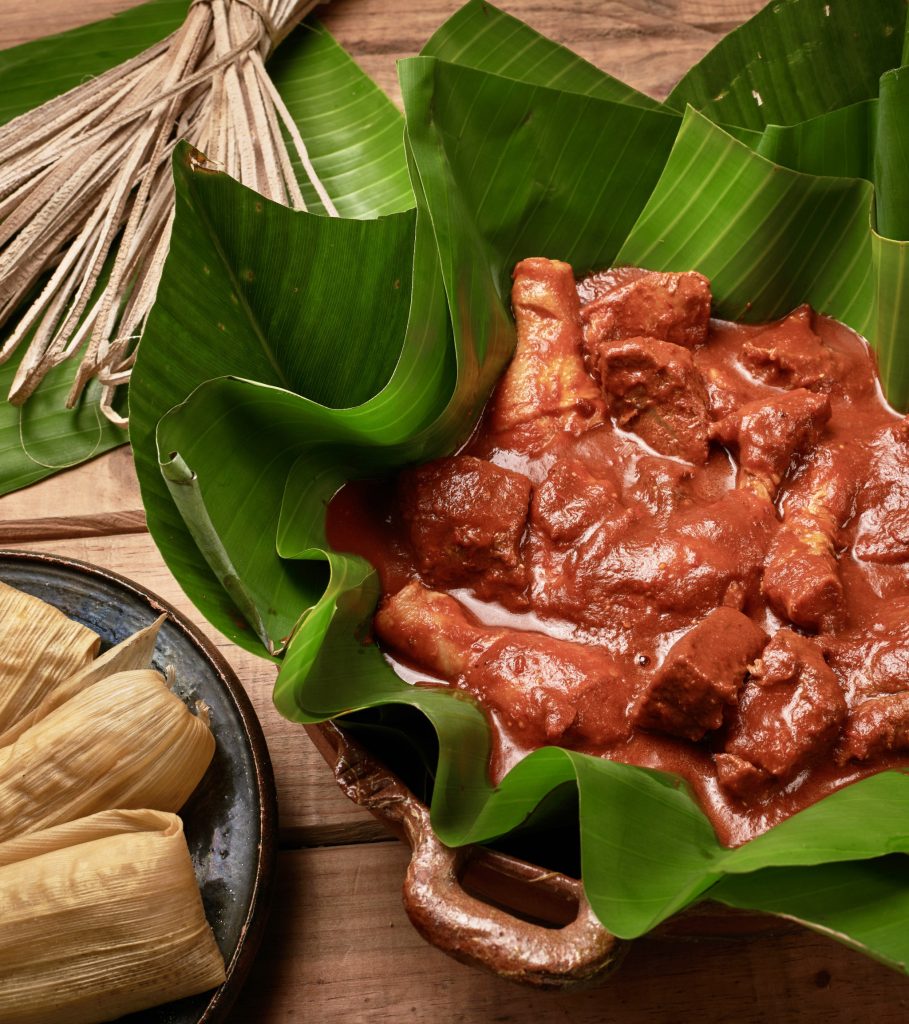
“Guatemalan Subanik in plantain leaves”
Pepían
Guatemala’s most important dish. A dense, aromatic sauce from roasted chiles, squash seeds, sesame and spices over chicken or turkey. The Antigua version is the reference point. Order this first.
Subanik
A Q’eqchi’ Maya specialty from Alta Verapaz — chicken or meat slow-cooked in a complex chile and tomato sauce wrapped in maxan leaves. One of the most ancient recipes in the country, rarely found outside Guatemala.
Jocón
A green sauce from tomatillos, cilantro and green chiles over chicken. Lighter than pepían, brighter in flavor. The color is extraordinary — it looks like it was made from pure jungle.
Tamal Colorado
The classic Guatemalan tamal — masa dough colored and flavored with achiote (annatto), filled with meat and wrapped in banana leaves. Completely different from Mexican tamales. A staple of Sunday mornings and family celebrations.
Rellenitos de Plátano
Mashed ripe plantain stuffed with sweetened black beans, shaped into ovals and fried. Crispy outside, soft and sweet inside. One of Guatemala’s most beloved street desserts — and one of the easiest ways to understand the country’s love of plantain.
Guatemalan Coffee
Antigua, Huehuetenango and Cobán produce some of the world’s finest coffee. Drink it black and locally roasted whenever possible. The difference from what most of the world gets is significant — and deeply satisfying.
Practical Information
What You Need to Know Before You Go
📅
When to Go
November to April is dry season — the classic window. May to October brings lush landscapes, fewer tourists and lower prices; rain typically comes in the afternoon. Avoid September–October for Petén. Semana Santa in Antigua is spectacular but book months ahead.
🚌
Getting Around
Private shuttles between Antigua and the lake are the practical choice. For Petén: fly from Guatemala City to Flores. Tuk-tuks for short distances. Do not drive yourself between Guatemala City and Antigua at night.
💵
Budget Guide
Guatemala is significantly more affordable than Costa Rica or Belize. A comfortable mid-range trip — boutique hotels, good restaurants, private transport — runs $150–250 per person per day. Carry quetzales for local markets; cards work at hotels and larger restaurants.
🛡
Safety — The Honest Version
The route on this itinerary is well-traveled and generally safe for visitors who exercise common sense. Don’t walk alone at night in unfamiliar areas. Use recommended private transport. The vast majority of visitors have completely safe and wonderful trips. I’ve been taking people here for years without incident.
✈
Getting There
Direct flights to Guatemala City (GUA) from Miami, Houston, Atlanta, Dallas and New York. Flores / Mundo Maya Airport (FRS) connects from Guatemala City for the Tikal leg — about an hour, multiple flights daily. Book both legs together.
🎤
What to Pack
The highlands (Antigua, Atitlán) are at an altitude — bring a light layer year-round. Petén is hot and humid; lightweight breathable clothing is essential. Sunscreen and insect repellent for Tikal are non-negotiable. Good walking shoes for cobblestones and temple steps.
Budget Breakdown
What to Expect to Spend on 7 Days in Guatemala
Guatemala is significantly more affordable than Costa Rica or Belize for equivalent — or better — experiences. Here’s a realistic breakdown for the style of travel this itinerary represents: boutique hotels, good restaurants, private transport, real experiences.
Accommodation
$80–180
per night
Boutique hotels and unique lodges. Jungle Lodge Tikal and Villa Maya are the highest-cost nights; the lake and Antigua are more economical.
Food & Drink
$40–80
per person / day
Breakfast at a local café $5–10, lunch at a good restaurant $12–20, dinner $18–35. Street food and market meals are $2–5 and often the most memorable.
Activities & Transport
$50–120
per person / day
Private shuttles $25–50/trip, domestic flights to Flores ~$80–120 each way, site entries $5–20, private guides $40–80 per tour.
Total Estimated Trip Cost — Per Person
$1,500 – $2,500
for 7 days · excluding international flights · comfortable mid-range travel
Expense
Budget Option
Mid-Range (This Itinerary)
Boutique hotel / lodge
$30–50/night
$80–180/night
Meals (per person/day)
$15–25
$40–80
Antigua → Panajachel shuttle
$15 shared
$40–55 private
GUA → FRS domestic flight
$80 (advance)
$80–120
Tikal park entry
—
~$20/day
Private guide (Tikal, Antigua)
Group tour $15–25
$50–80
Museum entries, activities, tuk-tuks
—
$15–40/day
💡 Money-saving tip: The biggest variable in your Guatemala budget is transport. Sharing shuttles vs. going private can save $100–200 over the week. If you’re traveling as a couple or family, private transport is often barely more expensive than shared once you split the cost — and gives you total flexibility on timing.
Ready to Make It Yours?
This Guatemala Itinerary Took Me 30 Years to Refine
What you’ve read here is the skeleton. The full version — the specific guides I trust, the exact logistics for your travel dates, the seasonal adjustments, the restaurants I save for clients, the properties I’ve personally vetted from both sides of the tourist divide — that’s what I build when someone works with me on a personalized Guatemala itinerary. Every trip is different because every traveler is different.
I’ve been sharing Guatemala with people for most of my adult life — first from Florida, now as a local living in Guatemala and rediscovering new hidden gems. If this article sparked something, I’d love to help you turn it into a real trip.
Paula moved from her native Guatemala to SW Florida with her husband and two children and together they are discovering what it means to live life between two languages.
Paula studied architecture and now makes a living as a freelance writer,traveler and amateur photographer.She started her writing & publishing career as the editor of Bebé y Mamá, the first parenting magazine in Guatemala.She is the founder of www.GrowingUpBilingual.com and www.365thingsswfl.com and writes articles in Spanish and English for both magazines and the web on travel,food and bicultural and bilingual parenting .
When she is not on a plane or road trip she likes to create recipes inspired in the flavors of her native Guatemala.