Disclosure: This article contains affiliate links. If you book or buy something through one of my links, I may earn a small commission at no extra cost to you. I only recommend places and services I have personally used or vetted.
Chuitinamit is an ancient Tz’utujil Maya archaeological site across the bay from Santiago Atitlán, Guatemala, and one of the most unusual places you can visit on Lake Atitlán. Reached only by boat, the trip takes you through private agricultural land to a collection of remarkable carved stones and smaller artifacts found on the hillside where the ancient Tz’utujil city of Chiya’ once stood. You can also continue higher to the Mirador Chuitinamit for spectacular views back across the lake toward Santiago and the volcanoes.
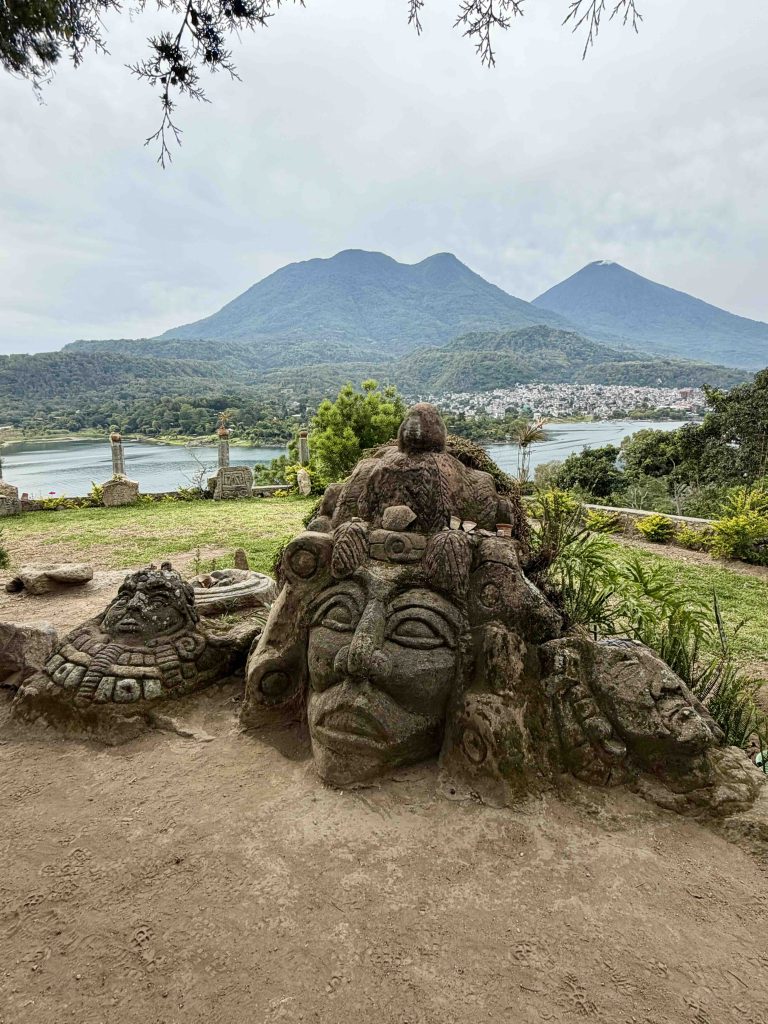
This isn’t a formal archaeological park with restored temples, signs and marked trails. The larger Chuitinamit archaeological site extends across privately owned farmland, while the area most travelers visit is a private property where a Tz’utujil landowner named Cruz has gathered carved stones and artifacts he says he has found on his land. That distinction is important, because it explains both what makes Chuitinamit fascinating and why visiting with a local guide matters.
Our complete Chuitinamit tour from Santiago Atitlán took only about two to two and a half hours. The lancha ride was around five minutes, followed by an easy 10- to 15-minute uphill walk to the private collection. We also added the higher mirador, which required another roughly 20 minutes of much steeper, very overgrown hiking.
In this guide I’ll show you exactly how to visit Chuitinamit from Santiago Atitlán, what the hike is really like, what you see once the owner opens the gate, how much our tour cost, what to wear and bring, whether I think the mirador is worth the extra climb and why this small site is much more historically important than its informal appearance suggests.
And if you’re planning a Guatemala trip and want help finding local guides and experiences like this and fitting them into an itinerary that makes sense, I offer personalized Guatemala trip planning through Magical Guatemala.
Chuitinamit at a Glance
✓ Where: Across Santiago Bay from Santiago Atitlán, Sololá
✓ How to get there: Private lancha from the Santiago Atitlán dock
✓ Boat ride: About 5 minutes
✓ Walk to the private collection: About 10–15 minutes uphill
✓ Mirador Chuitinamit: About 20 additional minutes, considerably steeper and more overgrown
✓ Landowner fee: Q25 per person, included in our guided tour
✓ What we paid: Approximately Q500–Q600 total for three people including lancha, guide and access
✓ Total time: About 2–2½ hours for our complete visit including the mirador
✓ Guide: I do not recommend attempting Chuitinamit without a local guide
GETTING THERE
How to Visit Chuitinamit From Santiago Atitlán
The easiest way to visit Chuitinamit is to arrange a local guide in Santiago Atitlán who will organize the private boat and access to the property for you.
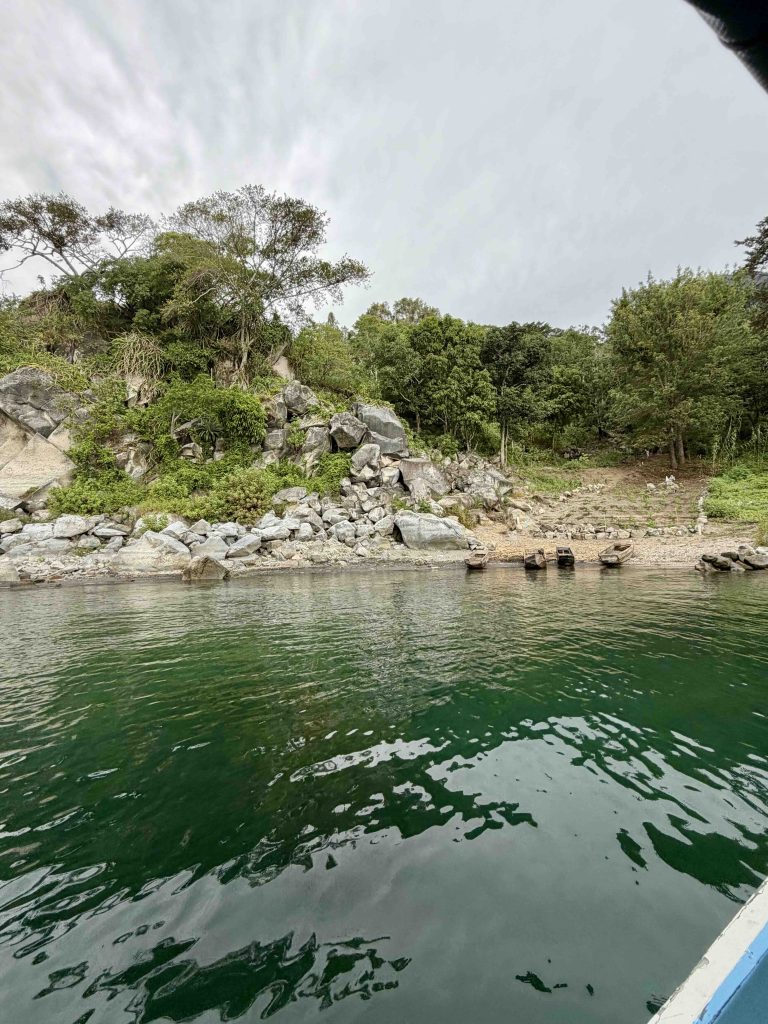
Our tour started at the main Santiago Atitlán dock. From there we boarded a private lancha and crossed the bay toward the Chuitinamit side.
The ride took about five minutes. It really is that close. You can see how short the distance is once you’re standing on the Santiago dock looking across the bay.
There is no formal tourist dock when you arrive. Our lancha pulled up along a rocky section of shoreline and we began walking uphill almost immediately.
This private lancha is separate from the public boat system around Lake Atitlán. If you’re arriving in Santiago from another lake town, my Lake Atitlán boat services guide explains how the public lanchas, docks and routes work.
THE FIRST HIKE
How Difficult Is the Hike to Chuitinamit?
The walk from the lakeshore to the main private collection is much easier than I expected.
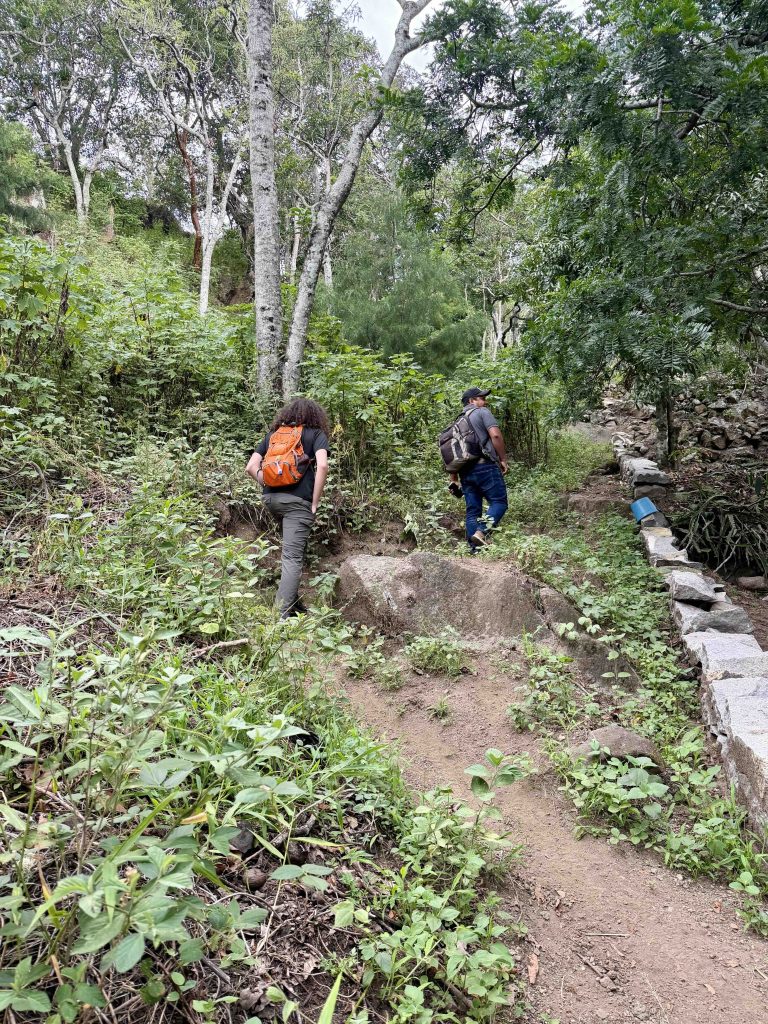
It took us about 10 to 15 minutes walking uphill. The path is unpaved and uneven, but I would not consider this part of the Chuitinamit hike especially difficult for someone who is reasonably comfortable walking on rough ground.
The path crosses privately owned agricultural land. We walked through areas planted with coffee, chipilín and other crops rather than following anything that resembles a developed tourist trail.
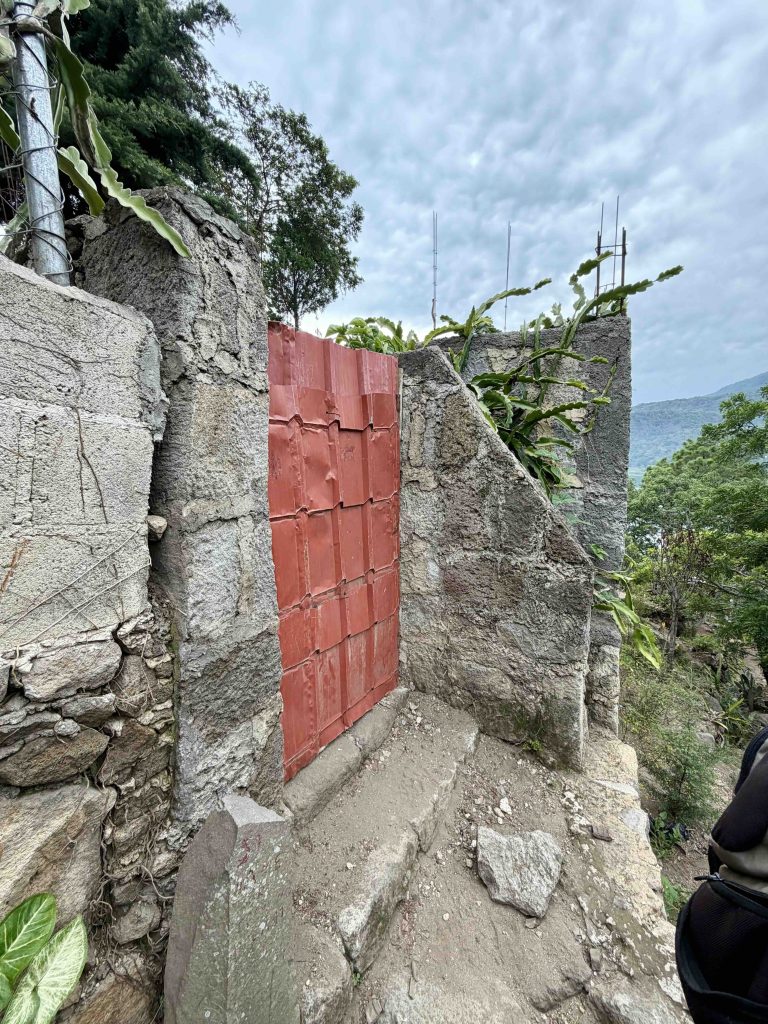
Eventually you reach a stone wall and a locked metal door. That is the entrance to the property containing the main collection visitors are usually shown.
WHAT TO EXPECT
What You Actually See at Chuitinamit
This is where the experience was very different from what I expected after reading about the Chuitinamit archaeological site online.
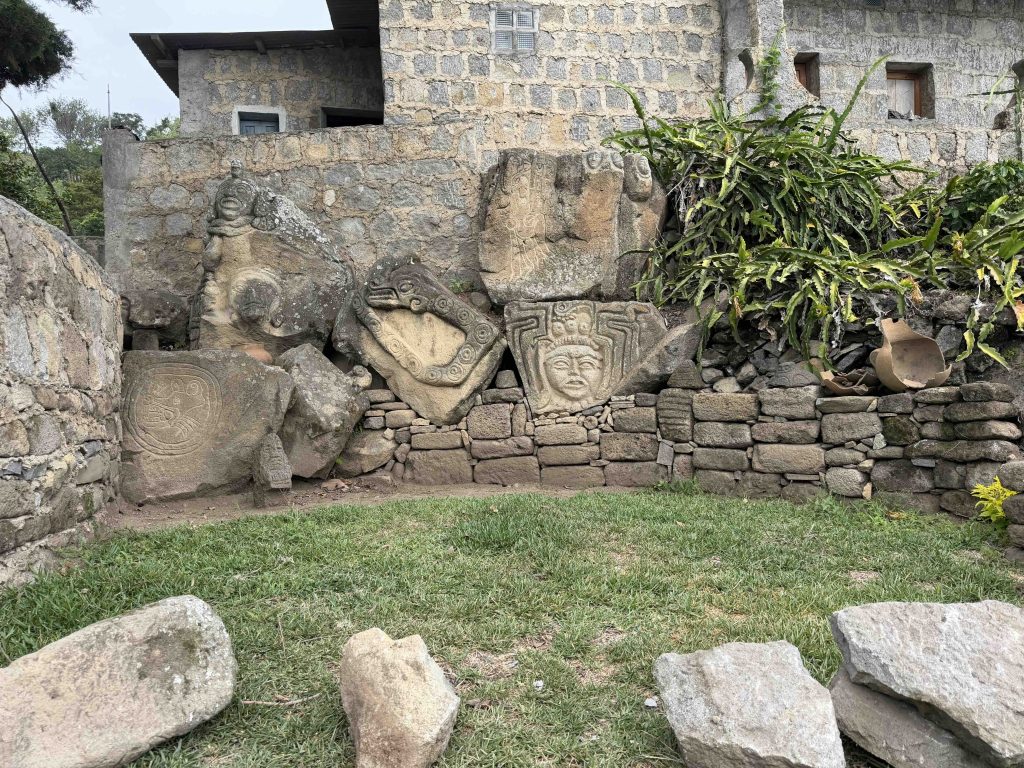
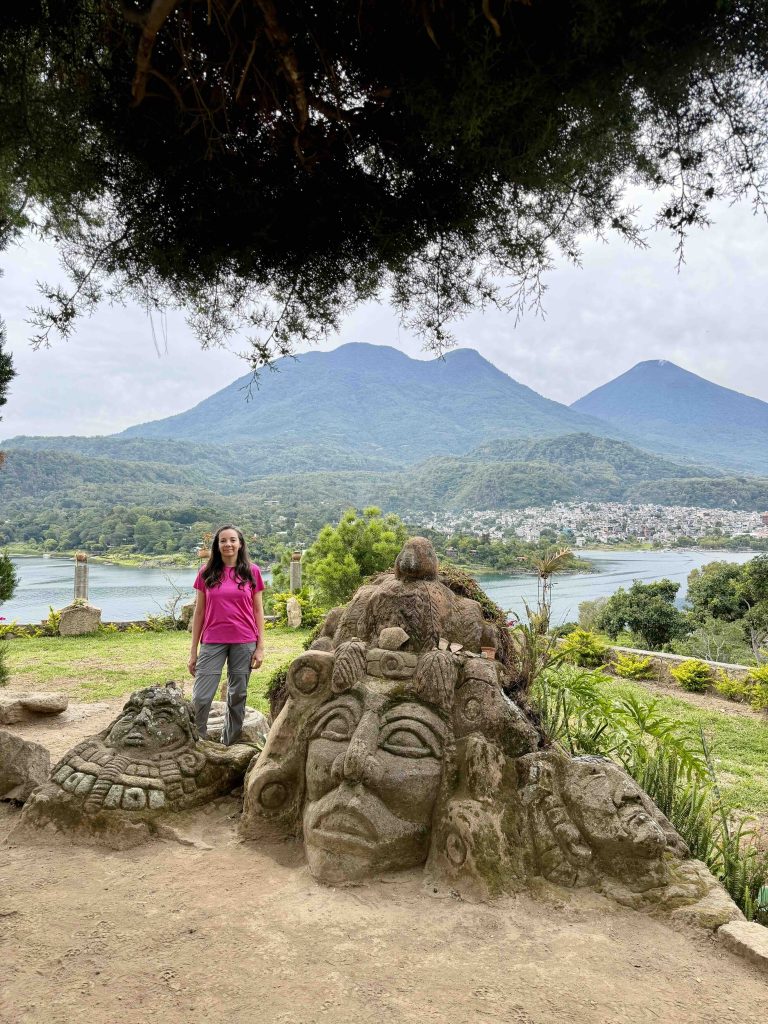
The larger ancient city once covered much more of this hillside. What you visit today is a privately owned area where Cruz has gathered many of the carved stones and other pieces he says were found on his property.
That means the display you see today is not an archaeological reconstruction of where these objects originally stood.
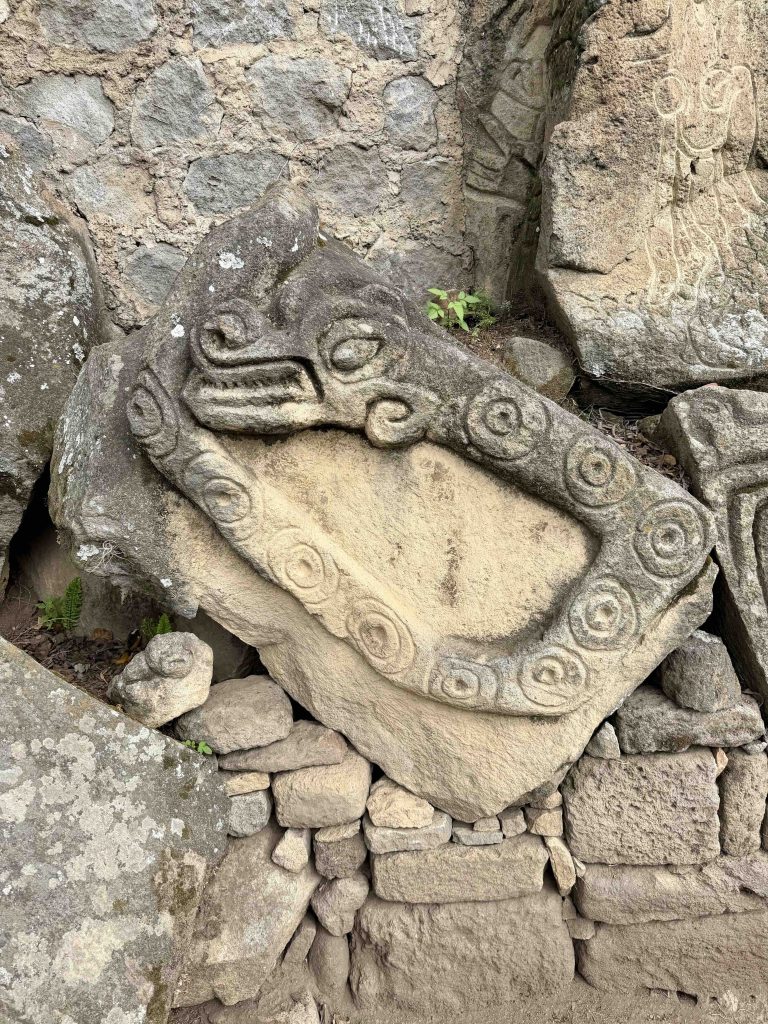
Some stones have been stacked together. Some are incorporated into walls. Others have been cemented into place, which we were told was done in part to make the heavy carved pieces harder to steal.
There are also clearly newer additions mixed into the collection. One of the most striking examples is a painted Christian saint placed among carved stone faces and Maya imagery.
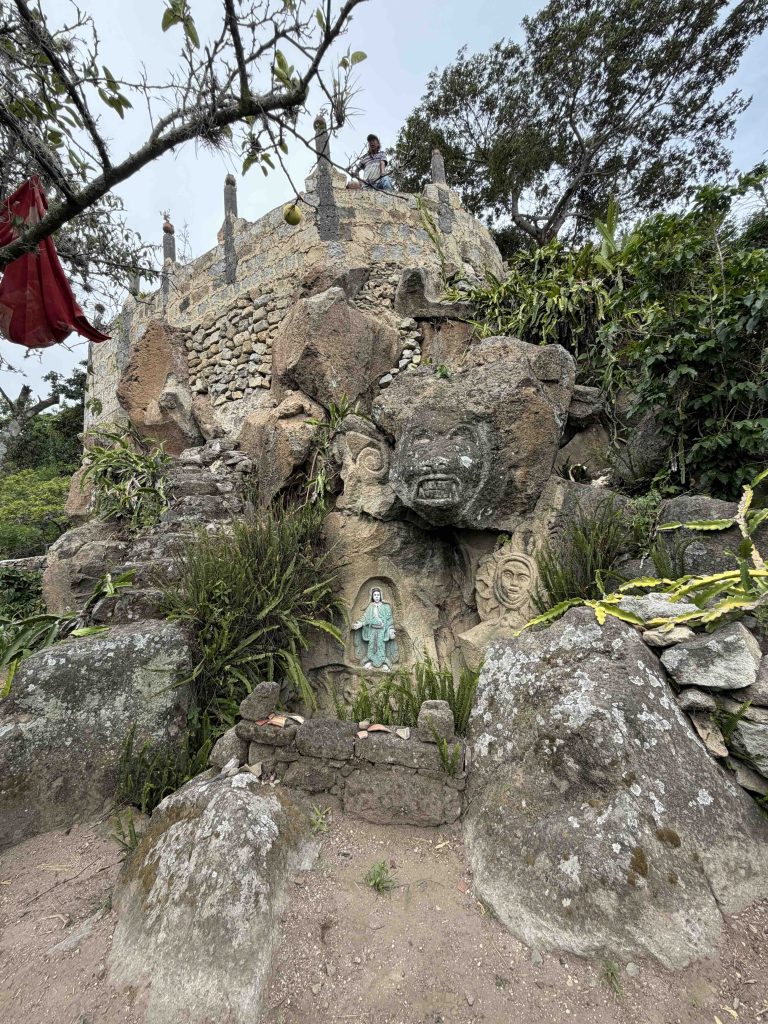
That mixture is an important thing to understand before visiting. The archaeological site itself is ancient, and genuine pre-Hispanic carved stone has been documented at Chuitinamit. But you cannot assume that every object in the current display is pre-Hispanic, that everything dates to the same period or that the pieces are sitting where ancient Tz’utujil residents originally placed them.
THE LANDOWNER
The Landowner Charges Q25 Per Person to See the Collection
The property is private, and Cruz currently charges Q25 per person for access. In our case this was already included in the amount we paid our guide, so we didn’t pay him separately.
He does not simply sit at the gate waiting for visitors. When we arrived, our guide called him on the phone. He was across a narrow section of the lake and came over in a cayuco to meet us and unlock the property.
That alone is one reason I don’t think Chuitinamit works as a do-it-yourself attraction. Access depends on relationships with people who own and work this land.
SMALLER FINDS
Inside the Room of Smaller Chuitinamit Artifacts
The giant carved faces make the dramatic photographs, but one of the things that surprised me most was inside a small room on the property.
This is not a museum. It is literally a simple room with a bed, where smaller objects Cruz says were found on the land are kept and displayed in an extremely informal way. Some are arranged on fabric or on the floor. Painted pottery fragments and pieces of small figures are gathered together in a plastic basket.
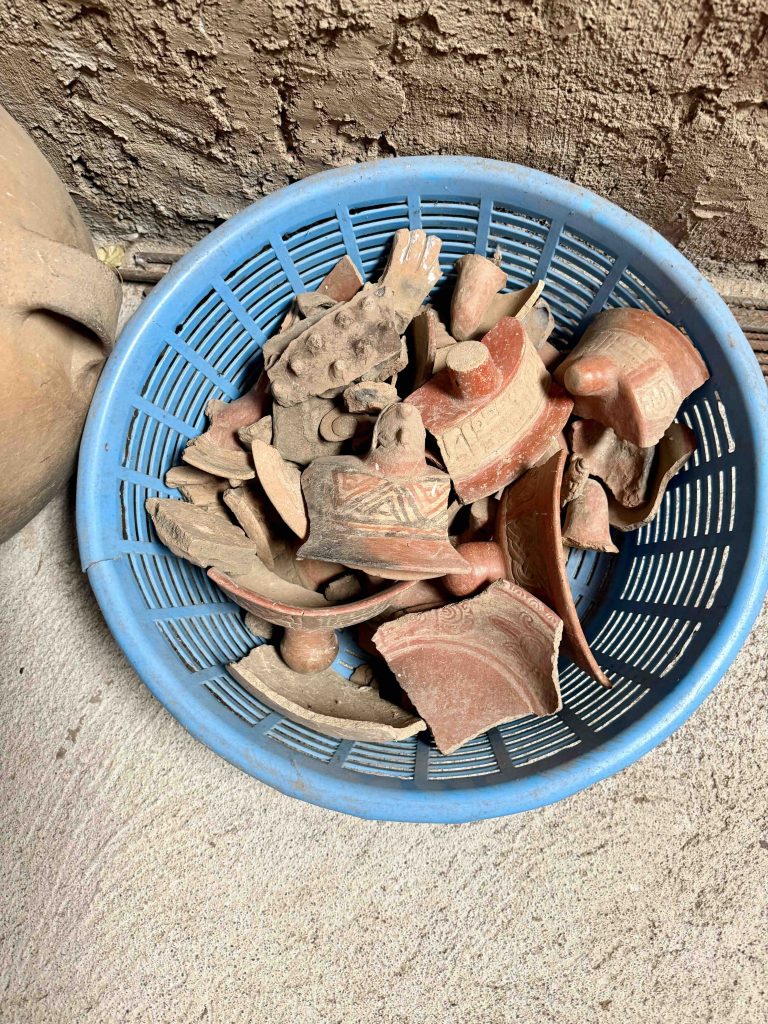
We saw small carved heads and figures, painted pottery fragments, stone pieces and other objects. Some are extraordinary, which made the lack of labels, catalog numbers or even basic information about where individual pieces were found especially striking.
The Skull and the Objects Cruz Says Came From a Tomb
One of the most unexpected things Cruz showed us was a human skull sitting inside a terracotta vessel. The shape of the cranium immediately caught my attention because the upper portion is unusually high and elongated.
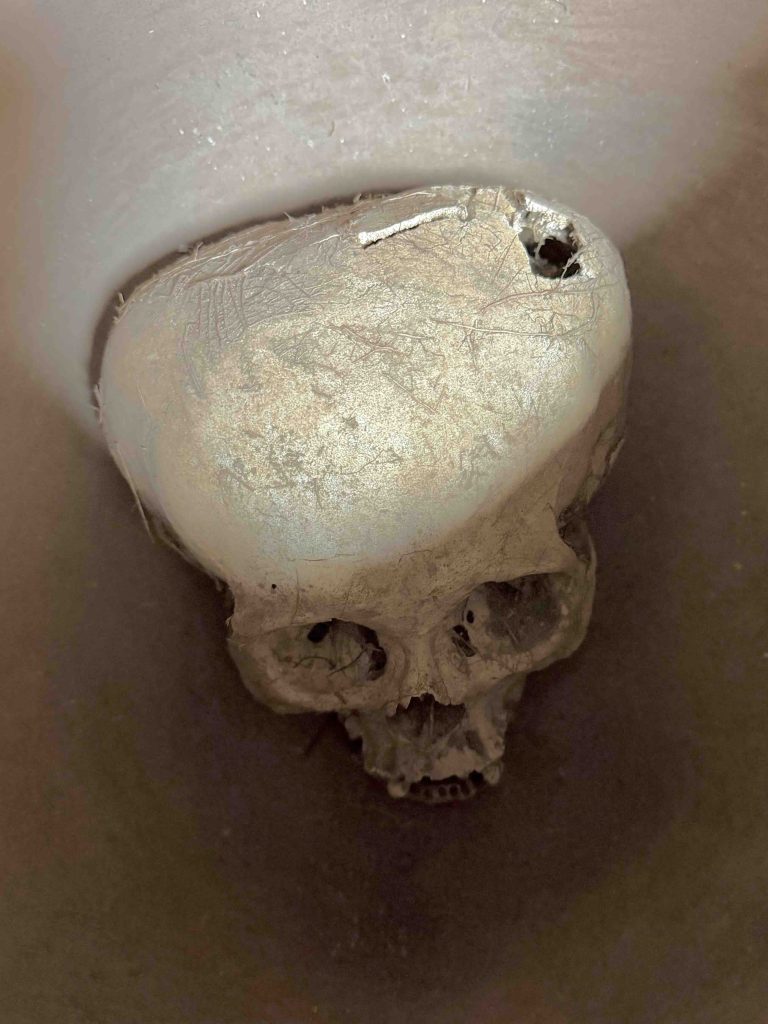
Intentional cranial modification is well documented among ancient Maya populations. Children’s heads could be shaped during infancy using different forms of pressure or binding, producing several recognizable cranial forms. Looking at this skull, it is tempting to wonder whether that could explain its shape, but I don’t think it would be responsible to make that identification from appearance alone. The remains would need to be examined by a qualified bioarchaeologist.
Cruz also showed me photographs of objects he said he excavated from a tomb on the property, including jade necklace beads and beautifully decorated pottery. According to him, some of those pieces are now in a museum in San Juan La Laguna. I have not independently confirmed which museum holds them or found published archaeological documentation tying those particular objects to the burial, so I am sharing that as Cruz’s account of what he found rather than as independently verified provenance.
That is also why I am intentionally not assigning dates or archaeological identities to individual objects in the room. There simply isn’t enough information available to visitors to do that responsibly.
THE MIRADOR
Is Mirador Chuitinamit Worth the Extra Hike?
Yes—but this is where the hike becomes considerably more challenging.
While we were waiting for Cruz to arrive, we continued uphill with our guide toward the Mirador Chuitinamit. It took us about another 20 minutes.
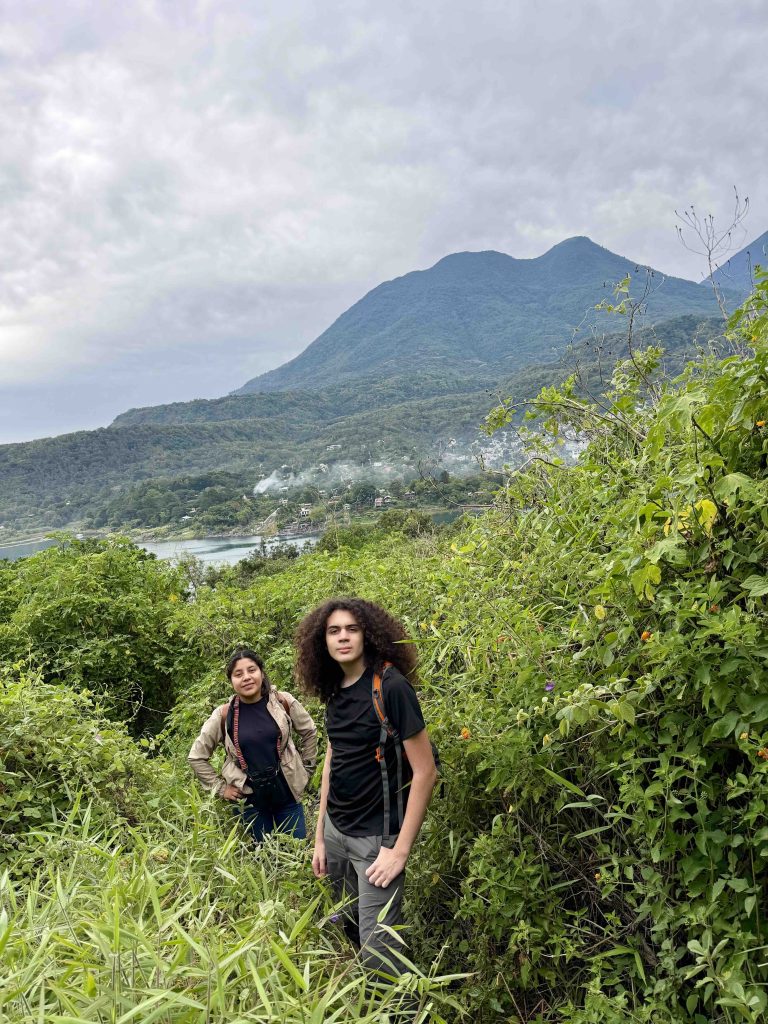
Unlike the initial 10- to 15-minute walk, this trail was steep and very overgrown. In places our guide was essentially bushwhacking through the vegetation to get us through.
Along the way we passed additional carved stones scattered among the agricultural plots. Some were partially buried or sitting beside the trail, and some appeared to have been damaged or defaced.
At the top, the view made the extra effort worthwhile for me.
You can see Santiago Atitlán wrapped around the bay with the volcanic landscape rising behind it. It is one of those viewpoints that gives you a completely different sense of the geography of this part of Lake Atitlán.
Near the mirador our guide also showed us a large stone with a hollowed section that local tradition identifies as having been used for baptisms after the Spanish arrived.
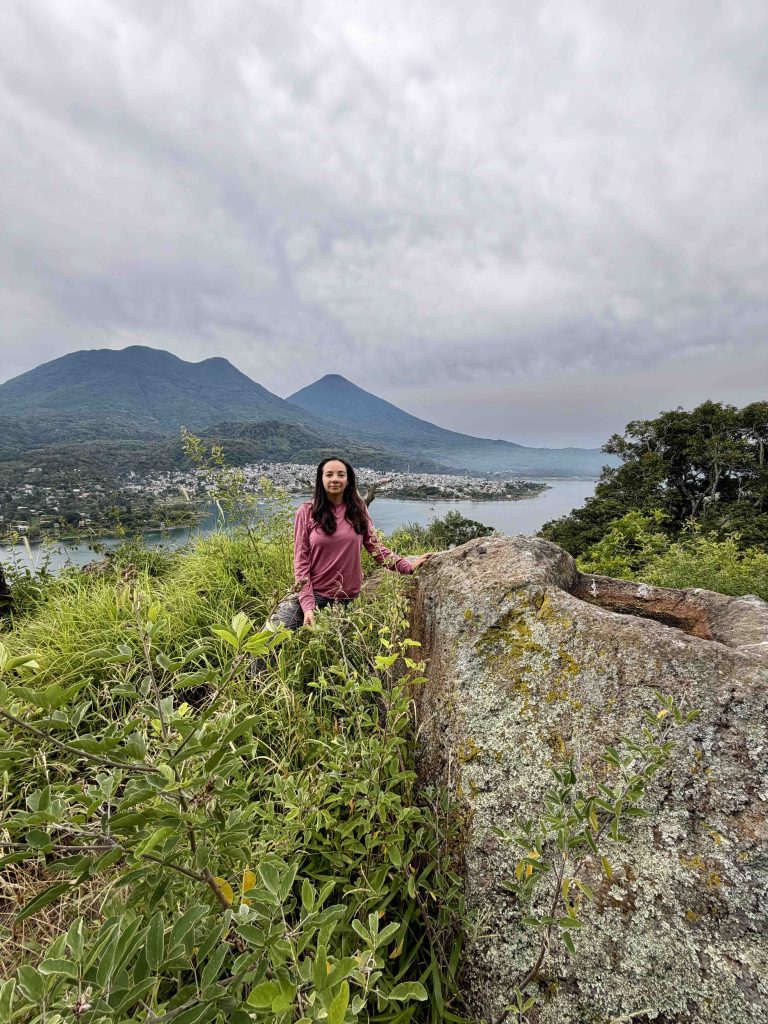
I have not found archaeological documentation confirming that use, so I would describe it as local oral tradition rather than established archaeological fact. But it is another reminder that this landscape continued to be used after the Spanish conquest and that not everything visible around Chuitinamit necessarily belongs to the same historical period.
WHAT TO WEAR
What to Wear and Bring to Chuitinamit
If you’re only walking to the main private collection, you don’t need serious hiking gear. Comfortable closed shoes with good traction should be enough.
If you’re adding the mirador, dress for the vegetation rather than just the weather.
WHAT I WOULD BRING
- Long pants
- Lightweight long sleeves if hiking to the mirador
- Closed shoes with good traction
- Bug spray
- Plenty of sunscreen
- Hat
- Water
- Binoculars or a birding camera if you enjoy birds
- Camera—you will use it
The long pants are not an exaggeration. By the time we came back from the mirador, mine had picked up lots of very sharp little burrs from the vegetation.
Bug spray is also worth bringing, and I would apply sunscreen before leaving Santiago instead of waiting until you start to feel the sun. Even with cloud cover, you’re hiking at elevation and parts of the route are exposed.
Guatemala Trip Prep Essentials
These are the travel tools I use or recommend when planning a Guatemala trip:
Rental car: Compare cars with DiscoverCars if you’re driving between Guatemala City, Antigua, Lake Atitlán and other parts of the country.
eSIM: Holafly lets you arrive with mobile data already working. Use code PAULAGUB for 5% off.
VPN: NordVPN is what I recommend for keeping your connection private on hotel and café Wi-Fi.
Travel insurance: TravelInsurance.com makes it easy to compare plans, especially for a trip that includes hiking, boats and more remote areas.
BIRDING
Chuitinamit Is Also a Surprisingly Nice Birding Walk
I went for the archaeology and ended up paying a lot of attention to the birds too.
The trail passes through coffee, dense vegetation and cultivated land, and we found quite a few birds during such a short outing. If you’re into birding like I am, don’t leave your binoculars or birding camera at the hotel just because you’re thinking of Chuitinamit as an archaeological tour.
Give yourself permission to stop occasionally and look around. The birdlife is another reason I wouldn’t rush this visit.
GUIDES
Do You Need a Guide for Chuitinamit?
I would not visit Chuitinamit without a local guide.
This isn’t simply because you’ll learn more history with someone local.
You have to cross private agricultural land. The main collection is behind a locked gate. Cruz needs to be contacted. There isn’t a marked tourist trail. And if you continue to the mirador, the path becomes overgrown enough that our guide was actively finding the way through the vegetation.
Local guides know the owners of the land and know where visitors can and cannot walk. That matters here far more than it does at a government-run archaeological park.
It is also the respectful way to visit. You’re moving through land people farm and through cultural heritage connected to the Tz’utujil community.
Go Beyond the Standard Itinerary
Want Help Finding Experiences Like Chuitinamit?
Places like this aren’t as simple as dropping a pin on Google Maps. I help travelers build Guatemala itineraries around trusted local guides, realistic transportation and experiences that fit the way they actually want to travel.
COST
How Much Does a Chuitinamit Tour Cost?
We paid around Q500–Q600 total for three people for our private Chuitinamit tour from Santiago Atitlán.
That included:
• Private lancha from Santiago Atitlán
• Local guide
• Q25-per-person access fee paid to the landowner
• The visit to the private collection
• Our hike to the higher mirador
Consider that a current ballpark rather than a fixed official price. Boat and guide rates can vary, so confirm the total and exactly what is included before you leave Santiago.
Our entire experience took around two to two and a half hours. If you spend longer photographing the stones, birding or talking with Cruz, allow more time.
THE ARCHAEOLOGY
What Is the Chuitinamit Archaeological Site?
Now that you know what visiting Chuitinamit looks like today, the archaeological history makes much more sense.
Chuitinamit is the modern name most commonly used for the archaeological site associated with Chiya’, an important Tz’utujil Maya political center on the southern side of Lake Atitlán.
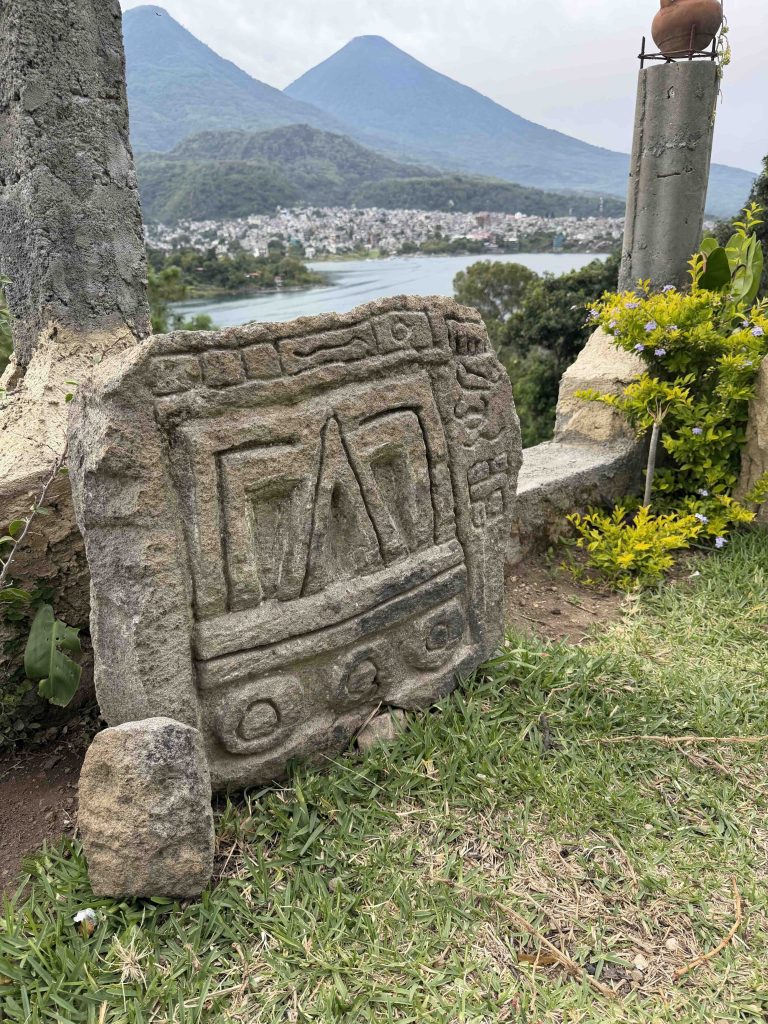
This was not simply a tiny settlement where a few carved stones happened to survive. Archaeological research describes Chuitinamit as a major Postclassic center, and researchers have documented terraces, masonry platforms, a principal plaza, pyramidal structures, an elevated ceremonial and administrative area, a ballcourt, altars and petroglyphs across the larger site.
Very little of that has been consolidated or restored for visitors, which is why the site can seem smaller than it really is when you arrive.
The ancient city extended across a hillside that is now divided into private agricultural properties, so much of what survives is hidden beneath vegetation, crops and later changes to the land.
THE NAME
Why Is Chuitinamit Also Called Chiya’?
If you research the site, you’ll quickly run into several names: Chuitinamit, Chiya’, Chiya and sometimes Pueblo Viejo.
Chiya’ is the Tz’utujil name used in archaeological and historical research and is generally translated approximately as “near the water.” Chuitinamit is the name most commonly used today when travelers and local tourism sources refer to the archaeological area.
For travel planning, searching for Chuitinamit Santiago Atitlán or Mirador Chuitinamit will usually bring up the place described in this guide.
TZ’UTUJIL HISTORY
Why Chuitinamit Was Important to the Tz’utujil Maya
Before the Spanish conquest, Chiya’ was an important center of Tz’utujil political power in the Lake Atitlán region.
Ethnohistoric research associates the site with the Tz’ikinajay ruling lineage, whose influence extended beyond the lake toward the fertile Bocacosta below the highlands.
The elevated setting becomes much easier to understand once you make the hike yourself. From this side of Santiago Bay, the lake and the surrounding terrain spread out below you. Across the Guatemalan highlands, Postclassic Maya communities often chose naturally defensible elevated locations.
After the Spanish invasion and the colonial reorganization of Indigenous communities, the center of Tz’utujil life shifted across the bay to what is now Santiago Atitlán.
That connection is one reason I think you get much more out of Chuitinamit if you spend time in Santiago too. My complete Santiago Atitlán guide covers the church, market, weaving traditions, murals, Maximón and the modern Tz’utujil community across the water.
STONE CARVINGS
What Are the Giant Stone Faces at Chuitinamit?
The carved faces are what immediately grab your attention—and they are also one of the reasons Chuitinamit deserves more than a quick mention in a Santiago travel guide.
Archaeologists have documented an unusual sculptural tradition at Chuitinamit, including distinctive trapezoidal stone sculptures. Some documented examples combine two serpent heads in profile with a frontal face.
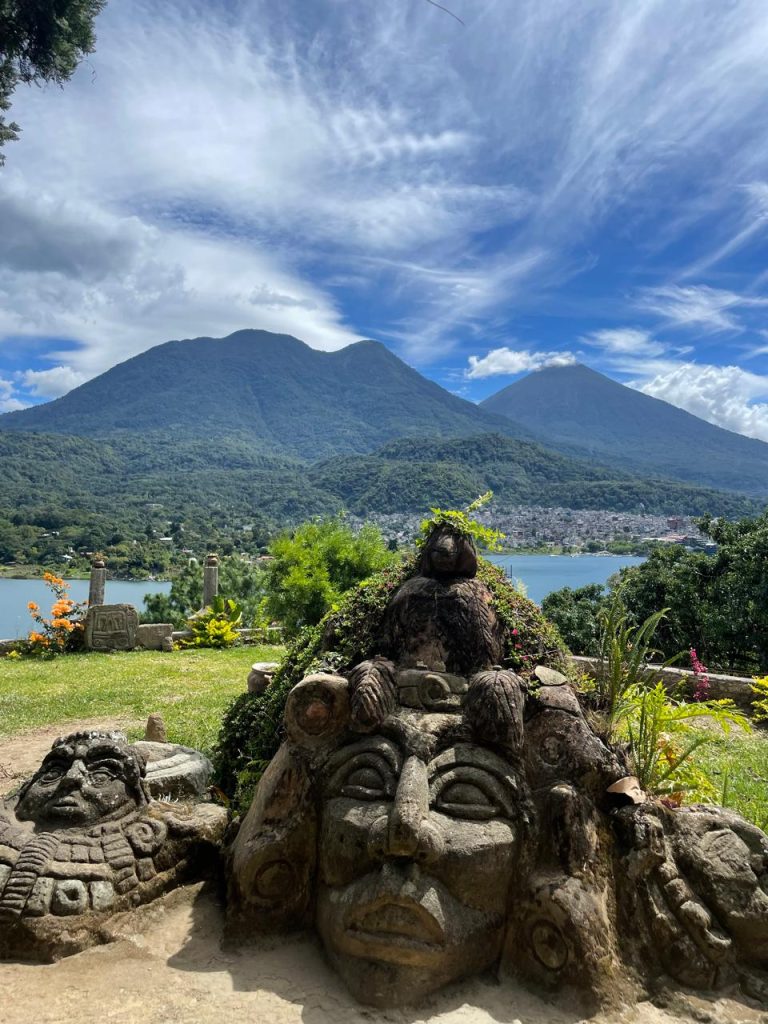
Researchers have proposed several possible interpretations. One hypothesis is that the trapezoidal forms may evoke the volcanoes surrounding Lake Atitlán and that parts of the serpent imagery could relate to a crater. A possible connection with Sakibuk, or “White Smoke,” a deity mentioned in Tz’utujil historical sources, has also been suggested.
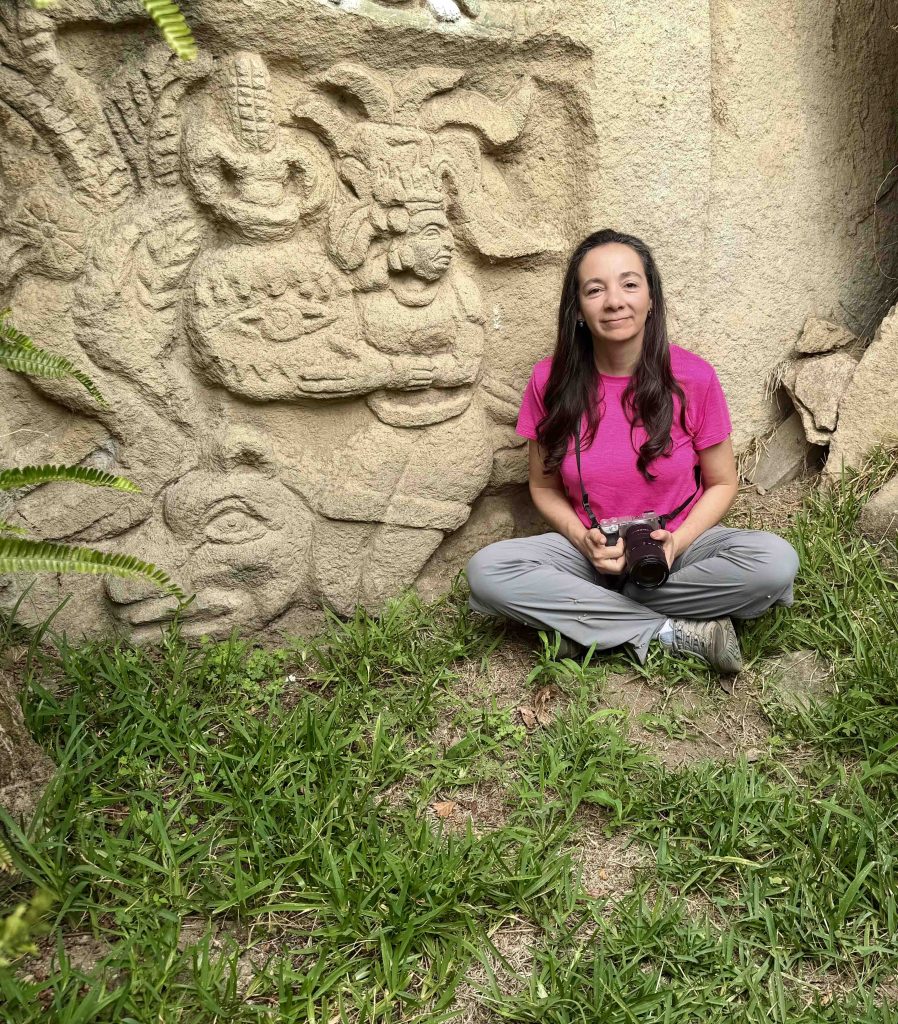
Cruz also gave us his own interpretations of some of the large compositions visible today. In one, he identified the figure at the front as Maximón and the figure above it as a quetzal. I found that interpretation fascinating, particularly in Santiago where Maximón remains such an important living tradition, but I would treat it as a local interpretation rather than an archaeological identification unless research on that specific sculpture supports it.
The same caution applies to the collection as a whole. Because pieces have been moved, rearranged and mixed with newer additions, I would not label every dramatic face you photograph at Chuitinamit as an untouched ancient monument without specific archaeological documentation for that individual piece.
PRESERVATION
The Part of Chuitinamit I Found Hardest to Process
Seeing so many remarkable pieces was incredible. It also made me a little sad.
For archaeologists, the exact place where an object is found matters enormously. Its relationship to a building, terrace, burial or other objects can provide information that disappears permanently when a piece is removed without documentation.
That became much more tangible after seeing the skull, the basket of ceramic fragments and Cruz’s photographs of the jade beads and pottery he says came from a tomb. The individual objects are fascinating, but without records of precisely where each was found and how the objects related to one another, part of their archaeological story becomes much harder to reconstruct.
During our visit we were also told that some pieces found on the land had been sold or disappeared over the years. Others were gathered into the current collection, with some of the heavier carvings cemented in place partly to protect them from theft.
My first reaction was to wish all of it had been documented, protected and preserved in context.
But I also don’t think the story is as simple as saying the objects belong behind museum glass.
This is private Tz’utujil land inside an ancient Tz’utujil cultural landscape, and Cruz is himself Tz’utujil. In the absence of the kind of conservation resources and infrastructure available at Guatemala’s national archaeological parks, he has created his own way of keeping pieces on the property, protecting some from theft and earning income by allowing visitors to see them.
I don’t have a neat answer for that tension between archaeological preservation, private ownership, Indigenous heritage and economic reality. But I think pretending that tension doesn’t exist would leave out one of the most important things I learned by visiting Chuitinamit.
COMPARING SITES
Chuitinamit vs. Iximché: Two Very Different Maya Sites
If you’ve visited Iximché, Chuitinamit is fascinating precisely because the visitor experience is so different.
Iximché was a Kaqchikel capital. Its plazas and structures have been excavated and consolidated, there are clear paths and visitor facilities and you can immediately understand that you’re walking through the remains of an ancient city.
Chuitinamit was Tz’utujil. Its archaeology is spread through privately owned agricultural land, very little has been restored and many of the carved stones visitors see today have been moved into a private collection.
At Iximché, the architecture helps tell the story. At Chuitinamit, you need a guide, some background and a willingness to look more closely. I wouldn’t choose one instead of the other. Visiting both gives you two completely different windows into Guatemala’s Late Postclassic Maya history.
WHERE TO STAY
Where to Stay for Visiting Chuitinamit
Stay in Santiago Atitlán. Chuitinamit is short enough to visit as a half-day outing, and I think it makes far more sense as part of two or three days exploring Santiago than as a standalone trip.
|
FULL-SERVICE HOTEL Hotel Tiosh Abaj A lakeside hotel with extensive gardens, pools and a restaurant, with convenient access to central Santiago. Read my Hotel Tiosh Abaj review → |
PRIVATE LAKEFRONT STAY Orilla Casas en Ati A quieter private stay outside central Santiago with kitchens, terraces and lake views surrounded by avocado trees. Read my Orilla Casas en Ati review → |
For more choices, see my complete guide to where to stay in Santiago Atitlán.
FINAL VERDICT
Is Chuitinamit Worth Visiting?
If you’re spending time in Santiago Atitlán and you’re interested in Maya history, I think Chuitinamit is absolutely worth visiting.
Just go with the right expectations.
Don’t expect restored pyramids or a traditional archaeological park. Expect a short boat ride, private farmland, a local landowner’s remarkable collection of carved stones, archaeological remains scattered across the hillside and a story that is far less tidy than the one you get at a national archaeological park.
Add the Mirador Chuitinamit if you are comfortable with a short but steep and overgrown climb. The view across Santiago Bay is fantastic, and along the way you get a much stronger sense that the archaeological site extends far beyond the collection behind the metal gate.
For me, what made Chuitinamit memorable wasn’t simply seeing the giant stone faces. It was seeing how much history is still scattered across these fields: carved stones beside crops, pottery collected in a plastic basket, a human skull inside a terracotta vessel and stories of objects from a tomb that have already left the property. Then you look across the bay at modern Santiago and realize that none of this history is very far away. It is still part of the landscape—and preserving, interpreting and living with it is far more complicated than I understood before I came.
Planning Santiago Atitlán?
I Can Help You Go Beyond the Usual Stops
Chuitinamit is exactly the kind of place that’s easier to experience when you know who to contact and how it fits into the rest of your trip. I help travelers build Lake Atitlán and Guatemala itineraries around the places they care about without turning every day into a race from one stop to the next.
KEEP EXPLORING
Keep Planning Your Lake Atitlán Trip
|
Santiago Atitlán Guide Plan the rest of your stay around Santiago’s Tz’utujil culture, market, church, weaving and traditions. Explore Santiago Atitlán → |
Iximché Archaeological Site Compare Chuitinamit with Guatemala’s restored Kaqchikel capital near Tecpán. Read my Iximché guide → |
|
Lake Atitlán Boat Guide Understand public lanchas, docks and routes before moving between towns around the lake. Learn how the boats work → |
Complete Lake Atitlán Guide Compare the different towns around the lake and decide where to spend your time. Plan your Lake Atitlán trip → |
|
Where to Stay in Santiago Compare hotels, private homes and lakefront stays around Santiago Atitlán. Compare Santiago accommodations → |
Hotels Around Lake Atitlán See my favorite hotels, vacation rentals and places to stay around Lake Atitlán. See where to stay on Lake Atitlán → |
Through her writing, Paula helps travelers discover Guatemala beyond the typical tourist route with practical advice, local recommendations, and authentic experiences that connect visitors with the country’s people, culture, and traditions.
Planning a trip to Guatemala? Paula offers personalized Guatemala itinerary planning and trip consultation services tailored to your interests, travel style, and budget. Contact her at [email protected] to learn more.
- San Lucas Tolimán Guatemala: Lake Atitlán’s Best-Kept Secret - September 24, 2026
- Hotel Tolimán Lake Atitlán: A Special Stay in San Lucas Tolimán - September 24, 2026
- Guatemala Dreams in San Lucas Tolimán: A Boutique Stay on Lake Atitlán - September 23, 2026

