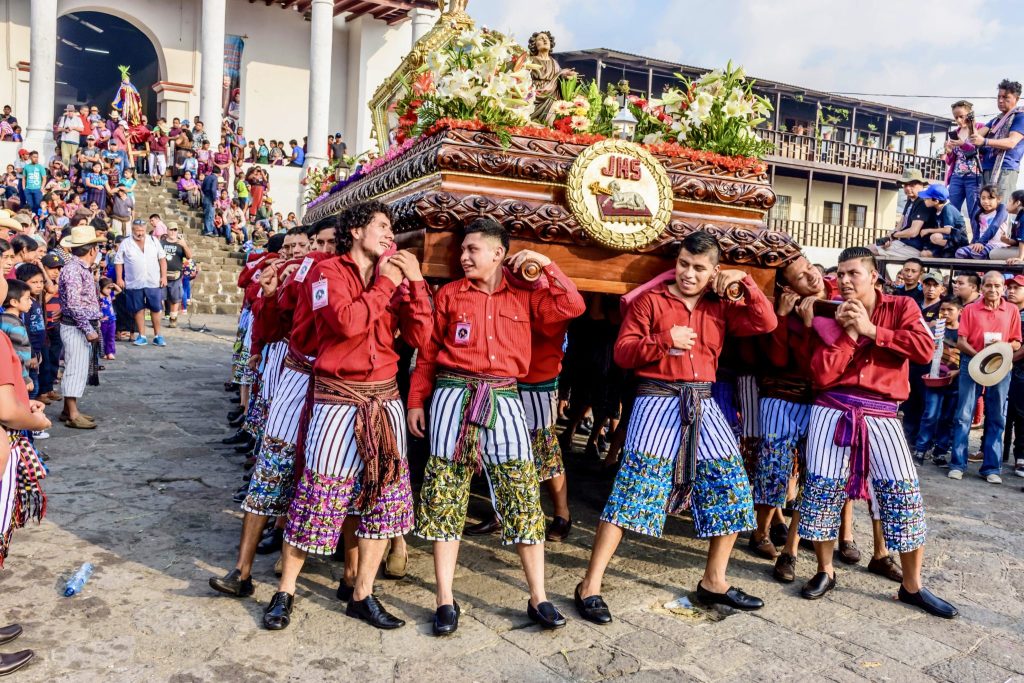
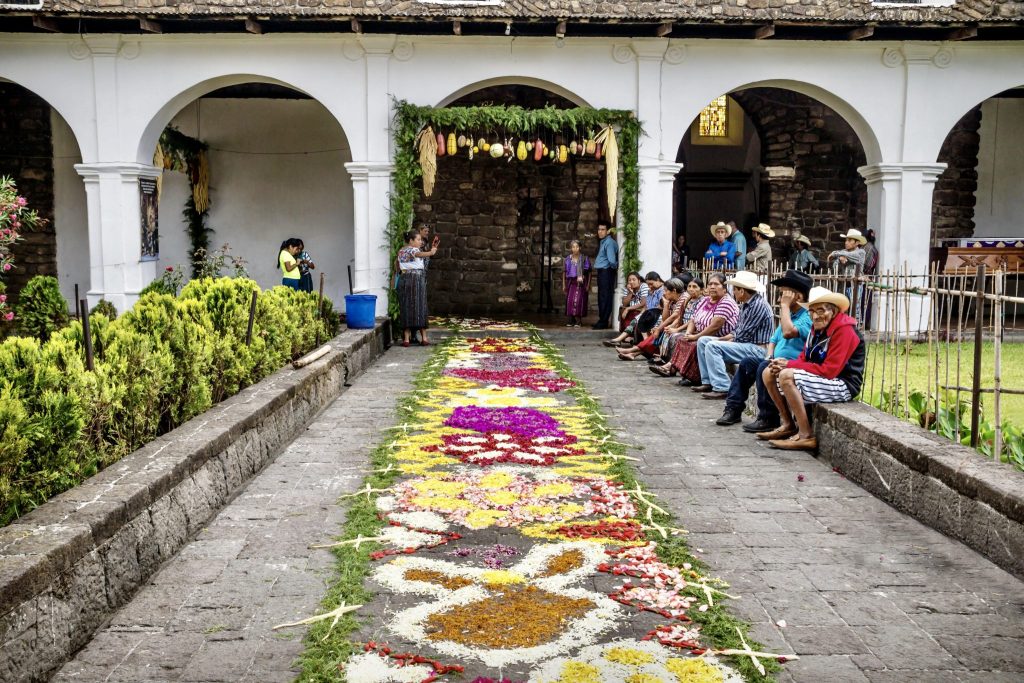
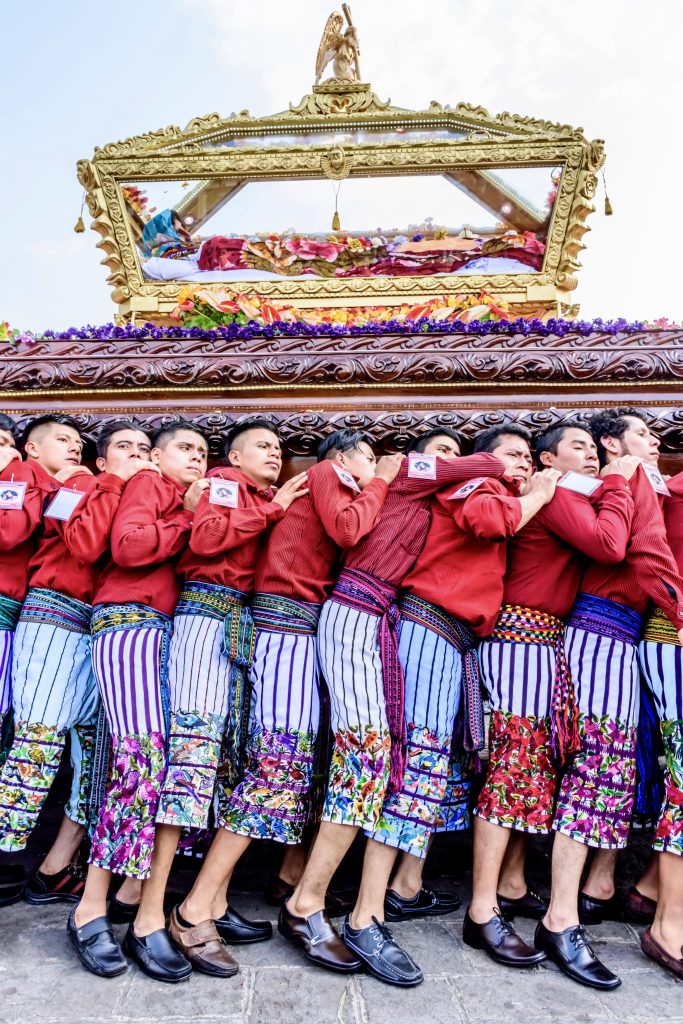
There is a moment on Good Friday here that I have been thinking about since the first time I witnessed it. The glass casket carrying the Señor Sepultado has been moving through the village streets since morning. Men in red shirts and the iconic short Tz’utujil pants embroidered with birds carry it three steps forward and two steps back, for hours. The air smells of incense and sawdust and tropical fruit. Every family along the route spent the night making an alfombra: not the geometric baroque masterpieces of Antigua, but something more organic, flowers, fruit, colored sawdust laid out in bright patterns on the cobblestones.
And then, from a side street, a figure appears on the back of a man walking very slowly and deliberately, moving back and forth to the sound of matracas and a drum. It is Maximón, the Rilaj Mam, the Gran Abuelo, carried by the telinel of the Cofradía Santa Cruz. He comes to walk behind the Catholic procession. Two figures from two different cosmologies, moving through the same streets of the same village. The crowd, mostly local, mostly Tz’utujil, completely absorbed.
I knew, standing there, that I was watching something that has no equivalent anywhere else in the world.
Before diving in: for planning Holy Week across all the lake villages, see Holy Week at Lake Atitlán: Semana Santa Traditions in Every Town.
What Makes Semana Santa in Santiago Atitlán So Different
When the Spanish Franciscan friars first brought the story of Jesus to the Tz’utujil Maya, the story took root immediately. Not because it replaced their beliefs, but because it fit naturally within them. The sacrifice of the sky god for the good of the people. The tree of life. Death as the condition for resurrection and the return of the rains. These were concepts already alive in Maya cosmovision.
In the Tz’utujil understanding, Holy Week is the period when the sky god Jesucristo has been sacrificed, and his counterpart, the earth god, the Rilaj Mam, Maximón, takes over while Jesus awaits resurrection. This is also the time to start planting. Every ceremony that happens during Semana Santa in Santiago, the fruit brought overnight from the Pacific coast, the fertility rituals encoded in the midnight processions, Maximón’s procession through the streets, follows a coherent cosmological logic that long predates Christianity and has simply absorbed it.
Nowhere else in Guatemala will you see this so openly. Nowhere else will you see Maximón join the procession of Christ.
Getting to Santiago Atitlán for Holy Week
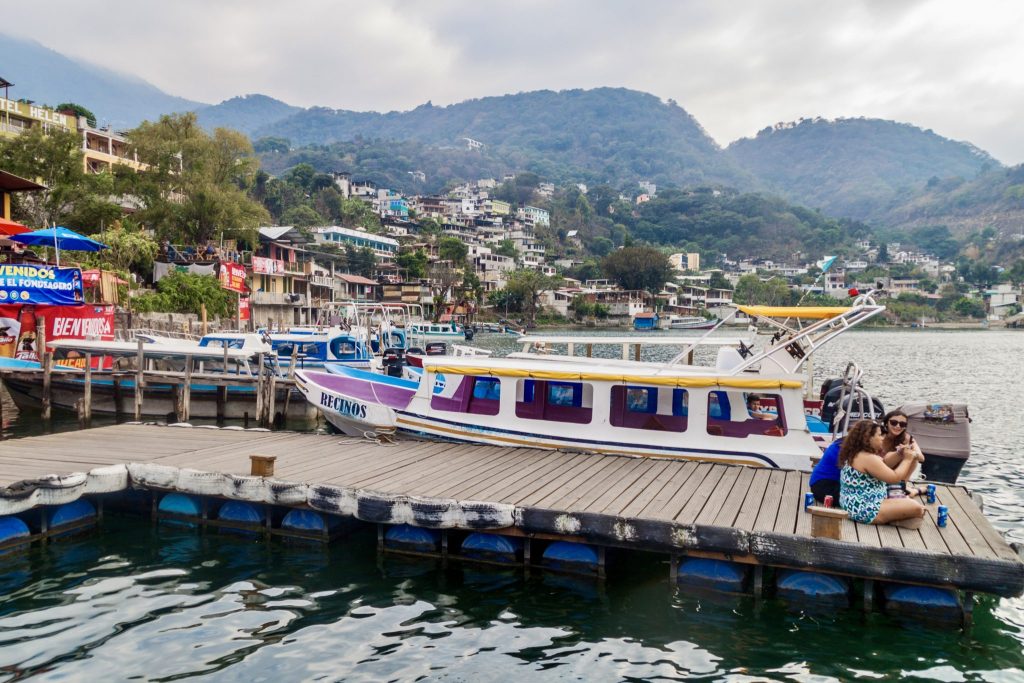
Santiago Atitlán sits on the southern shore of Lake Atitlán, accessible by lancha from Panajachel (25 to 35 minutes, around Q25 to Q35) or from San Pedro La Laguna (about 20 to 25 minutes). Lanchas run from approximately 6:30 AM to 7:30 PM.
On Good Friday, the morning lanchas fill up fast. Be at the dock early, ideally on the first or second boat of the day.
By road, Santiago is reachable via the Pan-American Highway, turning south at Godínez. Some travelers combine driving with lanchas, arriving by road and departing by boat.
For everything about navigating between lake villages: Complete Guide to Lake Atitlán Boat Services.
Where to Stay During Semana Santa at Lake Atitlán
Staying overnight in Santiago, particularly the night before Good Friday, changes the entire experience. You wake up in the village before anyone else arrives. You see the alfombras being made in the early morning darkness. You walk the streets before the day-trippers get off the boats. This is worth every bit of extra planning.
Book two to three months ahead. Everything fills for Holy Week, and minimum stays of three to five nights are standard.
If you cannot find accommodation in Santiago itself, Panajachel is an excellent base. It is just 25 to 35 minutes by lancha to Santiago, and the early morning boats make a Good Friday dawn arrival completely manageable.
Staying in Santiago Atitlán:
Hotel y Restaurante Bambu is my top pick in Santiago, with lake views, a swimming pool, hot tub, sauna, and a restaurant with views of the water and the volcano. Beautiful gardens, excellent birdwatching with a local guide, and a warm staff. About a 15-minute walk or short tuk-tuk from the village center.
Hotel Tiosh Abaj is another strong choice, with a private beach area, outdoor pool, and good reviews from families.
Casa Josefa Hotel is smaller and more central, with excellent breakfasts, a garden, and an intimate feel. The right choice if you want to be in the heart of the village rather than on the lake road.
For private houses with lake views, especially for families or groups, Airbnb in Santiago turns up options that never appear in hotel listings.
Staying in Panajachel:
Hotel Atitlán is the most beautiful property in Panajachel, with extraordinary gardens, a private beach, a pool, and views across the lake to the three volcanoes. It is a genuinely special place to base yourself for Holy Week at Lake Atitlán.
Posada de Don Rodrigo is a colonial-style hotel right in the center of Panajachel with a pool, restaurant, and a location that puts you walking distance from the public dock for early morning lanchas to Santiago.
Hotel Dos Mundos is a well-regarded mid-range option in Panajachel with a pool, garden, and comfortable rooms, good value for Holy Week when larger hotels fill quickly.
Holy Week in Santiago Atitlán: Day by Day
Palm Saturday: The Fruit Arrives from Chicacao
This is one of the most significant and least-documented events of the entire week, and almost no visitors know it is happening.
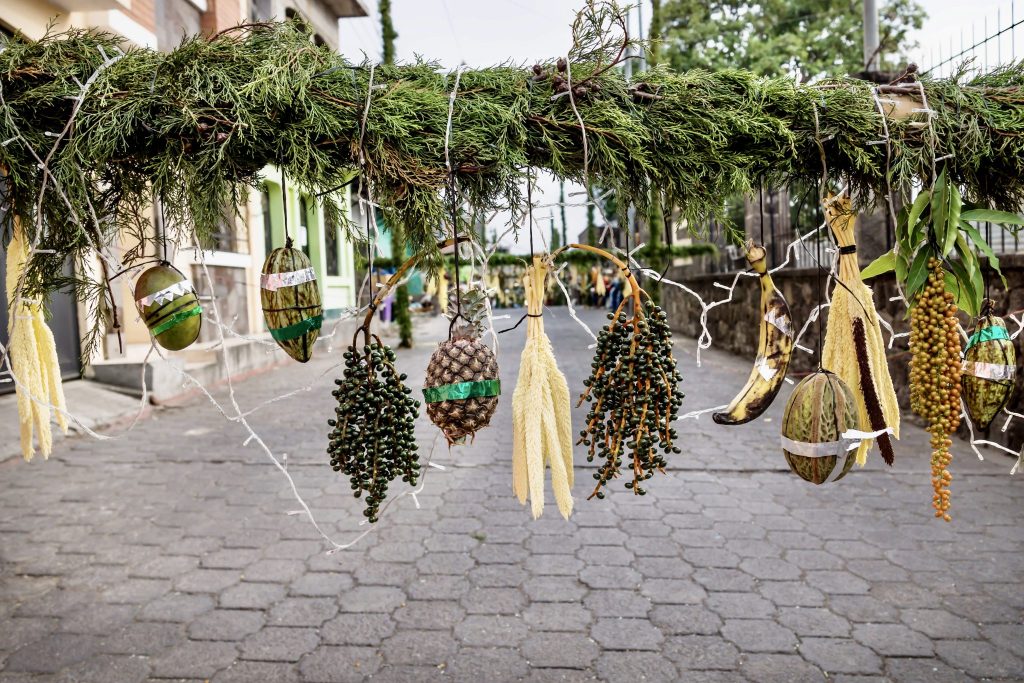
The day before Palm Sunday, young men from the cofradías walk overnight to Chicacao, a village on the Pacific coast lowlands that was historically part of Tz’utujil territory, to bring back tropical fruit: cacao, pataxte, melocotones, bananas. The route they walk is ancient. It reaffirms a relationship between Santiago and Chicacao that goes back centuries.
This is a fertility rite and rain-calling ceremony, the opening of a week that is fundamentally about the earth’s capacity to give life. When the fruit arrives on Palm Saturday morning it is examined as an augury: fresh and perfect means a good year ahead; bruised or rotten is a bad sign. The fruit is then hung throughout the week from giant bowers arching over the village streets, mixed with flowers and greenery, transforming Santiago into something that feels genuinely otherworldly.
Insider tip: If you can arrive on Palm Saturday, walk the streets as the bowers are being assembled. They are unlike anything else you will see during Holy Week anywhere in Guatemala.
Palm Sunday: First Processions and Orientation
Palm Sunday marks the beginning of the official Holy Week celebrations with an evening procession from the convent to the Iglesia Parroquial Santiago Apóstol, historically at 7:00 PM, followed by mass.
This is also a good moment to take your time with the church itself. The Iglesia Parroquial was founded by the Franciscans in 1547 and is one of the most extraordinary colonial churches in Guatemala. The carved altarpiece was renovated in the 1970s by two local brothers, Diego and Nicolás Chávez Sojuel, who quietly transformed a European vision of heaven into a Maya sacred mountain. Look for the two cofradía members climbing toward a cave at the peak. Near the entrance, a memorial plaque honors Father Stanley Rother, the American missionary beloved by this community who was assassinated here in 1981. His cause for canonization has been formally advanced.
Palm Sunday is a day of arrival, orientation, and first ceremony. The cofradías are beginning their internal preparations. The fruit arches are up. The village is starting to come alive.
The first traditional Semana Santa foods appear today. Torrejas (sweet egg-and-bread fritters soaked in honey syrup, dusted with cinnamon) start showing up at every corner. For the full picture of what to eat during Holy Week: Traditional Guatemalan Semana Santa Foods: A Complete Guide.
ocks fill up and the roads from Panajachel toward Antigua and Guatemala City get congested by mid-afternoon.
Holy Monday: The Clothes Go to the Lake
In the evening, the cofrades of the Cofradía Santa Cruz carry Maximón’s garments to the lakeshore and wash them in the water. This is a ritual purification. The lake is considered sacred, and washing the Gran Abuelo’s garments in it is the opening act of his ceremonial cycle for the week.
This is a quiet, intimate ceremony. Walk to the lakeshore in the evening to witness it, but observe from a respectful distance and leave the camera down.
Holy Tuesday: Maximón Is Dressed in Secret
The garments dry all day while the cofradías are in full activity. There is celebration with music and liquor at the Cofradía Santa Cruz that has a purely local quality, worth experiencing if you want to see the week before the visitor energy of Thursday and Friday arrives.
Late at night, in a ceremony that is one of the most guarded in Santiago, the telinel and the alcalde dress Maximón inside a large reed mat. Only the most initiated cofrade members are permitted to attend. This one is not for outsiders, and that is as it should be.
Holy Monday: The Clothes Go to the Lake
In the evening, the cofrades of the Cofradía Santa Cruz carry Maximón’s garments to the lakeshore and wash them in the water. This is a ritual purification. The lake is considered sacred, and washing the Gran Abuelo’s garments in it is the opening act of his ceremonial cycle for the week.
This is a quiet, intimate ceremony. Walk to the lakeshore in the evening to witness it, but observe from a respectful distance and leave the camera down.
Holy Tuesday: Maximón Is Dressed in Secret
The garments dry all day while the cofradías are in full activity. There is celebration with music and liquor at the Cofradía Santa Cruz that has a purely local quality, worth experiencing if you want to see the week before the visitor energy of Thursday and Friday arrives.
Late at night, in a ceremony that is one of the most guarded in Santiago, the telinel and the alcalde dress Maximón inside a large reed mat. Only the most initiated cofrade members are permitted to attend. This one is not for outsiders, and that is as it should be.
Holy Wednesday: Maximón Moves Through the Streets
Holy Wednesday is the day most visitors who are spending more than just Good Friday in Santiago come for, and it rewards the effort completely.
The morning begins with a presentation of the fruit from Chicacao at the municipal building around 10:00 AM, the formal examination of the augury. A marimba begins to play.
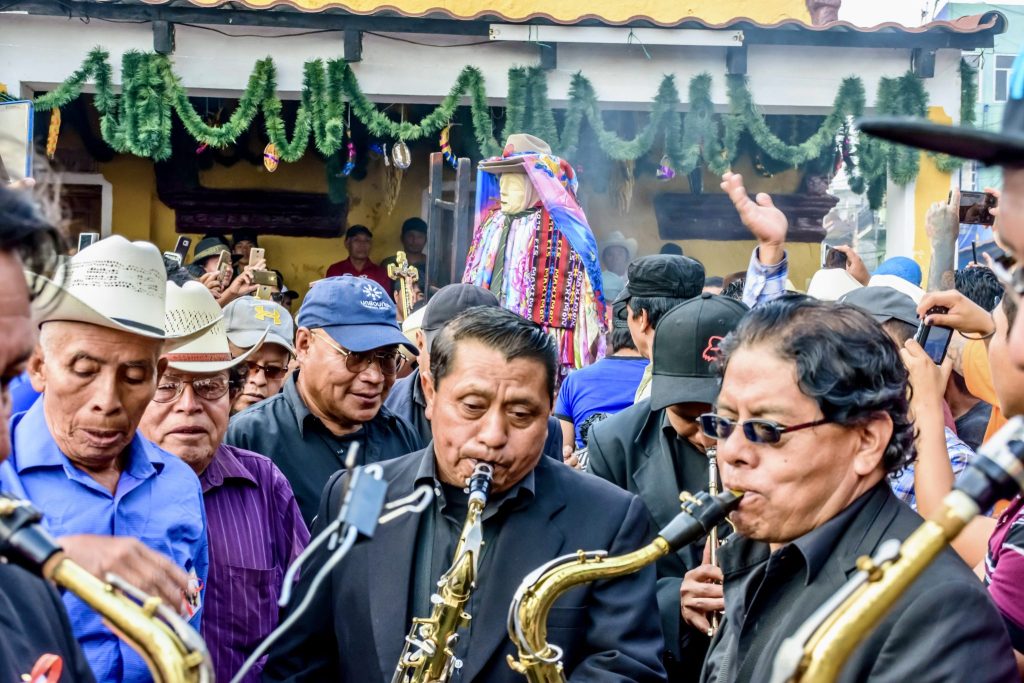
In the afternoon, Maximón processes through the streets. The chamán of the cofradía carries him out, accompanied by women over 60 recognized as ancestral authorities, carrying candles, followed by men and children with decorated fruit baskets. The figure is danced through the narrow streets to a son composed specifically for the Gran Abuelo. He visits the mayor’s office first, installed on a tule mat (the traditional Maya symbol of power) while the mayor and his advisors pay their respects. Then he is carried to his chapel on the side of the church plaza.
There was a time when Maximón hung inside the church next to Jesus, as sacred brothers. When Catholic priests found out, they demanded he be removed. The community moved him to the doorway. The Church eventually compromised and gave him a chapel on the church square. He did not go far.
Standing in that plaza on Holy Wednesday afternoon, watching Maximón arrive as the marimba plays and the cofrades settle him in, with the village almost entirely local around you, is one of the most alive moments of the entire week.
Holy Thursday: Visit Maximón Before the Crowds Arrive
This is the insider tip for Holy Week in Santiago Atitlán: Thursday is the best day to visit Maximón.
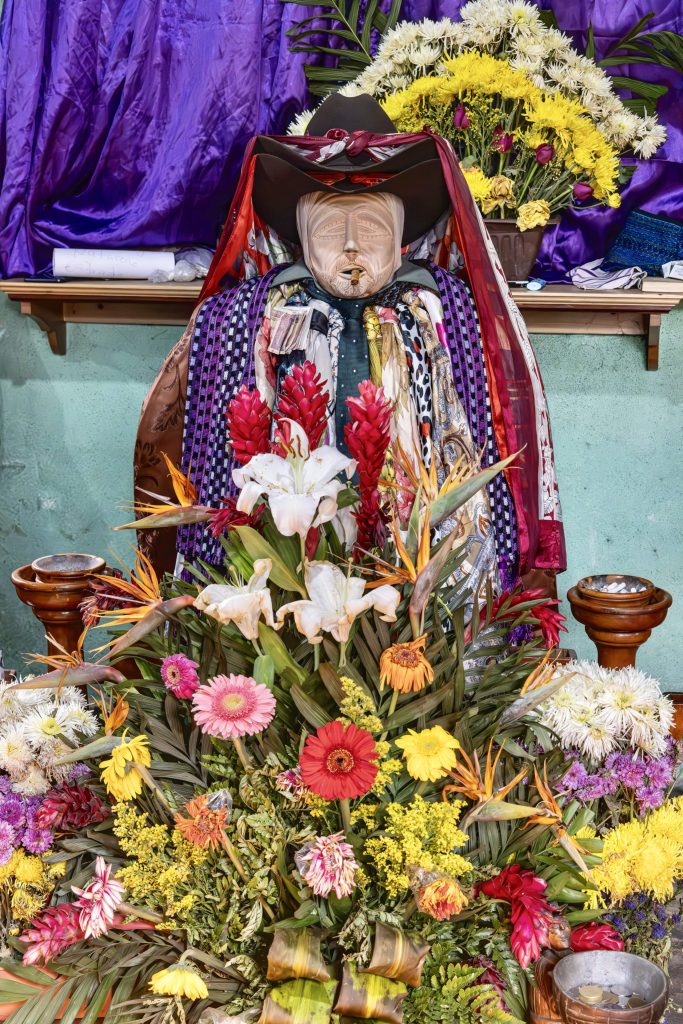
On Holy Thursday, Maximón is in his chapel all day receiving visitors, locals bringing offerings of cigars, candles, flowers, and liquor, making real petitions with real intention. The cofrades are available. The atmosphere is unhurried. The Good Friday crowds have not yet arrived, and the experience is as personal as it gets. Bring an offering (cigarettes, veladoras, flowers, or aguardiente), make a donation, and give it time. For everything about visiting Maximón: Maximón, Guatemala’s Most Mysterious Figure.
Spend the afternoon walking the procession route. By Holy Thursday, every family is making or completing their alfombra, organic and colorful, made with flowers, fruit, and pine needles in designs that reflect the Tz’utujil aesthetic tradition. Walking the route as families work is one of the most intimate parts of the entire week.
In the evening, a midnight procession takes place with Jesus, María Dolores, and the figure locally known as San Juan Carajo. After the procession, there is a distinctly Maya fertility and rainmaking ceremony. Watching this at midnight, with fireworks going off across the village and marimba bands playing simultaneously from different cofradías, you understand viscerally that what you are watching has nothing to do with the Spanish Catholic tradition.
Good Friday: The Day the Universe Holds Its Breath
Good Friday in Santiago Atitlán is unlike any other day in Guatemala.
Get there before dawn. The first lanchas leave Panajachel around 6:30 AM. If you are staying in Santiago, simply wake up early. This is the single most important logistical instruction in this entire article: the village before the day-trippers arrive is a completely different place. You can walk the full procession route, see the alfombras in their final state, buy torrejas from vendors just setting up, and stand in the plaza as the light comes up over the volcanoes with incense already drifting from the church.
The morning begins with the adornment of the Señor Sepultado. In the Tz’utujil understanding, everyone must give themselves fully to this day for the universe to continue working. Jesus is placed in the great glass casket with much ceremony, accompanied by the “rain prayer,” a man who has dedicated his life to crying for Jesus while he is on the cross, a figure of great spiritual importance in the community.
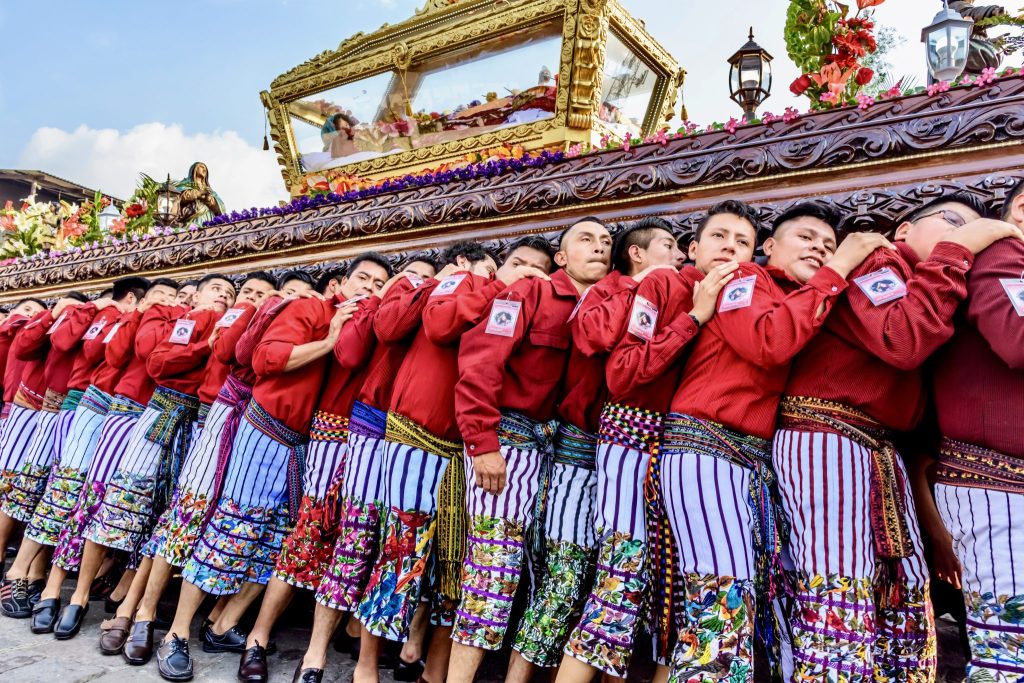
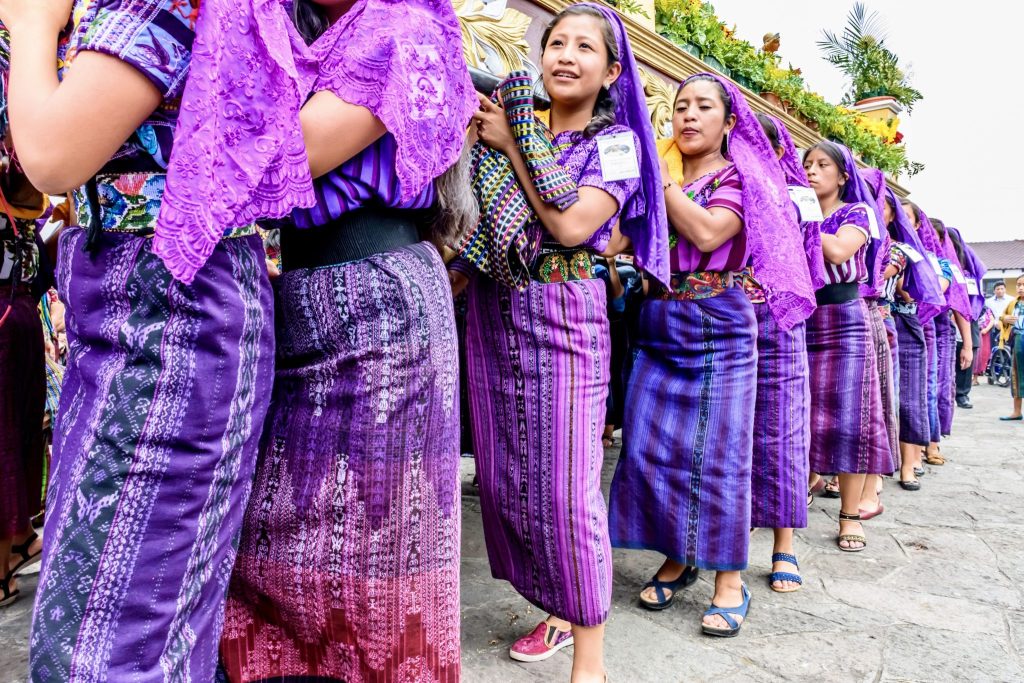
When all is ready, the procession begins: men on both sides of the casket, three steps forward and two steps back, swaying constantly, moving through streets covered in alfombras. The procession departs from the 1547 church and pauses for two full hours in front of the church atrio, an act of penitencia and gratitude. The cargadores wear red shirts and the traditional Tz’utujil short pants embroidered with birds. The women carrying the Virgin’s anda wear traditional cortes and huipiles with purple lace mantillas. The andas are covered in bright tropical flowers.
The procession then continues toward the four small chapels of the village. In Tz’utujil cosmovision, these represent the four corners of the universe, and the procession will travel to all four, continuing all night long.
At approximately 4:00 PM, the telinel emerges from the chapel with Maximón on his back. Every eye in the plaza turns to him. The community watches closely how the telinel dances the Maximón bundle. A spiritually strong telinel dances for a long time, and what he is doing has nothing to do with entertainment. Maximón dances around the other figures, joins the procession behind the casket, and when he has done what he came to do, returns to the cofradía.
This is the moment: a Maya spiritual figure joins a Catholic procession of the burial of Christ, walking behind the coffin to the sound of rattles and a drum. The two halves of this community’s spiritual life converge in the same street. It is not a conflict. It is a completion.
Where to stand: Be on the main street between the church and the first part of the route by 9:00 AM at the latest. For the arrival of Maximón in the afternoon, be in the church plaza.
Food: Good Friday is one of the great days for street food anywhere in Guatemala. Torrejas, atol, tamales, garnachas, chuchitos, vendors line every path from the dock into the village all day. Eat as you walk.
Holy Saturday: The Village Breathes Again
Holy Saturday is quieter, in the way that days after catharsis are always quieter. The cosmic work of the week has been done.
The notable event is at around 3:00 PM, when Santiago Apóstol, the patron saint, is brought from his cofradía back to the church. The alfombras have been walked over and swept away. The bowers of fruit are starting to age. The streets feel wide and open.
If you can stay a second night in Santiago, Holy Saturday evening in the village is genuinely lovely: quiet, warm, smelling of the week’s incense and flowers, with the lake flat and the volcanoes visible in the late light.
Easter Sunday: Lighter, Celebratory, and Time to Go
Easter Sunday has a different character entirely, fireworks, early mass, a lighter mood. Maximón leaves his chapel to return to his cofradía for the rest of the year.
By mid-afternoon the lake begins its mass departure. If you are leaving, go early. The docks fill up and the roads from Panajachel toward Antigua and Guatemala City get congested by mid-afternoon.
Quick Reference Schedule
| Day | Date | Key Events in Santiago Atitlán |
|---|---|---|
| Palm Saturday | March 28 | Men arrive from Chicacao with tropical fruit; fruit arches assembled |
| Palm Sunday | March 29 | Procession from convent to church at 7 PM; first mass of Holy Week |
| Holy Monday | March 30 | Maximón’s garments washed in lake, ~8 PM, lakeshore |
| Holy Tuesday | March 31 | Garments dry; cofradías in full activity; Maximón dressed secretly at night |
| Holy Wednesday | April 1 | Fruit presentation at municipal building ~10 AM; Maximón processes through streets afternoon |
| Holy Thursday | April 2 | Maximón in chapel all day receiving visitors; midnight procession with Jesus, María Dolores, San Juan Carajo |
| Good Friday | April 3 | All day: adornment of Señor Sepultado; procession from church; 2-hour station at atrio; route to four corners; Maximón joins procession ~4 PM |
| Holy Saturday | April 4 | Santiago Apóstol returns from cofradía to church, ~3 PM |
| Easter Sunday | April 5 | Resurrection mass; Maximón returns to cofradía for the year |
All times are approximate (más o menos) — nothing in Santiago Atitlán runs on a fixed clock, and the ceremonies begin when they are ready.
What Makes Santiago Different from Every Other Semana Santa
People sometimes ask whether they should choose Antigua or Santiago for Holy Week. This is the wrong question. They are not competing versions of the same thing. They are different things entirely.
Antigua’s Semana Santa is the Baroque Catholic tradition of Spain transplanted to the Americas and amplified over four centuries. The alfombras are precision works of colored sawdust and flowers. The andas weigh tons and require hundreds of cucuruchos in purple robes. The processions are enormous, solemn, and organized to the minute. It is overwhelming and magnificent, and if you have not seen it, it belongs on your list.
Santiago’s Semana Santa is something that Antigua cannot offer: a living Maya cosmological ceremony. The sacrifice and resurrection of a sky god, the temporary reign of an earth deity, the return of the rains, the opening of the agricultural cycle — all of this is happening simultaneously with the Catholic observances, and not as a folk embellishment but as the core spiritual engine of what the week means. Nowhere else in Guatemala will you witness this so openly. Nowhere else will you see Maximón join the procession of Christ.
For the historical and cultural context behind all of this, Semana Santa in Guatemala: Traditions and History traces how these regional traditions developed from their colonial origins to the present.
Practical Tips for Semana Santa in Santiago Atitlán
Hire a local guide. This is not a suggestion — it is the single most important thing you can do for your experience in Santiago, especially during Holy Week. A knowledgeable local guide transforms cryptic ceremonies into legible meaning, opens doors to cofradías that are otherwise closed to uninitiated visitors, and allows you to ask the questions that would otherwise go unanswered. Atitlán Living lists trusted guides including Dolores Ratzan (a member of the Cofradía Santa Cruz who speaks English) and Miguel Pablo Sicay. Contact them in advance, especially if you want to participate in a ceremonial visit to Maximón.
Book accommodation two to three months ahead. Hotel Bambu, Hotel Tiosh Abaj, and Casa Josefa Hotel all book out completely for Holy Week, and minimum night stays of three to five nights are standard. If you wait until the last month, you will find nothing.
Bring cash. Santiago has limited ATM infrastructure. Come prepared.
Dress modestly everywhere. No bare shoulders, no short skirts or shorts, not in the church, not near the cofradías, not during processions. This is not optional etiquette — it is a basic expression of respect for where you are and what is happening around you.
Don’t walk on alfombras. At any point before a procession has passed over them, alfombras are sacred offerings. Walking on one before the procession is a genuine breach of respect that will not be forgotten.
Stay for more than one day. If you can only do one day in Santiago, make it Good Friday. But if you can stay through Holy Thursday to Easter Sunday, you will see the week as a complete whole rather than as a spectacular fragment.
Be patient. Nothing here runs on schedule. The procession starts when it starts. Maximón appears when the telinel is ready. The ceremony at midnight begins when the ceremonies are ready. Bring this patience with you before you arrive, not as something you have to find once you are frustrated.
On Good Friday, arrive before 8 AM. Day-trippers from Panajachel and Antigua start arriving by midday. The village before 9 AM is incomparably more intimate than the village at noon.
Beyond Semana Santa: What Else to Do in Santiago Atitlán
If you have time beyond the Holy Week ceremonies, Santiago Atitlán has more to offer than most visitors discover.
The Cojolya Association runs excellent weaving workshops showing the traditional Tz’utujil backstrap loom technique, the textiles of Santiago, with their distinctive bird motifs, are among the most beautiful in the country. The Mujeres de Maiz cooperative is another option for direct, meaningful engagement with the textile tradition.
The market, busiest on Fridays and Sundays, is not a tourist market. It is a genuine working market where local women come from the surrounding communities to buy and sell. Go without an agenda and simply walk it.
The Iglesia Parroquial Santiago Apóstol rewards multiple visits. The more you know about it — about the brothers who repainted the altarpiece to embed Maya cosmology inside a colonial church, about Father Stanley Rother’s murder and the community’s response, about the wooden saints dressed annually in new clothes by local women — the more you see each time you enter.
For families traveling with children during Holy Week, Santiago is manageable and genuinely engaging, the lancha ride, the bowers of fruit, the market, the colors. See Best Things to Do with Kids at Lake Atitlán for broader ideas around the lake.
For active travelers, the village near San Antonio Palopó on the eastern shore is worth a day trip by lancha, a more remote, deeply traditional community with its own textiles and a beautiful church. See our guide to Visiting San Antonio Palopó for what to expect. And for the complete overview of what Santiago and the whole lake have to offer across all seasons, Complete Guide to Visiting Lake Atitlán is the place to start.
Frequently Asked Questions
When is Semana Santa in Santiago Atitlán in 2026? Holy Week runs from Palm Sunday, March 29, through Easter Sunday, April 5, 2026. The most important day in Santiago Atitlán is Good Friday, April 3. Palm Saturday (March 28) marks the arrival of the fruit from Chicacao and the start of traditional ceremonies.
Do I need to speak Spanish to visit Santiago Atitlán during Holy Week? Basic Spanish helps, especially at the market and for navigating the village. In the cofradías and with older community members, Tz’utujil is the primary language. A local guide who speaks English and either Spanish or Tz’utujil is the best solution.
Is it respectful for non-Maya, non-Catholic visitors to attend? Yes, if you come with genuine curiosity and respect. The cofradía system in Santiago has historically been open to visitors, and the ceremonies are not secret (with specific exceptions like the Tuesday night dressing of Maximón). The key is showing up with humility, following local norms, not photographing without permission, not walking on alfombras, and recognizing that you are a guest in someone else’s spiritual life.
What should I bring to visit Maximón? An offering: a pack of cigarettes, veladoras (glass pillar candles), flowers, or a small bottle of aguardiente. A small cash donation (around Q5 to Q10) to the cofradía. And the willingness to spend time rather than rushing. For the full practical guide, see
How crowded does Santiago Atitlán get on Good Friday? Busy, but nothing like Antigua. By midday on Good Friday, the village is noticeably crowded with Guatemalan and international day-trippers. The experience before 9 AM is intimate and local. The experience at noon is tourist-adjacent. This is why staying the night before is the single best logistical decision you can make.
Can I combine Santiago Atitlán and Antigua in the same Holy Week trip? Yes, and it can work very well. Many people do the early days of Holy Week in Antigua (Palm Sunday through Holy Wednesday) and then travel to the lake for Holy Thursday through Easter Sunday. For more on combining the two, see Holy Week in Guatemala 2026: Key Dates, Major Processions, and What to Expect.
What is the minimum time to spend in Santiago Atitlán during Holy Week? One full day on Good Friday is the minimum. Two nights (arriving Holy Thursday, staying through Good Friday) is the sweet spot for most travelers. The full week is for those who want to experience it completely.
Also in this series:
- Holy Week at Lake Atitlán: Semana Santa Traditions in Every Town
- Semana Santa in Santiago Atitlán: A Complete Guide to Holy Week Traditions
- Semana Santa Itinerary at Lake Atitlán: How to Plan Your Holy Week
- Maximón: Everything You Need to Know About Guatemala’s Most Fascinating Figure
- Traditional Guatemalan Semana Santa Foods: A Complete Guide
- How to Photograph Semana Santa in Guatemala
- Holy Week in Guatemala 2026: Key Dates, Major Processions, and What to Expect
- Semana Santa in Guatemala: Traditions and History
- Complete Guide to Visiting Lake Atitlán
- Best Things to Do with Kids at Lake Atitlán
- Visiting San Antonio Palopó

Paula studied architecture and now makes a living as a freelance writer,traveler and amateur photographer.She started her writing & publishing career as the editor of Bebé y Mamá, the first parenting magazine in Guatemala.She is the founder of www.GrowingUpBilingual.com and www.365thingsswfl.com and writes articles in Spanish and English for both magazines and the web on travel,food and bicultural and bilingual parenting .
When she is not on a plane or road trip she likes to create recipes inspired in the flavors of her native Guatemala.
- Lent Processions in Guatemala 2026: How to Experience Cuaresma Even if You’re Not Here for Holy Week - February 22, 2026
- Holy Week at Lake Atitlán: Semana Santa Traditions In Every Town - February 21, 2026
- Maximón, Guatemala’s Most Mysterious Religious Figure: Everything You Need About San Simón - February 20, 2026

