This article contains affiliate links. If you book or buy something through one of my links, I may earn a small commission at no extra cost to you. I only recommend products, places, and services I have personally used or vetted.
Planning a Spain and Portugal road trip itinerary and tired of finding the same recycled route everywhere — Barcelona, Madrid, Lisbon, Algarve, done? This is the Spain and Portugal itinerary with kids I wish had existed when I drove this loop with my two children, ages 8 and 10. Two countries, 14 days, one clean circular route that skips the obvious, goes deep into UNESCO cities most American families have never heard of, and tells you honestly what it costs to do this trip properly in 2026.
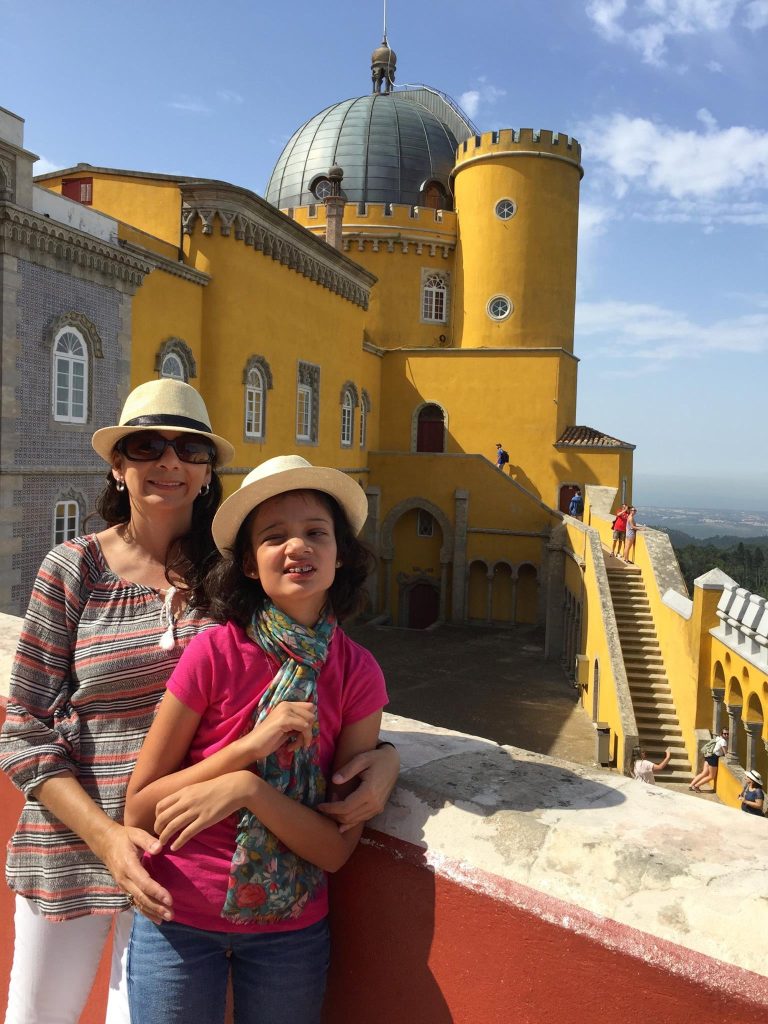
At Pena Palace in Sintra with my daughter.
We did this route in what I thought was 7 days. When I actually sat down and counted the nights — 3 in Madrid, 1 in Valladolid, 2 in Porto, 4 in Lisbon, 1 in Mérida — it was closer to 12. And I had still managed to drive straight past two UNESCO World Heritage cities without stopping. My kids were 8 and 10, tired and hungry in the backseat, and we had places to be. Évora and Elvas disappeared through the car window. I still think about that.
What I remember clearly is what we did stop for: my son navigating a scavenger hunt through Madrid’s streets with a map he refused to hand over to anyone. Both kids standing in a Moliceiro boat in Aveiro absolutely convinced they were in Venice. My daughter running through Sintra like she’d found a real fairy tale. These are the moments that made the trip. The Spain and Portugal 14-day itinerary I’m giving you here is built to give you room for all of them — and for the stops we missed.
This Spain and Portugal road trip starts and ends in Madrid. It’s a loop — no one-way car rental complications, no backtracking, no flying between cities. Day 1 assumes you arrived the night before. Day 14 ends back in Madrid. What happens next is entirely up to you. This isn’t the Spain and Portugal greatest hits tour. It’s the one that goes where most people don’t, moves at a pace where families can actually see things, and happens to be one of the best road trips in Europe.
This Spain and Portugal road trip itinerary is for
✓ Families with kids 6 and up ✓ Couples and solo travelers who want depth over highlights ✓ Gen X and Millennials done with surface-level travel
✓ Anyone who wants two countries without two separate trips ✓ Travelers who want UNESCO history without the standard tourist crush
📌 Traveling with Kids?
Before you plan the logistics, read my full guide on traveling to Spain with children — from packing and jet lag to what actually keeps kids engaged on a long road trip through two countries.
Before We Start
What I’d Do Differently on This Spain and Portugal Road Trip
Part of being useful is being honest about what didn’t work. These are the warnings nobody gave me before I left.
Don’t Rush This
Mérida. Most travelers give it an afternoon. That is a mistake. Mérida has the best-preserved Roman ruins outside of Italy — better than a lot of what you’ll find in Rome itself. A 2,000-year-old amphitheater where gladiators fought. A Roman theater with 64 columns still standing. A circus larger than anything built anywhere in the Roman Empire at the time. Give it a full day and stay the night. This itinerary does exactly that.
Know Before You Go — Sintra
Sintra on a summer weekend is a different experience from Sintra on a Tuesday morning. July and August Saturday queues for Pena Palace run two to three hours just to get in. Go on a weekday. Go early. Book your entry tickets online the night before. If you arrive before 10am you’ll have the palace almost to yourself for the first hour. This single decision determines whether Sintra is magical or miserable — especially with kids.
Skip It
Hop-on hop-off buses in Lisbon and Madrid. Both cities are made for walking. Lisbon has trams. Madrid has one of the best metros in Europe. The hop-on hop-off is slow, expensive, and puts a window between you and the city. Kids are bored within twenty minutes. Walk instead.
The Two We Drove Past
Évora and Elvas. We drove from Lisbon straight to Mérida and watched two UNESCO cities disappear behind us. Évora is one of the most complete medieval cities in Portugal — Roman temple, bone chapel, medieval walls, and the finest food region in the country. Elvas, right on the Spanish border, has the largest dry-moat fortification system in the world, largely intact. Both are on this route. Both are in this itinerary. Don’t make our mistake.
Portugal Driving — Read Before You Rent
This is a loop that returns to Madrid, so there is no one-way drop fee. But you do need to declare that you’re crossing into Portugal when you pick up the car — some companies charge a cross-border fee, others (Enterprise has been reported not charging it as recently as 2026) include it. Budget companies sometimes prohibit cross-border entirely. Book with a major brand, declare Portugal at the desk, and get confirmation in writing. Portugal’s highways also use an electronic toll system with no cash booths — arrange a Via Verde transponder or toll solution with the rental company at pickup, or you’ll face charges added later. If you’re traveling with kids who need booster seats, budget an extra €6.76/day per seat — these are compulsory and charged locally in Portugal.
The Itinerary
Spain and Portugal Road Trip Itinerary: 14 Days, Two Countries
⏰ Route Overview
Madrid → Salamanca → Porto → Aveiro → Coimbra → Lisbon → Sintra → Évora → Elvas → Mérida → Cáceres → Madrid. Total driving distance approximately 2,400km over 14 days. Most driving days are 2–4 hours. Day 1 assumes you arrived the night before. Day 14 ends in Madrid — what you do from there is your own.
Day 1 starts in Madrid with activities. There is no “fly in” day built into the count.
01
Day One — Madrid
Settle In, Retiro Park, and the Best Churros in the World
📍 Madrid, Spain
Madrid is one of the most genuinely family-friendly capitals in Europe. Kids are welcome everywhere, late into the evening, without a second thought. Your first day is for landing softly and letting everyone adjust to European time.
Retiro Park — Morning
Start at Parque del Retiro — 350 acres of gardens and the Estanque Grande lake, where rowboats rent for €6. Kids love the rowing. The Crystal Palace inside the park is worth a quick stop — a 19th-century iron and glass greenhouse that hosts free rotating art installations.
Plaza Mayor and the Old City — Afternoon
Walk from Retiro through the city center toward Plaza Mayor. Have lunch under the arcades, then walk two minutes in any direction to find something better and cheaper than the tourist-facing restaurants on the square itself.
✨ Non-Negotiable With Kids — Chocolatería San Ginés
Five minutes from Plaza Mayor, San Ginés has been serving churros with thick hot chocolate since 1894. It’s open essentially all the time. Your kids will talk about this for the rest of the trip. Go for a late afternoon snack — it perfectly bridges the gap between the Spanish lunch hour (2–3pm) and dinner (9–10pm) for families adjusting to the schedule.
Where to Stay in Madrid
⭐ Top Pick · Best Location
Soho Boutique Opera
Steps from the Royal Palace and Opera metro. Boutique, well-designed, central. One of the best value options in Madrid’s historic core. Summer 2026 rates: €180–280/night.
Near Sol, family suites available, good design and genuine hospitality. A solid choice when you need more room for a family of four. Summer 2026: €160–250/night.
The Scavenger Hunt, the Prado With Kids, and Why Madrid Works for Families
📍 Madrid, Spain
Your second day in Madrid is the one that lands for everyone — jet lag mostly gone, the city starts making sense. This is also when you do the single best family activity on this entire Spain and Portugal road trip with kids.
🗺
Madrid Family Scavenger Hunt — Morning A guided scavenger hunt through Madrid’s historic center — part city tour, part treasure hunt. The route covers the Royal Palace, Plaza de Oriente, Plaza Mayor, Puerta del Sol through clues and puzzles the kids lead. About 2 hours. For 8-to-12-year-olds, this is genuinely the most engaged they will be at any point in the city.
🎨
The Prado — The Right Version for Families Book a private Prado kids and families tour — 90 minutes, scavenger hunts built in, Bosch’s monsters and Goya’s battles explained at kid level. The private format means the guide moves at your family’s pace. Don’t take children to the Prado for three hours without this.
👑
Royal Palace — Afternoon The largest royal palace in Western Europe by floor area — 135,000 square meters, 3,418 rooms. Book skip-the-line entry online. Kids who did the scavenger hunt this morning will already have context for what they’re walking into.
🍽
Mercado de San Miguel — Evening Two minutes from Plaza Mayor, this 1916 iron and glass market is a perfect family dinner — everyone picks what they want from different stalls, you find a standing table, and the kids discover that jamón ibérico, croquetas, and patatas bravas are actually things they like. Spain’s late dining culture means 8pm feels early here.
03
Day Three — Drive Day
Madrid → Salamanca — The Golden City
📍 Salamanca, Castilla y León — UNESCO World Heritage City
Drive west from Madrid — about 2.5 hours — and arrive in Salamanca by midday. Salamanca is built from a local stone called piedra de Villamayor — golden sandstone that turns amber in afternoon sun. The entire UNESCO old city glows. If you’ve been to Spain and never made it here, prepare to be surprised.
🐸 The Kids’ Game — La Rana de la Universidad
On the Plateresque facade of the University of Salamanca — oldest university in Spain, founded in 1134 — there is a tiny frog carved into the stone, hidden among skulls. Finding it is said to bring good luck on exams. Students have been searching for it for centuries. Hand your kids the task before you tell them where to look. They’ll find it and remember Salamanca for it.
🎓
University of Salamanca + The Frog The facade is one of the finest examples of Plateresque architecture in Spain. Inside: the historic library and the lecture hall where Fray Luis de León returned from the Inquisition and opened class with “As we were saying yesterday…” Entry is inexpensive and worth it.
🏛
Plaza Mayor — Afternoon Coffee The most beautiful baroque square in Spain. Sit under the arcades, order coffee, watch the students. Let the city settle in.
⛪
Old and New Cathedrals — The Hidden Astronaut Two cathedrals sharing a wall. On the exterior of the New Cathedral, carved in a 1992 restoration, there is an astronaut floating in space and a dragon eating ice cream. Find them before you tell your kids what to look for. They will lose their minds.
Where to Stay in Salamanca
⭐ Best Location · Converted Convent
Eurostars Las Claras
16th-century convent in the heart of the old city. Stone arches, inner courtyard, walking distance to everything. Summer 2026: €150–220/night.
Small boutique near the cathedrals, owner-run feel, excellent service. The kind of place that knows your name by breakfast. Summer 2026: €160–230/night.
The drive from Salamanca to Porto is about 3 to 3.5 hours on the A-62 west. Cross the border at Fuentes de Oñoro (Spain) / Vilar Formoso (Portugal) — no passport control, you’re in Schengen. Watch the landscape change as you cross: wide golden Castilian plains giving way to greener, hillier Portuguese terrain. It’s a natural transition worth noticing from the car.
🏛 Optional Stop — Zamora (1 Hour from Salamanca)
Zamora is known as the Romanesque capital of the world — more Romanesque churches per square kilometer than anywhere on earth. Compact old town, almost no tourists, and a cathedral with a Byzantine dome that looks like it landed from another century. A 2-hour lunch stop here breaks the drive nicely. If you have the time, stop.
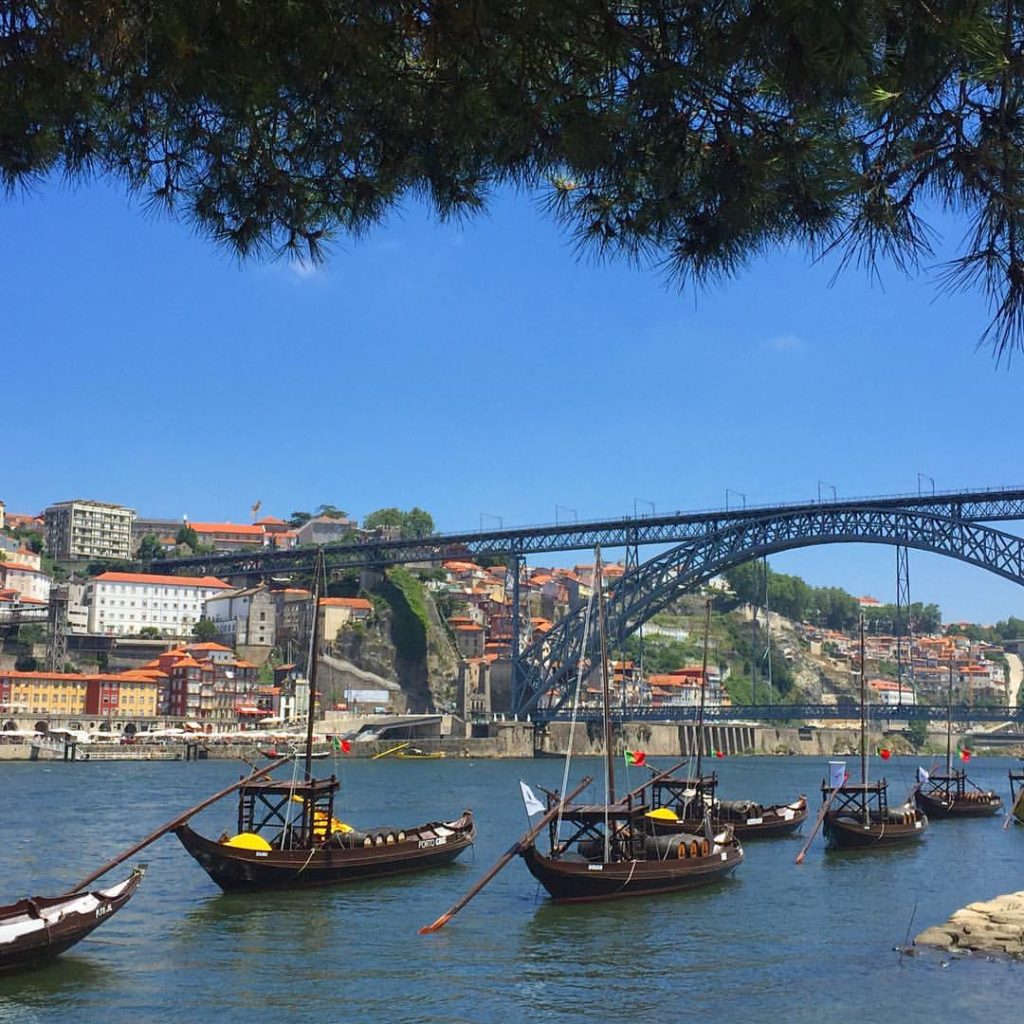
Arrive in Porto mid-to-late afternoon. Drop the bags and walk to the Ribeira — the riverside neighborhood along the Douro that is Porto’s postcard face. The view across to Vila Nova de Gaia, with the port wine lodges stacked up the hill, is exactly what it looks like in photos. It earns those photos.
Where to Stay in Porto
⭐ Top Pick · Boutique
Porto AS 1829 Hotel
Beautifully restored historic building in Porto’s old town. Boutique, well-located, staff welcome guests with complimentary port wine. Family suite available. Summer 2026: approximately $245/night.
Garden terrace with sweeping city views. Intimate and beautifully designed. Slightly further from the Ribeira but walking distance, and the terrace views justify it completely. Summer 2026: €220–320/night.
Livraria Lello, Port Wine, and the City That Earns Its Reputation
📍 Porto — UNESCO World Heritage City Centre
Porto is one of those cities that takes two days to start making sense. The first day you get used to the hills, the trams, the way the Douro smells at low tide. The second day it starts to feel like a place you understand. Give it both days.
The view from Vila Nova de Gaia across the Douro River to Porto’s Ribeira waterfront
📚
Livraria Lello — Morning (Book Entry in Advance) One of the most beautiful bookshops in the world, with the Harry Potter connection relevant for kids of a certain age. The Art Nouveau interior, the famous red staircase, the stained glass ceiling — genuinely spectacular. Buy your entry ticket online before you go; entry fees were introduced to manage crowds. Go early morning when it’s quietest.
🍷
Port Wine Cellars in Vila Nova de Gaia — Afternoon Cross the Dom Luís I Bridge on foot — the view from the upper level is one of the best in Porto — and walk down to the wine lodges. Graham’s, Sandeman, and Taylor’s all do well-run tours. Adults taste. Kids get the story of how port wine is made (it’s genuinely compelling when explained well) and grape juice. Allow 90 minutes.
🚋
Tram 1 to Foz do Douro — Late Afternoon The historic tram 1 runs from the Ribeira along the river mouth to Foz do Douro, where the Douro meets the Atlantic. Kids love the tram. The Foz neighborhood has a lighthouse, a beach, seafood restaurants, and a completely different feel from the old city. Have dinner here.
🥪
The Francesinha — Porto’s Proudest Dish Porto’s answer to the croque monsieur: a sandwich of cured meats layered inside bread, covered in melted cheese and drenched in a spicy tomato-beer sauce. It is enormous and specific to Porto. Café Santiago is the most famous spot. Order it at lunch so you have time to recover. Kids usually prefer the pastel de nata — more on that in Lisbon.
06
Day Six — Drive Day With Stops
Porto → Aveiro → Coimbra → Lisbon
📍 Aveiro · Coimbra (UNESCO) · Lisboa
Your longest movement day. Leave Porto by 8:30am. Aveiro is 45 minutes south. Coimbra is another hour from Aveiro. Lisbon is two hours from Coimbra. You’ll arrive late — which is fine, the first Lisbon night is for settling in.
Aveiro — Morning (2 Hours)
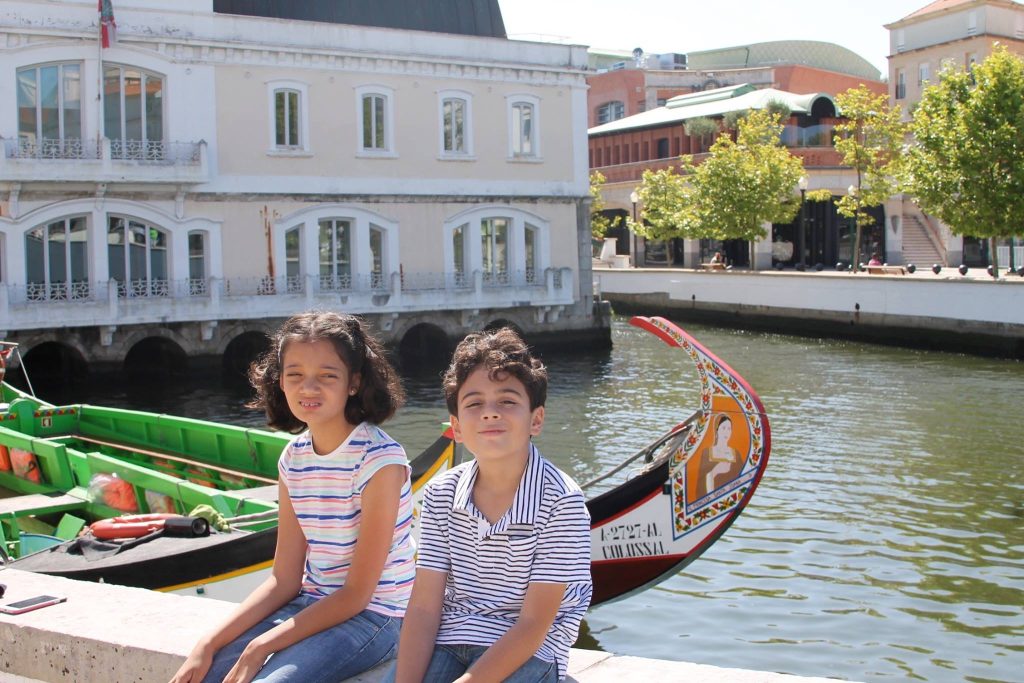
Aveiro is built around a lagoon system crossed by canals. The traditional boats — called moliceiros — are wooden, hand-painted with folk scenes, and once used to harvest seaweed from the lagoon floor. A 45-minute Moliceiro boat ride through the canals was one of the highlights of the entire trip for our kids. They were completely convinced they were in Venice. They weren’t wrong about the canals.
Our two kids at the Aveiro canal, ready for their moliceiro boat ride.
🥚 Try Before You Leave — Ovos Moles
Aveiro’s traditional sweet — soft egg yolk filling inside wafer shells shaped like seashells, fish, and barrels. Made here since the 16th century by the city’s convents. Buy them at any bakery near the main canal. Kids find the shapes fascinating before they eat them.
Coimbra — Afternoon (2 Hours)
Drive one hour south to Coimbra. The University of Coimbra is a UNESCO World Heritage site in its own right. The Baroque library (Biblioteca Joanina) is one of the most extraordinary rooms in Europe — 18th-century shelves stacked floor to ceiling with 30,000 books and a colony of bats that come out at night to eat the insects that would otherwise damage the manuscripts. Kids find this remarkable. See more on what to do with kids in Coimbra in my full Coimbra with kids guide.
Exploring the University of Coimbra with kids.
🧩 For Kids — Portugal dos Pequenitos
Just across the Santa Clara Bridge, Portugal dos Pequenitos is a miniature park opened in 1940 — scaled-down replicas of every significant Portuguese monument, built to child height so kids can walk through the doorways. Children get a passport to stamp at different stations as they explore. An hour here, and you’ve covered the whole country in miniature before you’ve driven through half of it. Admission: €10.50 adults, €6.50 children 3–13.
Drive two hours south to Lisbon. Arrive early evening, check in, walk to dinner. You’ve earned it.
07–08
Days Seven and Eight — Lisbon
Castles, Trams, the Oceanário, and Pastéis de Belém
📍 Lisboa, Portugal
Lisbon rewards walking. Not because it’s flat — it has seven hills and the trams exist for good reason — but because the best of it is in the details you only see on foot: the azulejo tiles on every surface, the miradouros (viewpoints) that appear without warning at the top of steep streets, the fado drifting through a restaurant door at lunch. Four nights here gives you room to do this properly.
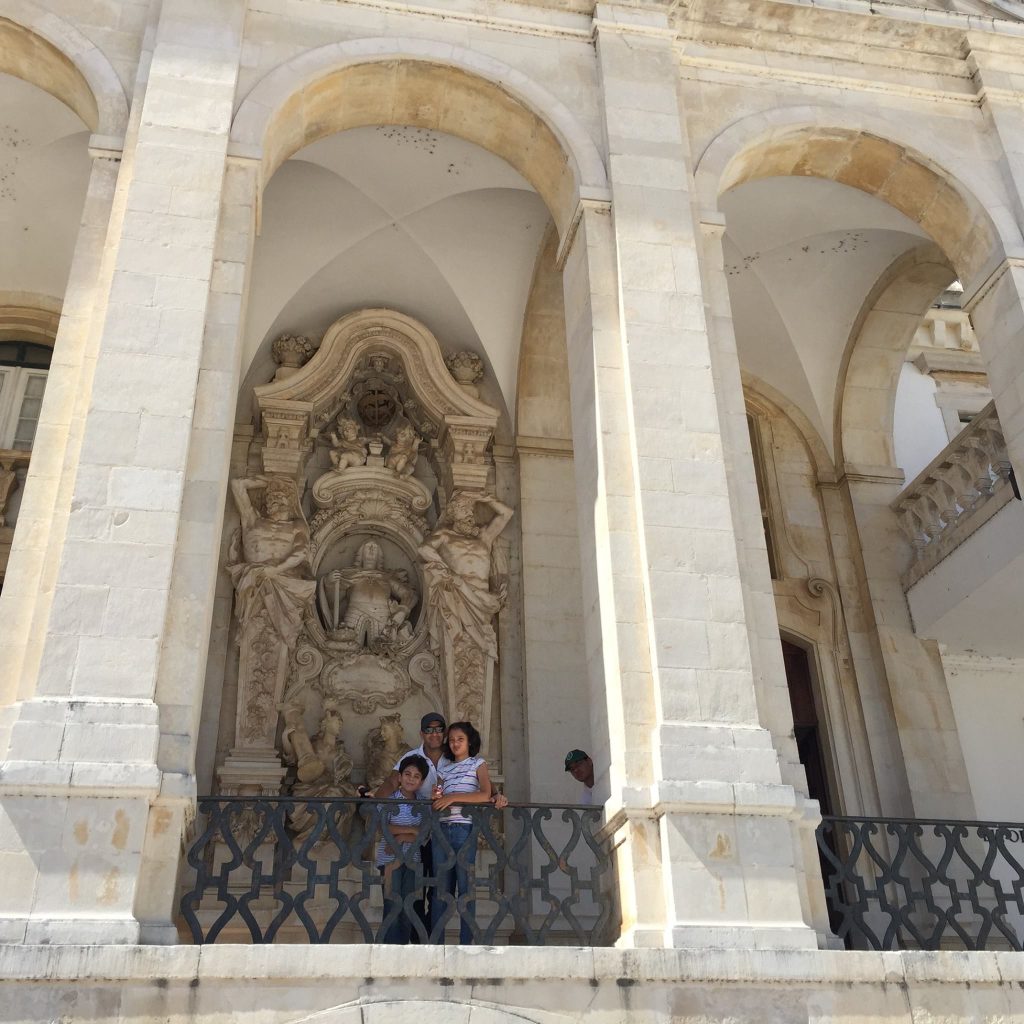
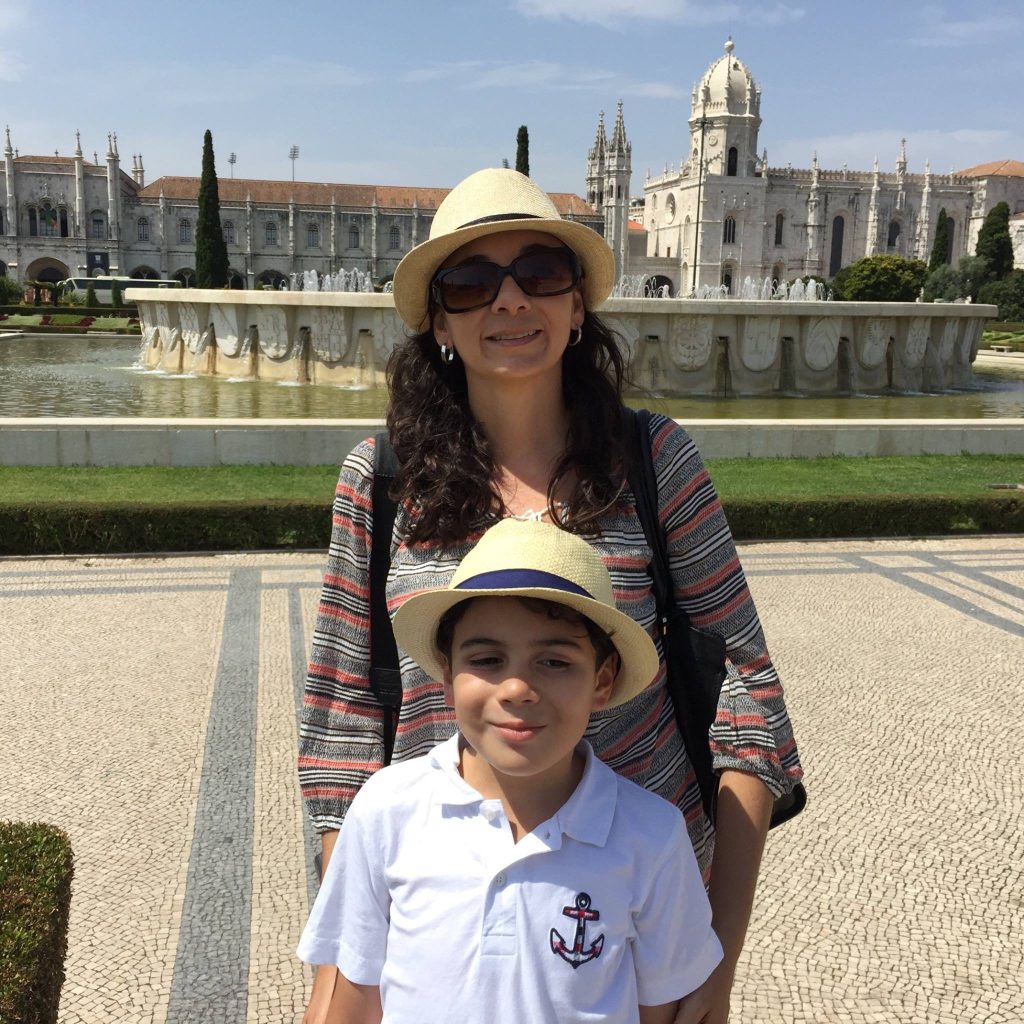
At the Mosteiro dos Jerónimos in Belém in Lisbon.
🚋
Tram 28 — Know What You’re Getting Into The iconic yellow tram through Alfama and Mouraria is one of the most pickpocketed routes in Lisbon. Keep bags in front of you, leave valuables at the hotel, and enjoy it for what it is — a genuinely lovely way to see the hills without climbing them. Walk up through Alfama, tram down.
🏰
Castelo de São Jorge — Morning The Moorish castle on Lisbon’s highest hill. Kids can walk the battlements, look through telescopes, and meet the resident peacocks and black swans. Views of the Tagus and the 25 de Abril bridge (which looks uncannily like the Golden Gate) are among the best in the city. Go early before tour groups arrive.
🐙
Oceanário de Lisboa — Best Kids Activity in Lisbon One of the best aquariums in Europe. The central ocean tank holds 5 million liters and you watch sharks, rays, sunfish, and thousands of other species from every level. Plan 2–3 hours. Kids who’ve been patient with cathedrals will be completely re-energized here.
⛪
Mosteiro dos Jerónimos + Belém — Day Two The Jerónimos Monastery is Manueline architecture at its peak — maritime motifs, armillary spheres, rope-like carvings woven into Gothic stone. UNESCO-listed, built to celebrate Vasco da Gama’s sea route to India, his tomb is inside. Book entry online. Queues can be long in peak season.
🥐
Pastéis de Belém — Non-Negotiable The Antiga Confeitaria de Belém has been making the original pastel de nata to a secret recipe since 1837. Get them warm, with cinnamon and powdered sugar, eaten standing at the counter. Your kids will request these every single day afterward. Let them.
Where to Stay in Lisbon
⭐ Views · Boutique · Alfama
Memmo Alfama
Boutique hotel inside the Alfama with rooftop pool and Tagus views. Design-forward, intimate, beautifully done. Note: adults-only. Summer 2026: $213–345/night depending on month. October near peak pricing.
On the waterfront near Cais do Sodré, well positioned for Belém and Alfama. River-view rooms available. Good for families who want central location. Summer 2026: €180–260/night.
On the waterfront near Cais do Sodré, well positioned for Belém and Alfama. River-view rooms available. Good for families who want central location. Summer 2026: €180–260/night.
Sintra — The Best Day Trip on This Road Trip for Kids
📍 Sintra — UNESCO World Heritage Cultural Landscape
Take the train from Rossio station — 40 minutes, no parking nightmare. Sintra is a UNESCO cultural landscape where Portuguese royals built their summer palaces in a cool forested ridge above Lisbon. For kids on a Spain and Portugal road trip, this is the day they’ll talk about longest.
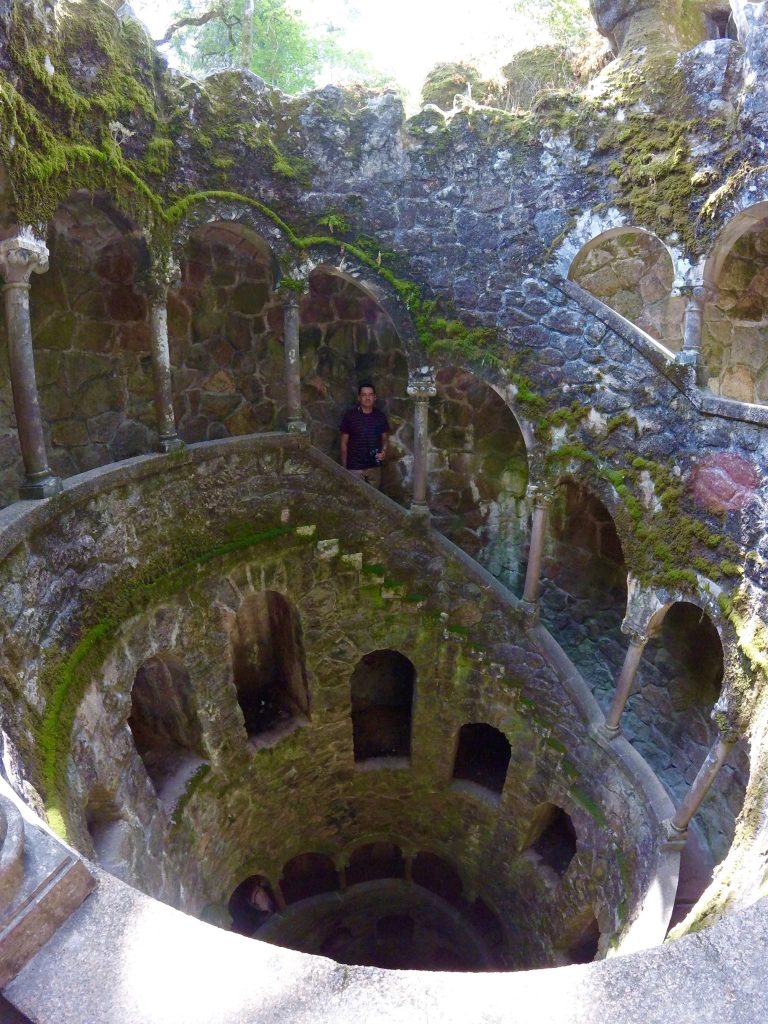
The Initiation Well (Poço Iniciático) at Quinta da Regaleira in Sintra
⚠️ Most Important Advice About Sintra With Kids
Go on a weekday. First train from Rossio, before 8am if possible. Book Pena Palace tickets online the night before. In July and August on a weekend, queues are two to three hours just to get in. On a Tuesday morning, you’ll have the palace almost to yourself for the first hour. This single decision determines whether Sintra is magical or miserable.
🏰
Palácio da Pena — The Whole Point Built for King Ferdinand II in the 1840s — bright yellow and red towers on a forested hilltop, frequently in the clouds. It looks like someone built a real fairy tale castle. For kids it is absolutely this. Drawbridge, ramparts to walk, forest paths. Allow 2–3 hours. Our kids talked about it for the rest of the trip.
🏰
Castelo dos Mouros — For Kids Who Like to Climb Moorish castle ruins 10 minutes’ walk from Pena through the forest. Walk the battlements, look down at the trees below. For 8-to-12-year-olds with energy, a natural sequel to Pena. Atlantic views on clear days.
🥐
Travesseiros at Piriquita — Don’t Skip Puff pastry pillows filled with almond cream, specific to Sintra. Skip the village restaurants entirely — tourist priced and nothing special. Do stop at Piriquita for these. Then take the train back to Lisbon for dinner.
10
Day Ten — Drive Day
Lisbon → Évora — The UNESCO City We Almost Missed
📍 Évora — UNESCO World Heritage City · Alentejo, Portugal
Drive 1.5 hours southeast into the Alentejo. The landscape changes dramatically: cork oaks, olive groves, low golden hills. We drove straight past Évora on our original trip because we hadn’t built in the time. It is one of the things I’d change. This 14-day Spain and Portugal itinerary has a night here — which is why the 14-day version is better than the 12-day rush job we actually did.
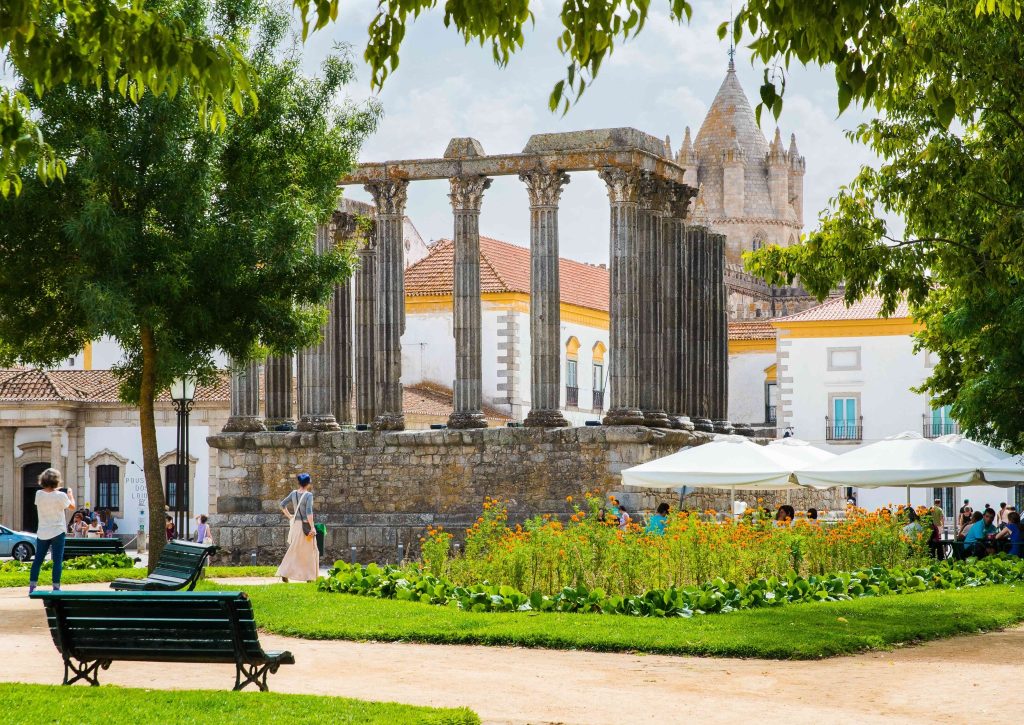
The 2nd-century Roman Temple of Évora standing in the heart of one of Portugal’s most beautiful and undervisited medieval cities, with Évora Cathedral rising behind it.
🏛
Templo Romano — 2nd Century, Center of the City 14 Corinthian columns still upright after 2,000 years. Saved from demolition because it was incorporated into the medieval town wall and used as a slaughterhouse for centuries. Extraordinarily well-preserved.
💀
Capela dos Ossos — A Family Conversation First The Chapel of Bones inside the Igreja de São Francisco: walls and columns covered in the bones and skulls of approximately 5,000 Franciscan monks. Above the entrance: “We bones here await yours.” At 8-10 years old, kids vary widely. Some find it fascinating; others find it disturbing. It was built as a meditation on mortality, not as shock. You know your children. Go in with context prepared.
🍷
Alentejo Dinner — Best Food Region in Portugal The Alentejo produces Portugal’s finest olive oil, celebrated wines (Herdade do Esporão, Herdade dos Grous), and a cuisine built around pork, bread, and the açorda — bread soup with garlic, eggs, and coriander that sounds humble and tastes remarkable. Ask your hotel for a genuinely local recommendation.
Where to Stay in Évora
⭐ Luxury · Historic Palace
M’AR De AR Aqueduto
Converted historic palace beside Évora’s Roman aqueduct. Pool, spa, garden. Excellent for families who want space. Summer 2026: €200–300/night.
Stylish and comfortable within walking distance of the historic center, but a little quieter than staying right in the middle of the crowds. The rooftop terrace and pool are especially beautiful at sunset. Summer 2026: €90–125/night.
Leave Évora this morning and drive east toward the Spanish border. One hour from Évora, right on the border, is Elvas — the second UNESCO city we drove past without stopping. This time, stop.
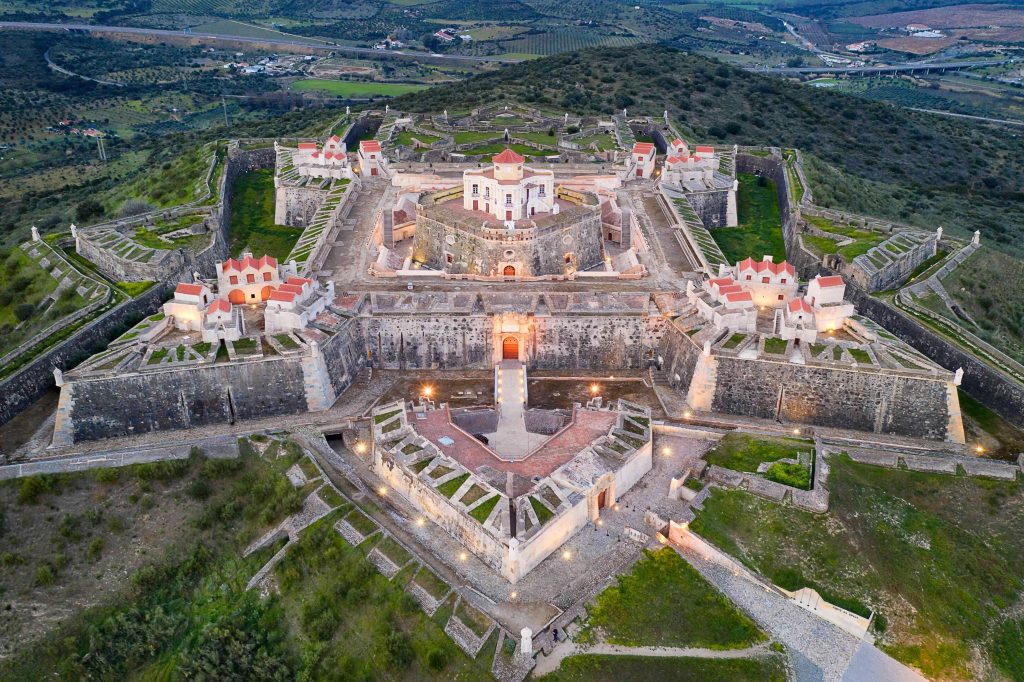
Aerial view of the star-shaped fortifications of Elvas at dusk.
🏰 Elvas — 2 Hours, Worth Every Minute
UNESCO since 2012 for having the largest dry-moat fortification system in the world. Walk the star-shaped bastions and moat — a 2-kilometer circuit that gives you the full scale of the military engineering. The Amoreira Aqueduct — 843 arches, built between 1498 and 1622 — runs along the approach road. For kids: climb the castle keep and look out across the plain toward Spain. Two hours maximum. Completely worth it for something almost nobody on this route stops for.
Cross into Spain at Badajoz. Drive one hour to Mérida — Augusta Emerita, capital of the Roman province of Lusitania, and arguably the best-preserved Roman city in Spain.
Where to Stay in Mérida
⭐ The Only Choice · Parador
Parador de Mérida
Converted 18th-century convent built on Roman foundations, steps from the amphitheater. Pool, excellent restaurant. The Paradores preserve Spain’s historic buildings as hotels — this is one of their best. Summer 2026: €130–200/night.
Well-rated, central, beautiful design and lots of character and more affordable than the Parador without sacrificing a good location for the Roman sites. Summer 2026: €90–140/night.
Mérida was the capital of Roman Lusitania — one of the most important cities in the Empire at its peak. Most travelers give it half a day. Give it a full day and you will be in the minority of visitors who actually understand what they’re looking at.
⚔️
Roman Amphitheater + Theater — Morning The amphitheater seated 15,000 and hosted gladiatorial combat. The theater has 64 columns still standing and still hosts performances in summer. Shared entry, allow 90 minutes minimum. For kids who know anything about gladiators, this is the most tangible history lesson of the whole trip.
🏛
National Museum of Roman Art Designed by Rafael Moneo and built over the actual Roman road. The mosaic collection alone justifies an hour. Kids who came from the amphitheater will have context for everything here.
🌉
Puente Romano — Walk It 792 meters long, dates from the 1st century BC, still essentially intact. Walk the full length. The view back toward the city with the Alcazaba on the bank is one of the best in Mérida.
🎭
Roman Circus — Often Overlooked One of the largest in the entire Empire — 400 meters long, 30,000 spectators. Most of it is under the modern city but the interpretive museum gives you the full scale. Kids who know what chariot racing is will be very into this.
13
Day Thirteen
Mérida → Cáceres — The Medieval City That Looks Like Game of Thrones
📍 Cáceres, Extremadura — UNESCO World Heritage
45 minutes north of Mérida, Cáceres is one of the most intact medieval cities in Europe. The old town — the Ciudad Monumental — has barely changed since the 15th century. Cáceres was used as a filming location for Game of Thrones seasons 7 and 8, standing in for King’s Landing. The streets that made it convincing are the streets you walk today. If your kids know the show, mention this before you arrive.
🏰
The Ciudad Monumental — Walk It All Noble towers, cobblestone plazas, Renaissance palaces — no power lines visible anywhere in the historic core. Francisco Pizarro was born nearby; his equestrian statue is in Plaza de Santa María. The old town is compact enough to cover entirely on foot in 2–3 hours.
🦅
White Storks — Spring Visitors In spring and early summer, white storks nest on virtually every tower and rooftop in Cáceres. The old town at dusk with storks silhouetted against the sky on every tower is one of those images that stays with you. Kids spot them immediately — they’re enormous.
🍽
Extremadura Lunch — Jamón Ibérico de Bellota Extremadura produces the finest jamón ibérico de bellota in Spain. Order a board with local cheese, Torta del Casar (a raw sheep’s milk cheese that liquefies inside its rind), and a glass of local wine. One of the great simple lunches in Spain.
Where to Stay in Cáceres
⭐ Historic · Inside the Old Town
NH Palacio de Oquendo
16th-century palace converted into a hotel, on the main plaza of the old town. Waking up inside the UNESCO zone with towers outside the window is worth the price. Summer 2026: €140–210/night.
The drive from Cáceres to Madrid is about 4 hours on the A-5 east. One optional stop on the way home.
🏰 Optional Stop — Trujillo (1 Hour from Cáceres)
Birthplace of Francisco Pizarro (mentioned in Cáceres) and Hernán Cortés. A compact hilltop town with a preserved castle, a Renaissance plaza dominated by Pizarro’s equestrian statue, and almost no tourists. One hour stop on the way home. Worth it if the kids still have curiosity left.
Arrive in Madrid by early afternoon. Return the car. The loop is complete. What you do next is your own.
What to Eat
The Dishes You Cannot Miss on This Spain and Portugal Road Trip
Two countries means two very different food cultures. Both reward curiosity, and both have dishes your kids will remember long after they’ve forgotten the museums.
Churros con Chocolate — Madrid
At San Ginés since 1894. Fried fresh, dipped in thick hot chocolate. Go for afternoon snack. Everyone finishes them.
Hornazo — Salamanca
Pork loin, chorizo, and hard-boiled eggs baked inside dense bread dough. Salamanca’s signature. Buy it warm from any bakery.
Francesinha — Porto
Porto’s towering meat sandwich in melted cheese drenched in spicy tomato-beer sauce. Enormous, specific to Porto, non-negotiable. Order at lunch.
Ovos Moles — Aveiro
Egg yolk sweets in wafer shells shaped like seashells and fish. Made since the 16th century. Kids love the shapes before they eat them.
Pastel de Nata — Lisbon
The original, from Antiga Confeitaria de Belém (1837). Warm, with cinnamon and powdered sugar. Your kids will request these every remaining day of the trip.
Açorda — Évora / Alentejo
Bread soup with garlic, olive oil, coriander, eggs, and bacalhau. Humble-sounding, remarkable in practice. The Alentejo version is the reference point for Portuguese comfort food.
Jamón Ibérico de Bellota — Extremadura
The finest jamón in Spain comes from Extremadura. Order a board in Cáceres or Mérida with Torta del Casar cheese. You’ll understand immediately what the fuss is about.
Travesseiros — Sintra
Puff pastry filled with almond cream, only at Piriquita in Sintra. Skip the restaurants in the village. Do not skip these.
When to Go
The Best Time for This Spain and Portugal Road Trip — Honestly
The honest answer depends which part of the route you’re asking about. This itinerary covers three different climate zones — the Castilian meseta, the Atlantic coast of Portugal, and the scorching interior of Extremadura — and they don’t all peak at the same time.
✅ Best Window — May and September–October
Weather: 18–27°C throughout the route. Comfortable for walking, mild in Extremadura, warm in Lisbon and Porto, occasional rain in Portugal only in October. Sintra is pleasantly cool. Wildflowers in spring, golden light in fall.
Crowds: Manageable at all sites. Sintra queues are tolerable if you go early. Mérida and Cáceres have almost no tourists compared to peak summer.
Prices: 25–40% less than July–August across all hotel categories. Best value on this entire itinerary. A family spending €2,800 in July might spend €1,900 in May for identical hotels.
⚠️ High Season — July–August
Weather: Madrid 33–38°C, Porto and Lisbon 28–35°C and packed, Extremadura 40–45°C. Mérida and Cáceres in August are genuinely punishing. If you’re doing this route in July or August, plan Extremadura for early morning only and keep afternoons at the hotel pool.
Crowds: Maximum everywhere. Sintra weekends are brutal. Book everything months in advance.
Prices: Peak across the board. Hotels as cited in the budget section. Domestic Spanish tourists also travel in August, making Extremadura’s smaller towns unexpectedly busy.
🔥 Avoid for Extremadura — June and August
Mérida and Cáceres regularly reach 42–45°C in July and August. This is not uncomfortable — it’s dangerous for kids and elderly travelers spending hours outdoors at Roman sites. If you must travel in summer, do Extremadura in the last week of June or first week of September when temperatures drop to a more manageable 35°C. Semana Santa (Holy Week before Easter) is spectacular in both cities but prices spike and accommodation books out months ahead.
💰 Budget Season — January–February
Weather: Madrid 5–12°C (cold, wear layers), Porto and Lisbon 12–16°C and occasionally rainy, Extremadura mild 10–15°C and perfectly walkable. Sintra is atmospheric and usually deserted.
Crowds: Minimal everywhere. You’ll have Mérida’s Roman sites largely to yourself.
Prices: 40–55% less than summer peak. Hotels that cost €250 in August often drop to €130–140. Excludes Christmas week and New Year, when prices briefly spike again.
Seasonality Quick Reference — Spain and Portugal
January–February
Cheapest prices, quietest crowds. Cold in Madrid, mild in Lisbon. Best if budget is priority.
April–June
Sweet spot. Excellent weather everywhere, manageable crowds, 25–35% below peak pricing. Best for families.
July–August
Peak pricing, maximum crowds, extreme heat in Extremadura. Book everything months ahead. Not recommended for Mérida/Cáceres in August.
September–October
Second-best window. Excellent weather. Note: Lisbon and Porto hotel pricing stays near-peak in October — budget accordingly.
November–December
Quiet, affordable (except Christmas week). Rain in Porto. Good for Madrid and Lisbon city breaks.
Practical Information
What You Need to Know Before You Leave
🚗
Renting a Car
This is a loop — pick up and return in Madrid, no one-way fee. Declare Portugal travel at the desk. Some companies (Enterprise has been reported not charging) include it; others charge €50-150. Budget companies sometimes prohibit cross-border entirely. Book a major brand. Get a family-sized SUV. Full CDW insurance is worth it. Portugal requires child booster seats (8–12 years) at approximately €6.76/day per seat — compulsory, charged locally.
🛣
Portugal Tolls
Portugal’s highways use an all-electronic toll system with no cash booths. Arrange a Via Verde transponder with the rental company at pickup — usually a small daily fee — or charges get added later at a premium. Spain still has traditional toll booths payable by card. Budget €80–120 total for Portugal tolls and €40–60 for Spain on this route.
💵
Money
Both countries use the euro. Cards accepted virtually everywhere. Carry cash for small purchases, market stalls, and tipping. Contactless payment is standard. Tipping culture is lighter than the US — 5–10% in restaurants is appreciated but not always expected.
👨👩👧👦
Traveling With Kids
Both Spain and Portugal are genuinely family-friendly cultures. Kids are welcome in restaurants at any hour. Locals engage with children warmly — it’s not performative. Best age for this specific route: 7 and up, given the amount of walking and historical content. Read my full guide on traveling to Spain with children for more detail.
🌍
Language
Spanish in Spain, Portuguese in Portugal. Spanish speakers will find Portuguese partially comprehensible in writing, harder spoken. English is widely spoken at all hotels, tourist sites, and city restaurants on this route. A few words of each language makes a real difference — locals notice and remember it.
🎒
What to Pack
Comfortable walking shoes — cobblestones at every stop. Light jacket for Sintra year-round. Sun protection and a hat for Extremadura if traveling May–September. Packable daypack for city days. Portable charger for kids on long drives. Download offline maps before you leave — Portugal’s rural roads are occasionally outside mobile coverage.
Before leaving for Spain and Portugal, make sure you have a reliable way to stay connected. While public Wi-Fi is widely available, having mobile data makes it much easier to navigate unfamiliar cities, access tickets, check hotel reservations, and use translation apps. I recommend purchasing an eSIM Europe plan before your trip so you have coverage as soon as you land and can travel seamlessly between both countries.
Budget Breakdown
What This Spain and Portugal Itinerary Actually Costs in 2026
All prices below reflect summer 2026 (June–August) — the most expensive window for this route. Prices vary significantly by season: traveling in May or October reduces the hotel budget by 25–40%. January–February reduces it by 40–55%. Food costs change little with season; car rental drops 15–25% in shoulder season.
These are honest 2026 rates based on actual booking data, not aggregator minimums.
Accommodation
€180–320
per room / night (summer)
Lisbon and Porto at the higher end. Évora, Cáceres, and Mérida more affordable. Memmo Alfama reached $345/night in October 2026. Porto AS 1829 approximately $245 in May.
Food & Drink
€85–115
per person / day
Breakfast at a café €8–15, lunch €18–30, dinner €30–50. Street food and market meals €5–12 and often the best option. Portugal is notably cheaper than Spain for equivalent quality.
Car + Transport
$800–950
total / 14 days with insurance
Family SUV with full CDW insurance. Add fuel (~€340-380 total), tolls (~€120-180), and cross-border fee (€0–150 depending on company).
Total Estimated Cost — Family of 4 · Summer 2026 · 14 Days
€11,000 – €16,000
excluding international flights · 2 rooms · mid-range boutique hotels
Per person: approximately €2,750 – €4,000 | Shoulder season (May or October): reduce by 25–35%
💡 Best value move: Travel in May. Hotels are 25–35% cheaper than July–August, Extremadura weather is perfect, Sintra is manageable, and you’re ahead of the main summer crowds. A family spending €14,000 in July can do the identical trip for approximately €9,500–11,000 in May. That gap pays for the flights.
Frequently Asked Questions
Spain and Portugal Road Trip — Common Questions
How many days do you need to visit Spain and Portugal?
For this specific loop covering Madrid, Salamanca, Porto, Lisbon, Sintra, Évora, Mérida, and Cáceres, 14 days is the realistic minimum to do it properly. You can compress it to 10–12 days but you’ll feel rushed at every stop and end up skipping things you’ll regret. Our original trip was meant to be 7 days — it turned out to be closer to 12, and we still drove straight past two UNESCO cities without stopping. The 14-day version exists specifically to avoid that problem.
Should you combine Spain and Portugal in one trip?
Yes — if you’re making the transatlantic trip, combining both countries in one road trip makes real logistical and financial sense. Both share excellent road connections, no border controls (both are in the Schengen area), and the contrast between Spanish and Portuguese culture, food, and architecture genuinely enriches both experiences. Most people who visit only one wish afterward they’d done both. The route in this itinerary is specifically designed as a circular loop from Madrid, so there’s no backtracking or awkward one-way car rental involved.
What’s the best month to visit Spain and Portugal?
For this specific itinerary — which includes Extremadura — May is the best single month. Weather is excellent throughout the entire route (18–26°C), Mérida and Cáceres haven’t hit their brutal summer heat yet, Sintra is manageable on a weekday, and hotel prices are 25–35% below peak summer. September is the second-best option: similar temperatures, fewer crowds than August, and the Alentejo is beautiful in early fall. Avoid July and August for Mérida and Cáceres specifically — temperatures regularly exceed 42°C and outdoor sites become difficult for kids. For Spain broadly: April–June and September–October. For Portugal’s cities (Lisbon, Porto): June through October all see elevated prices, with October remaining near-peak.
Can you do Spain and Portugal in one week?
Technically yes — a highlights version covering Madrid, Lisbon, and Porto can be done in 7 days. But on a route like this one, which includes UNESCO sites that take time to absorb and requires real driving between cities, one week means moving almost every single day and cutting each stop to a fraction of what it deserves. We thought we did our original version in 7 days. When we counted the nights honestly, it was closer to 12 — and we still rushed. If your time is genuinely limited to a week, the honest recommendation is to pick one country and do it properly rather than skimming two.
A lot of the families I hear from after publishing routes like this one come back with the same question: not “should we go back?” but “what would it actually take to live there?” Portugal keeps doing that to people – especially to multicultural families who notice how easy it is to feel at home. If that thought has crossed your mind after a few days in Lisbon or Porto, having help from an independent buyers agent in Portugal is worth a look before it becomes a serious one.
I did this Spain and Portugal road trip with two kids who thought they were in Venice in Aveiro and found a real fairy tale in Sintra. Now my dad is doing the same route. Some trips earn a second look — and a third.
Paula Bendfeldt-Díaz is a Guatemalan travel writer, photographer, and founder of Growing Up Bilingual. After spending more than 15 years in the United States, she now lives in Guatemala and shares detailed travel guides, traditional Guatemalan recipes, and cultural insights based on a lifetime of firsthand experience.
Through her writing, Paula helps travelers discover Guatemala beyond the typical tourist route with practical advice, local recommendations, and authentic experiences that connect visitors with the country’s people, culture, and traditions.
Planning a trip to Guatemala? Paula offers personalized Guatemala itinerary planning and trip consultation services tailored to your interests, travel style, and budget. Contact her at [email protected] to learn more.