
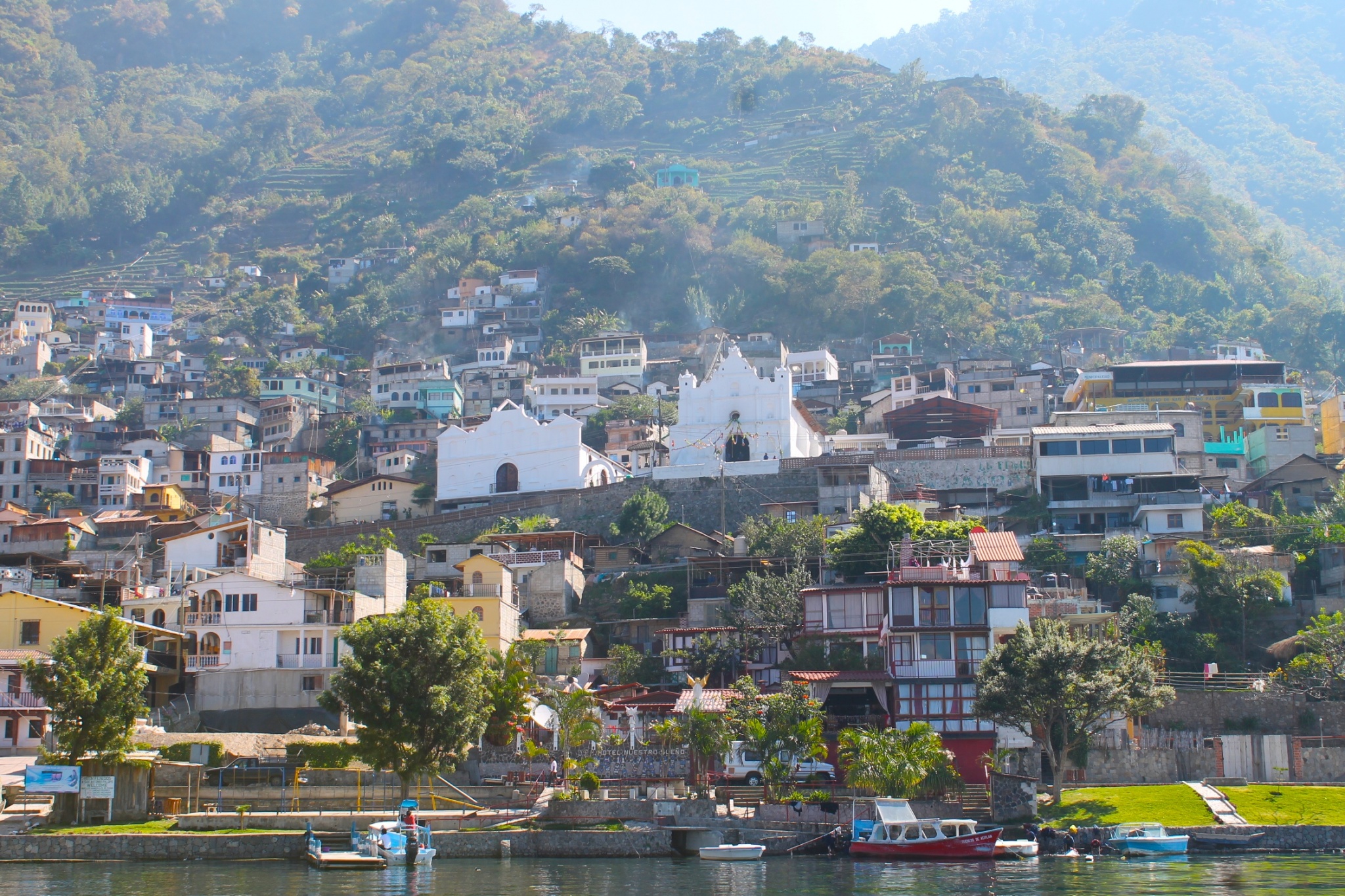
If you’re looking for an authentic experience and something unique to do in Lake Atitlan visiting the small town of San Antonio Palopó is a great option. Perched on the mountainside of in Guatemala, San Antonio Palopó is a small town that has remained relatively unspoiled. Unlike Panajachel, you will not find many tourists in San Antonio! There are few hotels or restaurants, and the town’s life centers around its ceramics and textiles. With a picturesque church acting as the focal point, San Antonio Palopo is a beautiful place you must see on your next visit to Lake Atitlan.
If you want to experience a quieter and more local side of Lake Atitlán, visiting San Antonio Palopó is one of the best things you can do. Perched above the lake on the eastern shore, this Kaqchikel Maya village has remained far less touristy than places like Panajachel or San Pedro. Life here still revolves around weaving, ceramics, farming, and community traditions that have existed for generations.
A Village That Still Feels Personal
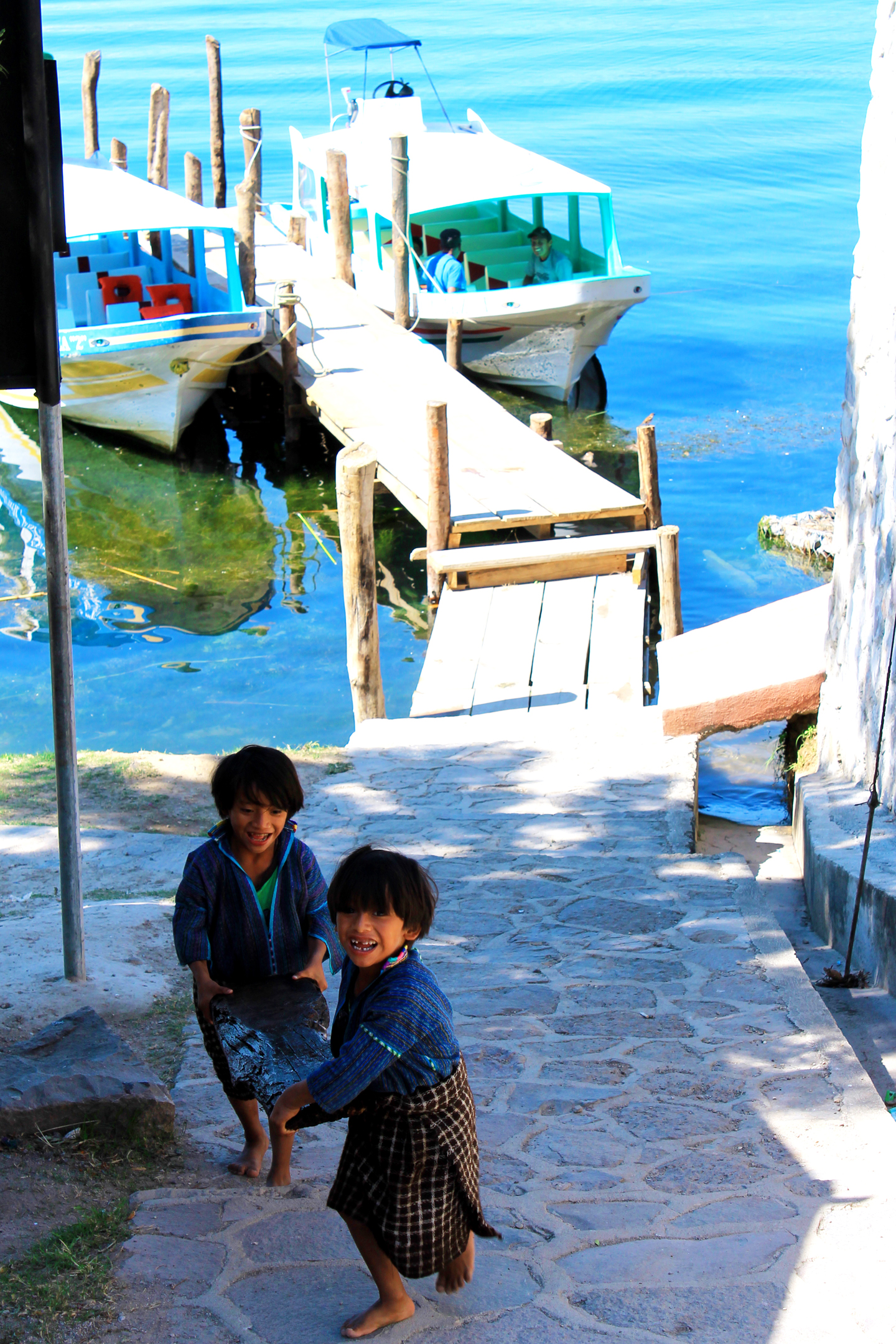
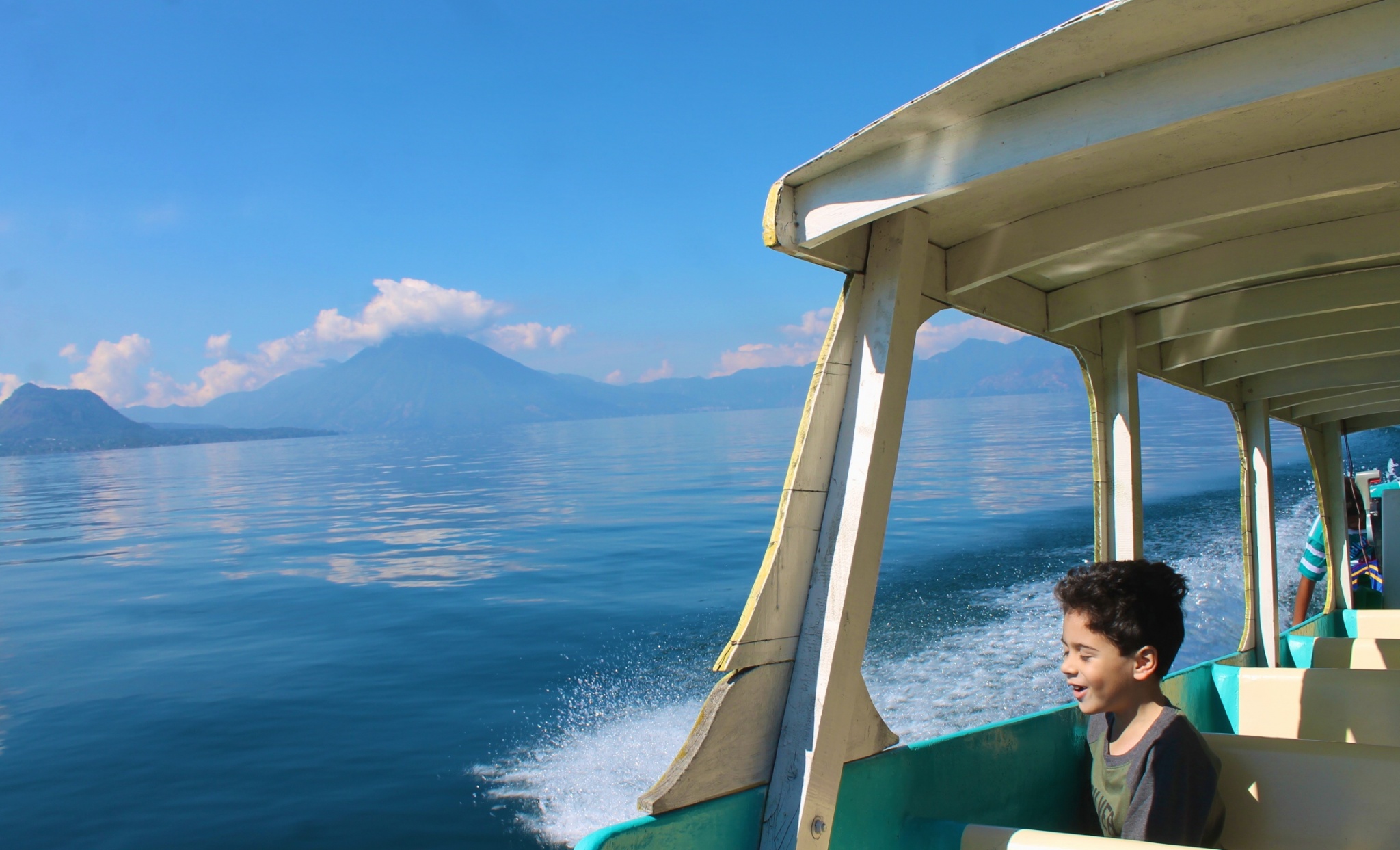
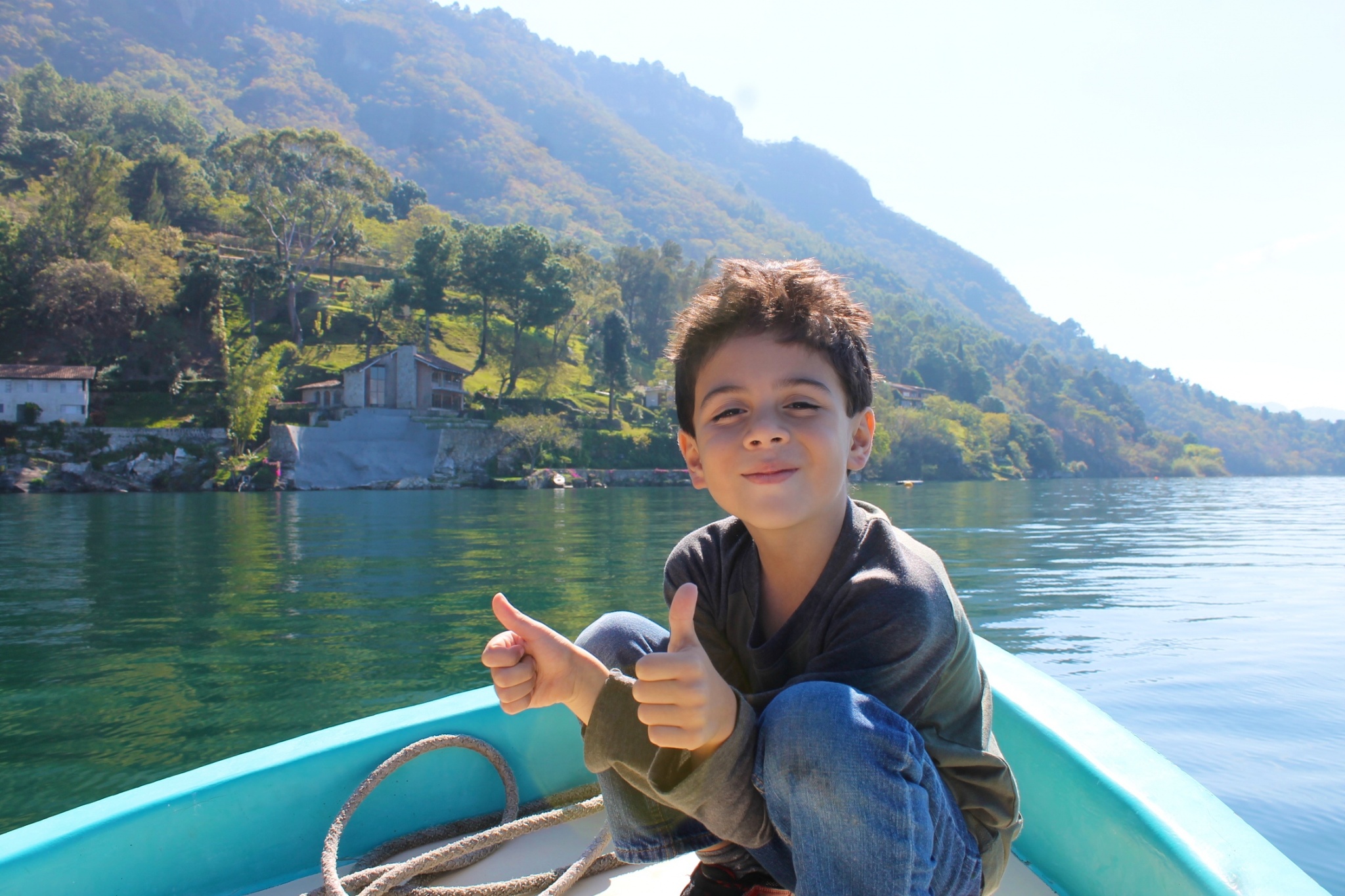
My kids loved the boat ride, thanks to the beautiful views of the lake. They also got along really well with Jorge and another boy who rode along. I loved to see them interact with the local children! I was impressed with Jorge, who knew a lot of English and spoke Spanish (besides his native Maya Kaqchikel . He even taught the kids some Kaqchikel words.
Many Mayan boys and men in Guatemala no longer wear these traditional outfits. So I was thrilled to see that in San Antonio, most men and women still wear their beautiful blue-hued traditional garments.
GETTING THERE
How to Get to San Antonio Palopó from Panajachel
San Antonio Palopó is about seven kilometers from Panajachel on the eastern shore road. The easiest options:
Tuk-tuk from Panajachel — easiest and cheapest
Tuk-tuks depart from near the main dock in Panajachel and make the run to San Antonio regularly throughout the morning. The ride takes about 20-25 minutes and costs approximately Q15-30 per person. You can also hire a tuk-tuk privately for around Q50-80 for the whole vehicle, which gives you flexibility on timing. Agree on the price before you get in.
Rental car — best for combining the whole eastern shore
If you want to combine San Antonio with Santa Catarina Palopó and San Lucas Tolimán in one day, a rental car is significantly more flexible than waiting for tuk-tuks. The eastern shore road is paved, straightforward, and easy to drive. My Guatemala car rental guide covers what you need to know before booking.
From the western shore villages — lancha to Panajachel first
If you’re based in San Pedro, San Marcos, or San Juan, take the public lancha to Panajachel (Q25-30 per person) and then a tuk-tuk from there. There is no direct boat service from the western shore to San Antonio. My complete Lake Atitlán boat services guide has all the current routes, schedules, and prices.
The eastern shore road connects Panajachel, Santa Catarina Palopó, San Antonio Palopó, and San Lucas Tolimán on a single straight route, a car makes it easy to combine all of them in a day. You can also stop at the painted murals in Santa Catarina without rushing the timing around tuk-tuk availability.

This Is My Country
Let Me Help You Plan Your Visit to the Eastern Shore
The eastern shore — San Antonio, Santa Catarina, San Lucas Tolimán, Santiago Atitlán — is the part of the lake most itineraries miss. I help people plan visits that actually cover it, with the workshops, the local restaurants, and the accommodation choices that make sense for who you are. Get in touch.
Activities and attractions
Best Things To Do in San Antonio Palopó
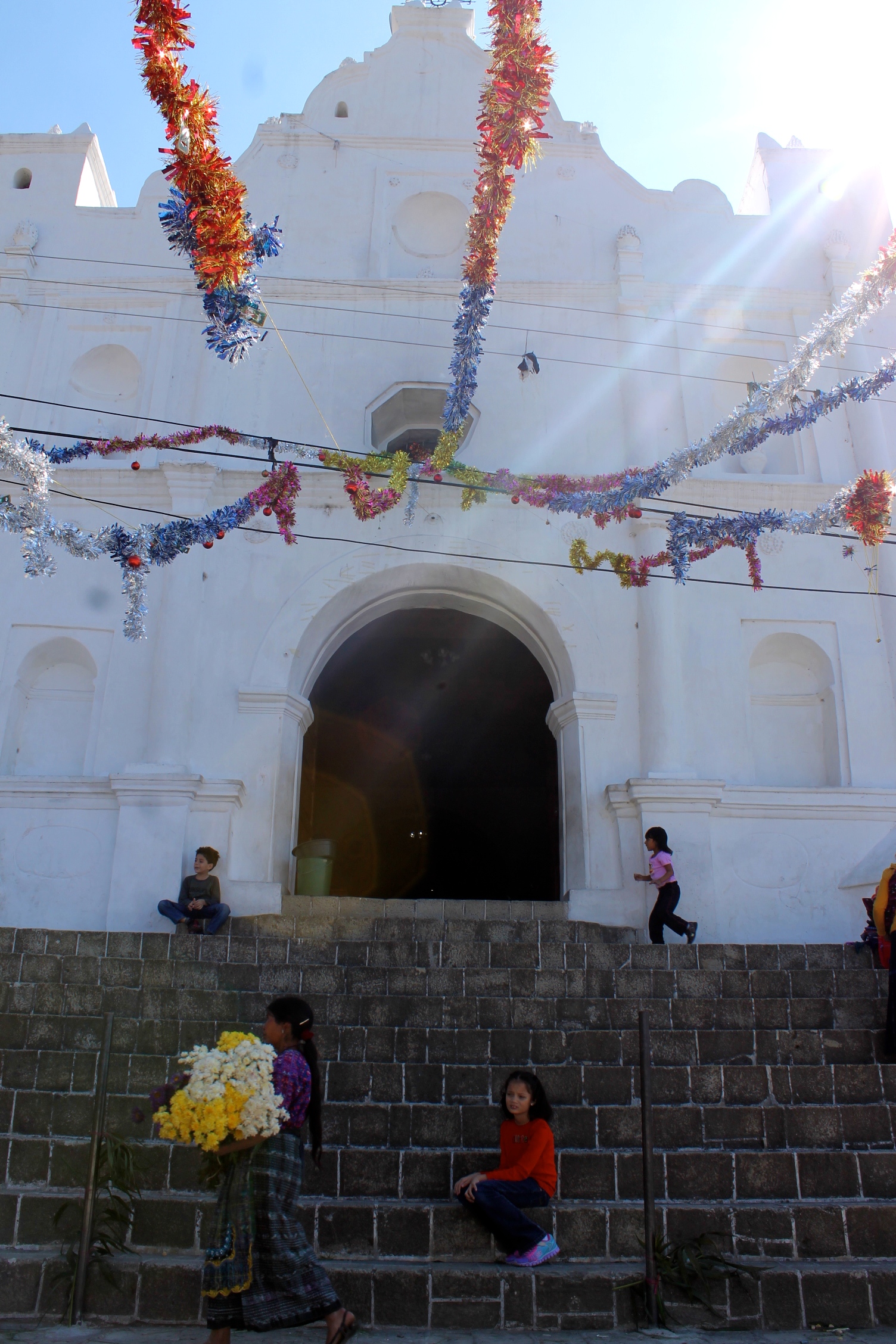
We started by walking up to the church overlooking the village. The path was steep, and there were lots of steps! But you can ride a tuk-tuk from the dock to avoid the steep climb.
The church dates back to the colonial era and was originally established by Franciscan missionaries. Inside, it feels simple but full of character, with red-tiled floors, carved religious statues, an intricate wooden pulpit, and a statue of San Antonio de Padua, the town’s patron saint. One of my favorite things is the beautiful view of the lake and the volcanoes from the top of the church steps.
Backstrap Loom and Treadle Loom Weaving — Something You Won’t See on the Other Side of the Lake
It was a weekend, and people gathered around the church selling food, flowers or just chatting. Then, a Mayan woman approached us and invited us to her house. She wanted to show us how she weaved the beautiful blue scarves she was selling. In addition, she offered to take us to the pottery workshop.
We followed the steep and dusty path to her home, a humble cottage made of adobe. She showed us how she prepared the threads for weaving on a backstrap loom using a wooden warp board.
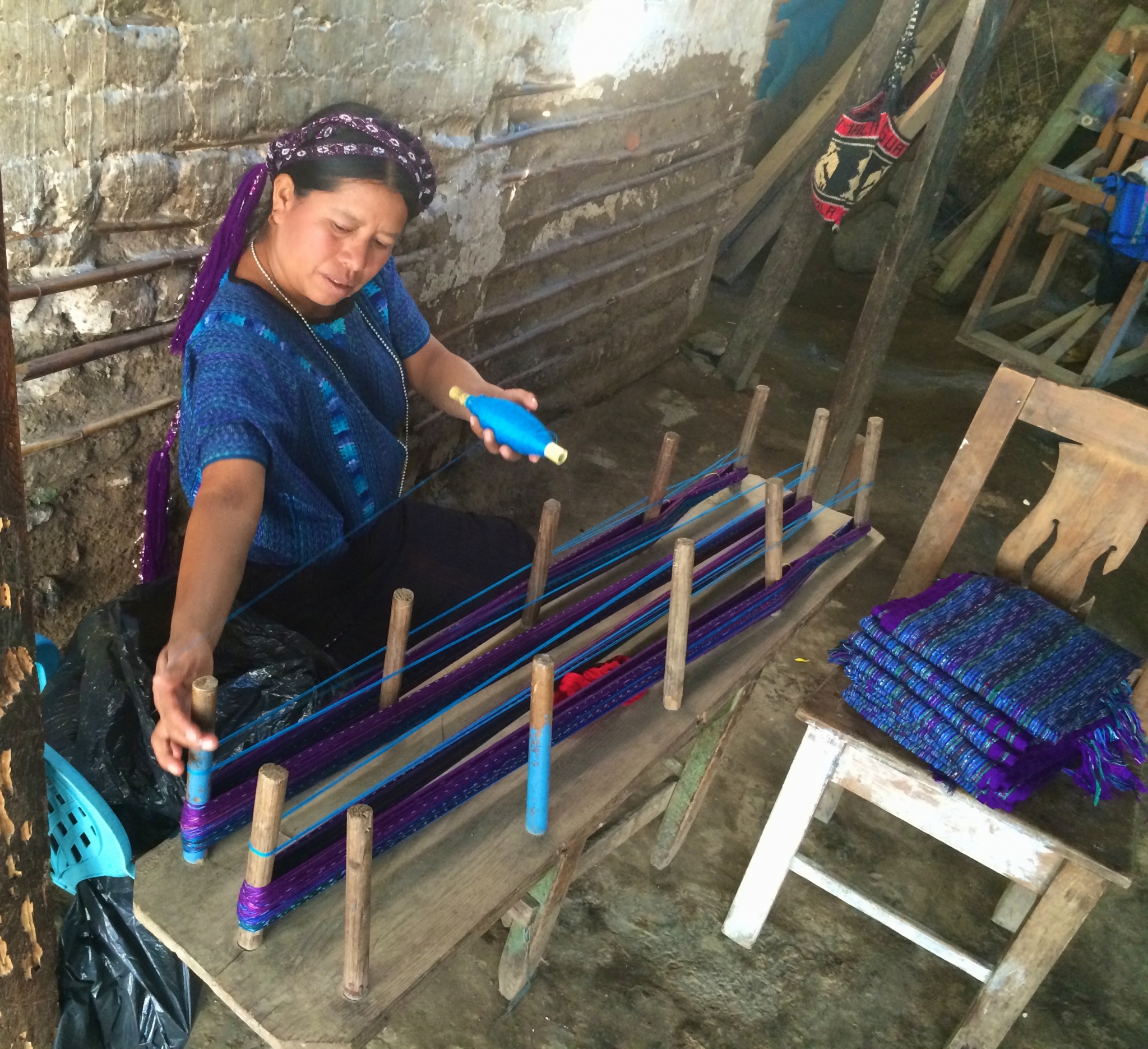
While you will find backstrap loom weaving across the lake, San Antonio Palopó developed a tradition of treadle loom weaving that makes this village distinct from almost everywhere else at the lake. The treadle loom was introduced during the colonial period and originally used to produce more structured fabrics for men’s garments. Over generations, the community adapted the technique into the beautiful textiles you see in the workshops and markets today. Watching a treadle loom in motion is a completely different experience from watching a woman weave on a backstrap loom in San Juan or Santiago — the whole body is involved, the rhythm is different, and the structure of the fabric it produces has a weight and precision that backstrap weaving does not. You can feel the history in every movement of the loom.
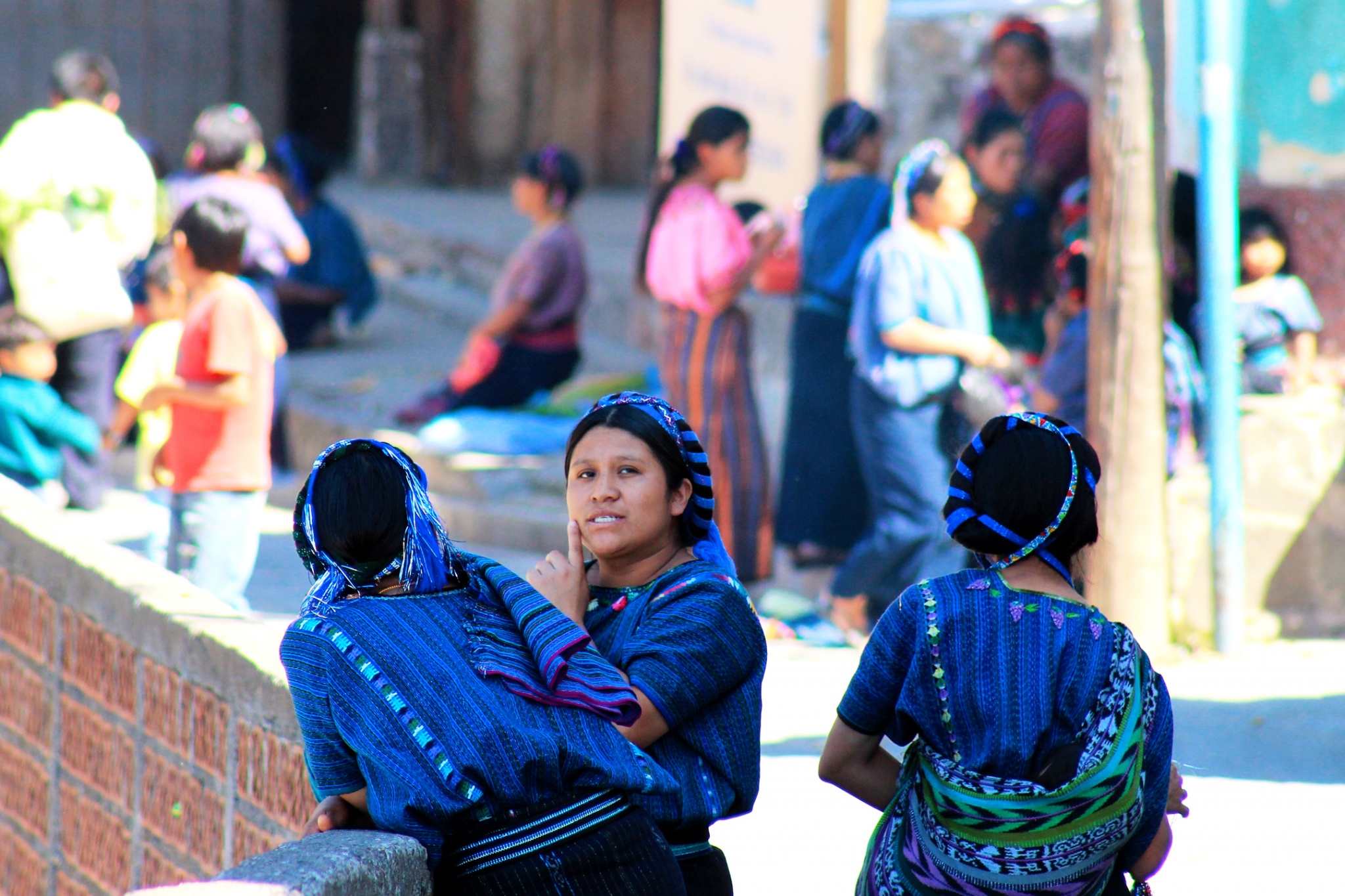
San Antonio is a Kaqchikel Maya community and most people in village still speak Kaqchikel as their first language, while younger generations move between Kaqchikel and Spanish. That linguistic tradition is part of the same living cultural identity you see in the textiles and ceramics. The patterns and techniques are not performed for tourism. They are how this community has made things for hundreds of years.
✨ BUY DIRECTLY FROM THE WEAVERS
When you buy directly from the family workshop — not from a middleman in Panajachel or Antigua — the money stays with the people who made the piece. That matters in a village like this, and the weavers and potters genuinely appreciate knowing their work went to someone who came to see how it’s made.
She then took us through packed dirt paths and arrived at the pottery workshop. Clay mugs, plates, and figurines were laid on the patio to dry. Even my kids were interested in discovering how the beautiful pottery from San Antonio Palopó is made. We watched men painting the pottery by hand and also saw the ovens where all the ceramic pieces were baked.
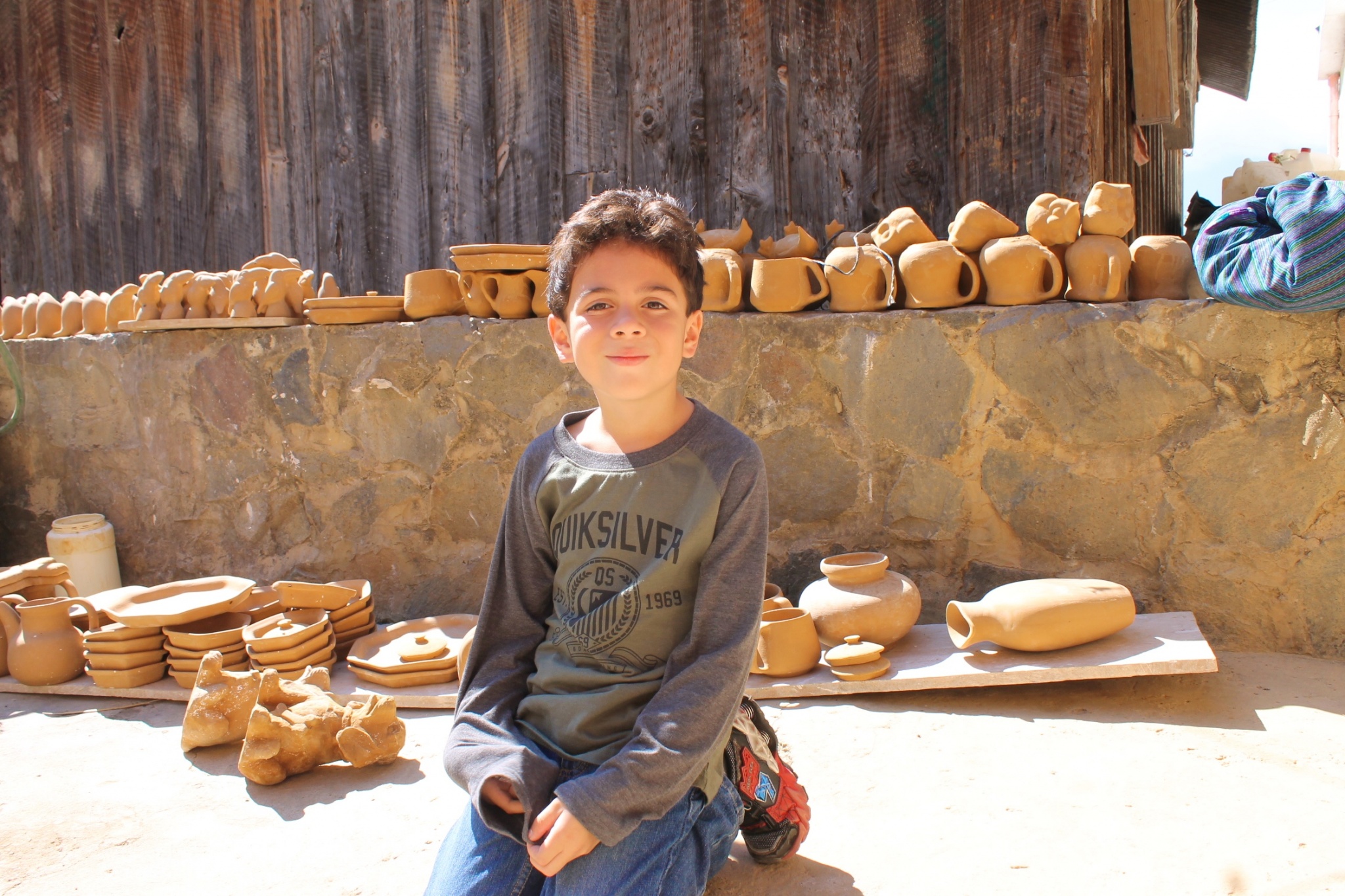
Origin and History of the San Antonio Palopó Pottery
In the highlands of Guatemala, years of volcanic eruptions and geology created exposed channels of clay in the rivers. This clay is of outstanding quality and perfect for making high-quality ceramics. Hundreds of years ago, the ancient Mayas made use of this clay. Starting in the Red Pottery period (AD 1200), Mayans used ceramics for practical purposes, in religious ceremonies, burials, and as a means of telling stories.
Nowadays, the unique pottery at San Antonio Palopó has evolved from ancient Mayan pottery to more modern techniques. One of the greatest influences came from the renowned American potter Ken Edwards. His search for good-quality clay brought him to San Antonio in the 90s.
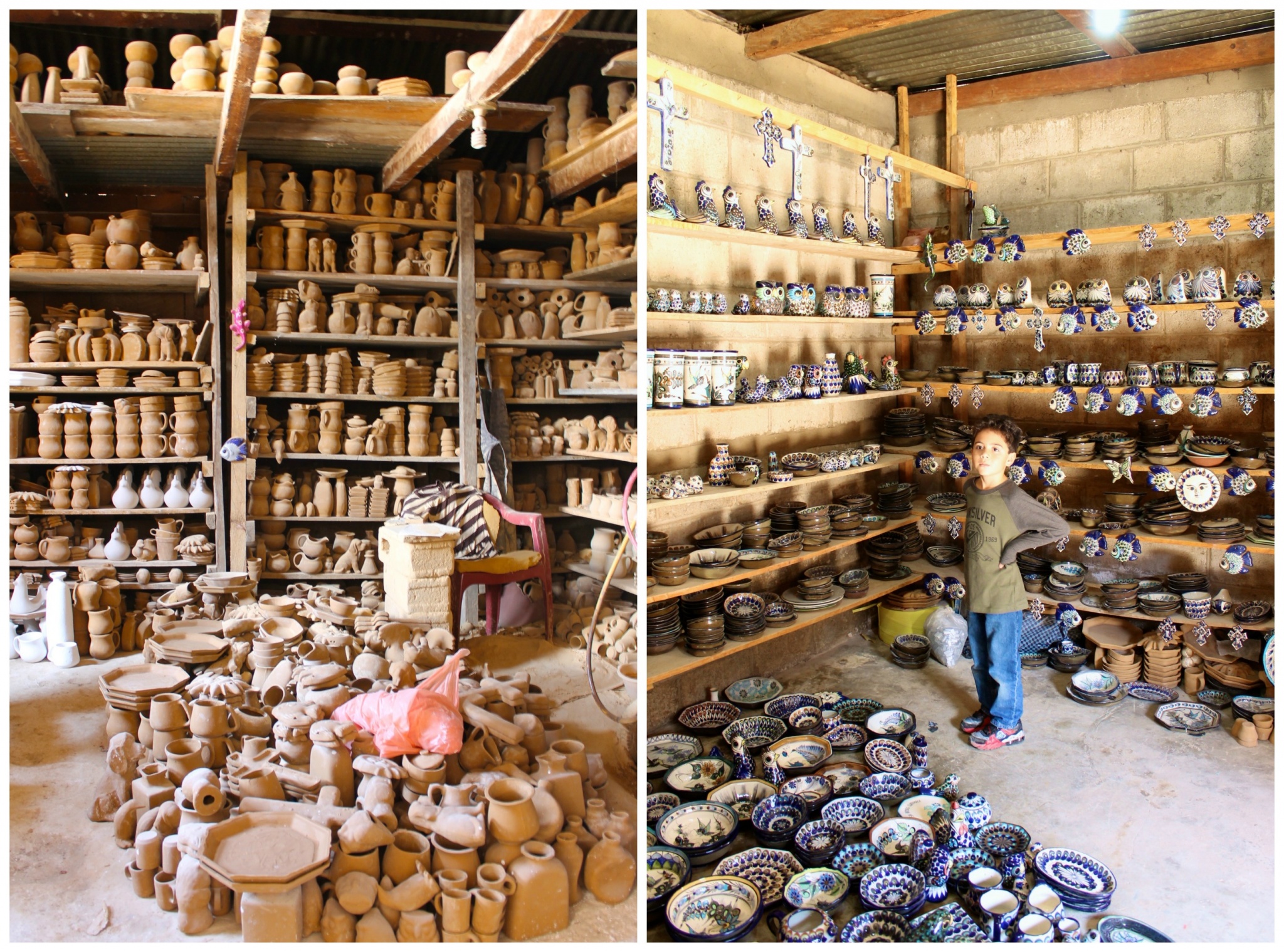
Entranced by the beauty of Atitlán, Edwards stayed for many years and set up a workshop. And when he left, his apprentices continued making pottery using the same techniques. Among them is the use of molds to create pottery more consistently and efficiently. Ken Edwards also introduced modern high firing techniques that burn the lead out of the glazes. Thus, the San Antonio pottery is lead-free and microwave safe. All of the pottery is hand-painted, and no two pieces are alike.
THE POTTERY WORKSHOPS
Where to See the Pottery Being Made
The pottery tradition in San Antonio blends pre-Hispanic ceramic techniques with Spanish influences — families passing down shapes, glazes, and firing methods through generations. The clay itself comes from the volcanic riverbeds around the lake; this high-quality material is what has made San Antonio’s ceramics distinctive since the Red Pottery period around AD 1200. The pieces you buy here were likely made by the same family for several generations in a row, in the same workshop, with the same volcanic clay.
Two workshops are consistently recommended and easy to find:
Ceramica Mayan (MayanKe) is on Calle del Lago in Barrio Chuacruz. They offer atelier experiences where you can work with clay from start to finish or just paint a pre-molded piece. Pottery class prices are typically Q50-55 per person. You can call ahead at +502-5515-5207 or find them on Instagram as Ceramica Mayan.
Ceramica Multicolor is up the hill from the docks and known for hands-on painting classes and letting visitors watch the traditional glazing and firing process. The many smaller family workshops along the lower lakeside roads are also worth walking into — the pieces are the same quality as the better-known workshops and your money goes directly to the maker.
You can also book the Santa Catarina and San Antonio Maya Tour from Panajachel — a half-day guided visit that combines both villages and includes stops at weaving and pottery workshops with a guide who can explain what you’re seeing. Good option if you want the context without navigating it yourself on a first visit.
DON’T MISS THIS
The Mirador and the Sleeping Elephant
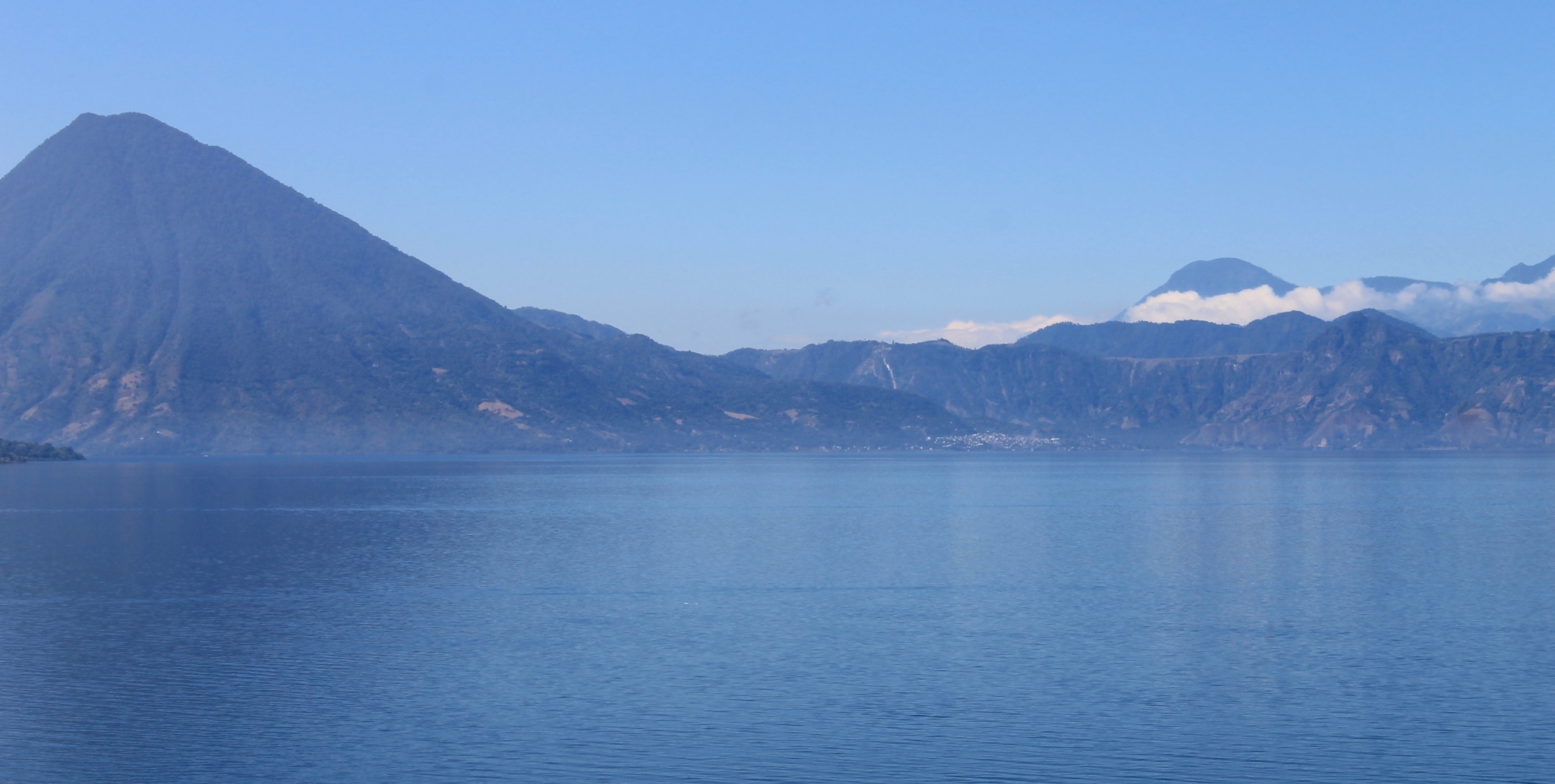
San Antonio Palopó has a mirador — a lookout point inaugurated in recent years — that most visitors completely miss because it’s not on the main pottery workshop circuit. From the mirador you get an unobstructed view of the lake and, directly across the water, Cerro de Oro. Local people call it “El Elefante Dormido” — the Sleeping Elephant — and once you see the profile of the hill from this angle it’s obvious why. The view from the mirador shows you the eastern shore of the lake from a perspective most visitors never see because they arrive by road from Panajachel and leave the same way. Ask locally for directions — it’s a short walk from the center of the village and worth every step.
💡 Tip: Go to the mirador before the pottery workshops, not after. The morning light on the lake and volcanoes is at its best before 10 AM, and by the time you come back down the workshops are fully open for the day.
IF YOU WANT MORE
Cascadas Palopó — The Waterfall Above the Onion Fields
Above San Antonio Palopó, the land rises steeply in terraced onion fields that Kaqchikel farming families have worked for generations. A 30-45 minute walk up through those fields brings you to Cascadas Palopó, a waterfall tucked into the ravine above the village. The climb is easy to moderate — it’s steep in sections but there’s nothing technical about it — and the views back down to the lake and the three volcanoes as you go up are worth the effort even before you reach the water.
What makes this hike different from the waterfall walks on the western shore is the agricultural context. You’re walking through active farmland, past families tending their crops, with the same lake view that these communities have lived with for centuries. Ask locally in the village for the current path to the waterfalls — the route varies slightly by season and there are no signs. No entrance fee. Wear shoes with grip and bring water.
📌 COMBINE IT WITH THE POTTERY MORNING
Mirador first thing in the morning. Pottery workshops and weaving mid-morning. Cascadas Palopó after lunch if you have energy and good shoes. Empanadas at Terrazas del Lago before you head back. That is a full and genuinely good day in San Antonio Palopó.
IF YOU’RE THERE IN JUNE
The Feria de San Antonio de Padua — June 13
Every June 13 the village celebrates its patron saint, San Antonio de Padua, with one of the most genuinely local festivals on the eastern shore of the lake. Processions, marimba music, traditional dances, and food fill the streets in the days around the 13th. If you’re traveling through the lake area in mid-June, this is the kind of festival that most tourists never see because it doesn’t appear in the standard itinerary — it happens in a village most people only know as a pottery day trip. Planning a trip around it is worth considering.
IF YOU’RE There during Holy Week
Semana Santa in San Antonio la Laguna
Semana Santa in San Antonio Palopó feels very different from Antigua Guatemala. Instead of massive crowds and elaborate processions designed around tourism, Holy Week here feels intimate, local, and deeply connected to the community itself.
During the week leading up to Easter, the streets around the church fill with the smell of incense and pine needles, while families decorate small alfombras and gather for processions that move slowly through the village. The lake and volcanoes create an incredible backdrop for the celebrations, especially in the early morning and evening light.
What I love most about Semana Santa here is that it still feels like a religious and community tradition first, not a spectacle. Visitors are welcome, but you feel like you are witnessing something that belongs to the village rather than something performed for tourists. If Antigua feels overwhelming during Holy Week, San Antonio Palopó offers a much quieter and more personal way to experience Semana Santa in Guatemala.
Why This Visit Stayed With Me
After I bought a beautiful piece of pottery and a scarf from the Mayan woman who gave us the little tour, we had to get going. So we hurried back down the dirt paths and the steps to the main dock. Jorge and the lancha captain were already waiting for us.

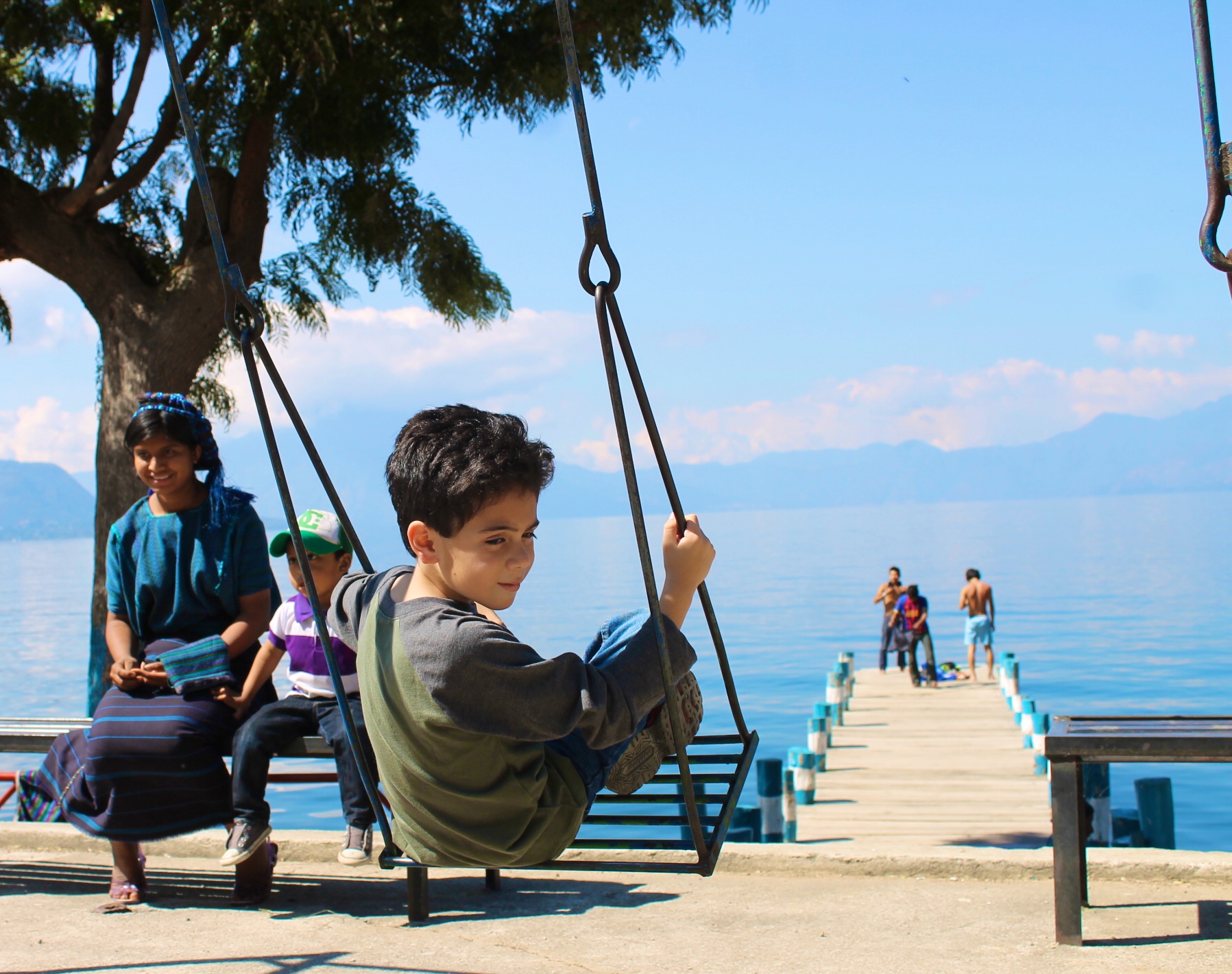
Next to the dock on the edge of the lake is a small playground where local boys have fun. My kids ran straight for the swings; I would have too if one had been available. I could only imagine the amazing feeling of swinging up into the sky while looking at the beautiful lake! It is my favorite picture of my son from our trip to Guatemala. I tried to convince him to swing looking at me to take the picture, but he refused. And I do not blame him! It was truly a magical moment.
The Boat Ride Back Across The Lake
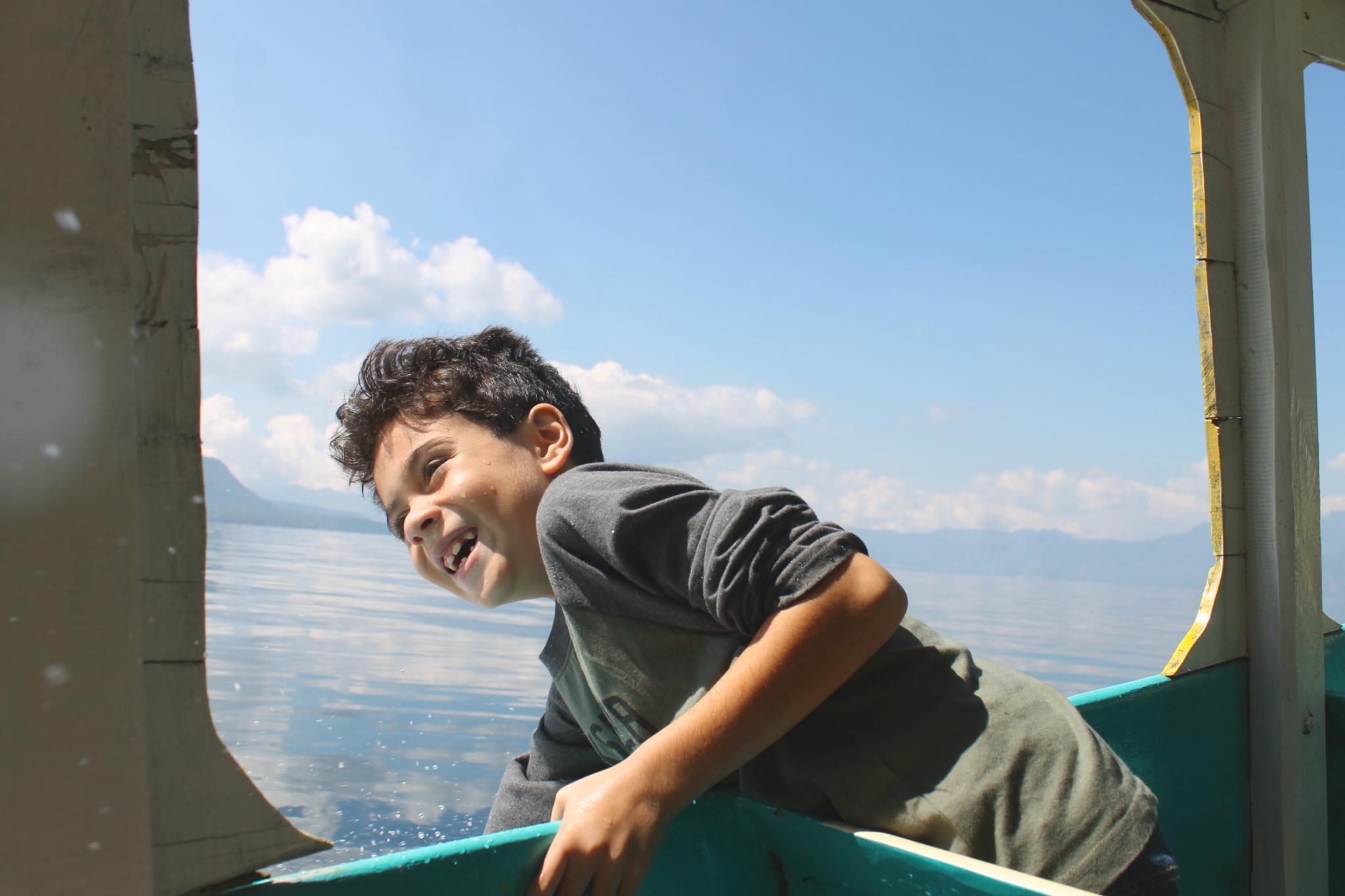
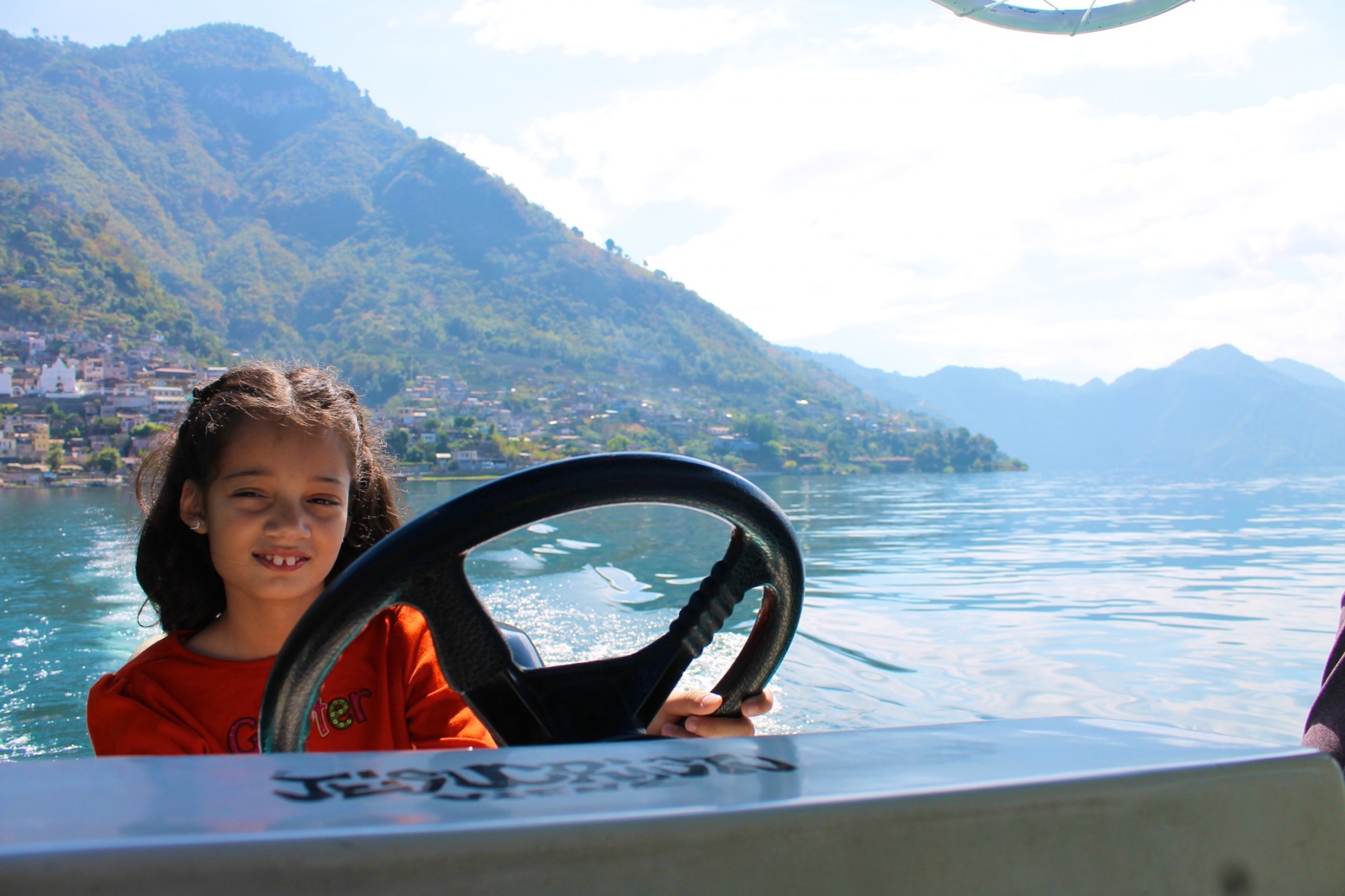
On our way back, my kids got the opportunity to drive the lancha for short periods, and they were ecstatic. The sun was shining bright, and the water looked covered in silver. In the distance, fishermen doted the lake on their wooden canoes with the volcanoes looming behind them.
The tranquility of the lake and its magic had taken full effect over us by now. We were all smiling and feeling like there was nothing in the world but this moment! Our family, the lake, the sound of the lancha as it crossed the blue waters, and the kids’ laughter. We spent three weeks in Guatemala, and this was definitely one of my favorite moments.
A Small Moment I Still Remember
We bid the boy and the boat captain goodbye at the dock in Santa Catarina Palopó. But then Jorge decided to tag along as we bought some gifts to take home and some toys for the kids. He had seemingly taken an interest in my 9-year-old daughter. He chatted with her, half in English and half in Spanish, complimenting her and teaching her words in Kackchiquel.
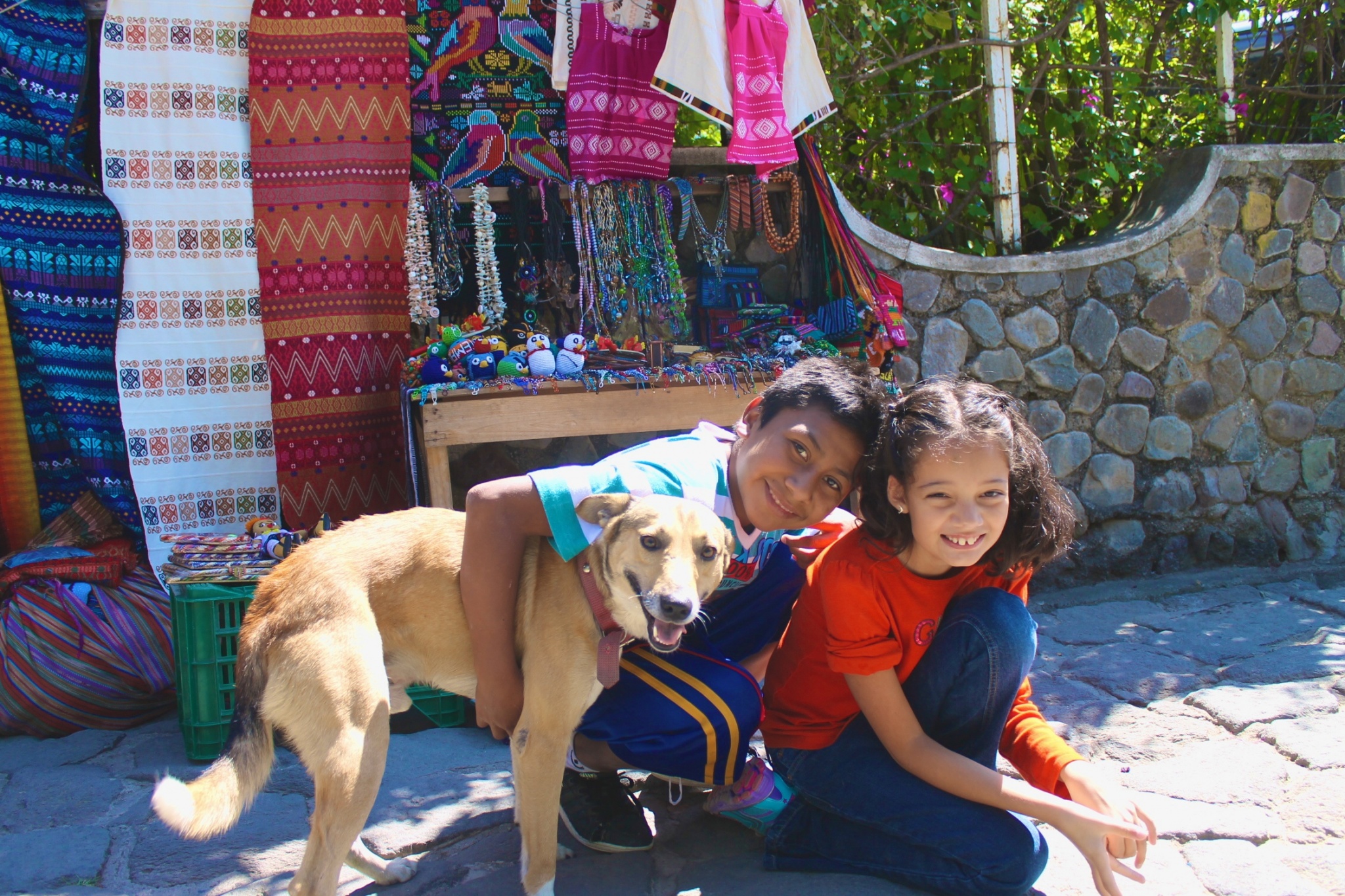
For my daughter, who struggles with social interactions, getting all this attention from Jorge was special. Surprising, she said: “Mommy Jorge is still here; he really likes me.” And when my daughter asked me to take a picture of her with a friendly local pooch, Jorge jumped at the opportunity! He even helped us haggle as we shopped. At some point, my husband and I joked that he seemed to want us to take him home with us.
ACCOMMODATION
Where to Stay in San Antonio Palopó
Most people don’t think of San Antonio as a place to spend the night, and that’s exactly why they should. This is one of the few villages at Lake Atitlán where an overnight stay genuinely changes your experience — the morning light, the quiet before the day-trip lanchas start running, the chance to be in the village when it’s just going about its day. The accommodation options are small and local, which fits the village completely.
IN SAN ANTONIO PALOPÓ
|
⭐ MOST FAMOUS — LEGENDARY EMPANADAS Hotel Terrazas del Lago The best-known hotel in town, right on the lakeshore, with a restaurant that serves the homemade empanadas that every visitor to San Antonio talks about. Family-owned, warm, and exactly the kind of local hotel you hope to find in a village like this. The owners have been welcoming guests the same way for years. Book via Booking.com — no Expedia link available. |
⭐ ECO HOTEL AND SPA — LAKE VIEWS Atitlán Oasis Eco Hotel and Spa Kaalpul An eco hotel and spa between San Antonio and San Lucas Tolimán with lake views, spa services, and the kind of quiet that’s genuinely hard to find at the lake. A strong option for travelers who want a serene, relaxed base on the eastern shore with more amenities than the small village guesthouses. |
|
⭐ LAKEFRONT — BETWEEN SAN ANTONIO AND SAN LUCAS Lakeview on the Rocks A lakefront property between San Antonio and San Lucas Tolimán — name says exactly what you get: lake views from a rocky shoreline. Good for travelers who want direct water access and the quiet of the eastern shore without being in the center of the village. |
⭐ BOUTIQUE — LAKESIDE Pink House on the Lake A small, distinctive lakeside property with the kind of character that comes with a name like “Pink House on the Lake.” Good for couples or solo travelers who want something intimate and different from a standard hotel. Located between San Antonio and San Lucas Tolimán on the eastern shore road. |
IN SANTA CATARINA PALOPÓ — 15 MINUTES BY TUK-TUK
If you want a more established base with better hotel infrastructure, Santa Catarina Palopó is fifteen minutes by tuk-tuk along the same eastern shore road — close enough to use San Antonio as a day trip destination while sleeping somewhere with a pool and a proper restaurant.
|
⭐ BEST NEARBY — SANTA CATARINA PALOPÓ Villa Santa Catarina Pool with lake views, comfortable rooms, and a location inside the most beautifully painted village at the lake. Fifteen minutes from San Antonio by tuk-tuk. My full review is on the site. Good for families and couples wanting a proper hotel base on the eastern shore. Check out my full review for Villa Santa Catarina here. |
⭐ BOUTIQUE LAKESIDE — SANTA CATARINA PALOPÓ Villas Balam’Yá A lakeside boutique property with direct lake access and some of the most beautiful room views on the eastern shore. My full review is on the site. A strong option for couples who want a quieter, more intimate experience than the hotels in Panajachel. Check out my full review for Villas de Balam’Ya here. |
IN Panajachel — 20 minutes but boat or 30 minutes by car
If you want a more established base with better hotel infrastructure, Santa Catarina Palopó is fifteen minutes by tuk-tuk along the same eastern shore road — close enough to use San Antonio as a day trip destination while sleeping somewhere with a pool and a proper restaurant.
|
⭐ BEST overall — panajachel Hotel Atitlán Wonderful lake views, gorgous gardens and an excellent restaurant. I love that this hotel is not in town but 5 min away from Panajachel in Tuk-tuk making it a peaceful place to stay at where you can really enjoy the lake’s views and the lake’s peaceful magic. |
⭐ great for families and in town — panajachel Porta Hotel del Lago A great option to stay in town, closer to restaurants and shops. All the rooms have balconies an great views and the hotel has a large pool. The restaurant serves traditional dishes as well as international food, perfect for families with picky kids like mine. Check out my full review for Porta Hotel del Lago here. |
additional reading
More Amazing Things to Do In Guatemala:
If you’re planning a trip to Guatemala or want to come back for more, you’ve come to the right place! From the best destinations to kid-friendly activities, I’ll share my love for my home country. Here are amazing things to do in Guatemala to make your trip a memorable one:
Visiting The Reserva Natural De Atitlán In Panajachel:
If you’re planning a trip to Panajachel, stopping at the Reserva Natural de Atitlan is a must-do. It is a perfect place to enjoy the lush natural beauty of the Guatemalan rainforest. Here you will find the best hiking trails in Lake Atitlán, with hanging bridges, waterfalls, and breathtaking lake views around every corner.
Getting Close To Nature At Auto Safari Chapín:
Located in Escuintla, Auto Safari Chapin is a great day trip for families and animal lovers. Whether you are visiting or living there, it is one of the best things to do in Guatemala with kids.
 feeding giraffes at Auto Safari Chapin
Dramatic Volcanic Black Sand Beaches In Guatemala:
If you haven’t walked along beautiful black sand beaches, you are missing out on a magical experience! Some of the best beaches in Guatemala are on its Pacific coasts, places of deep chill, and stunning wilderness. Guatemala’s beaches are full of palm trees to relax with an icy beverage on hand.
Best Guide To Visiting Tikal: The Most Spectacular Mayan Ruins In Guatemala:
Here is a guide to visiting Tikal that includes everything you need to know before seeing the most spectacular Mayan ruins in the world. It is a great starting point for enjoying the many adventures the Petén region offers.
An Enchanting River Ride: A Quick Guide To Río Dulce:
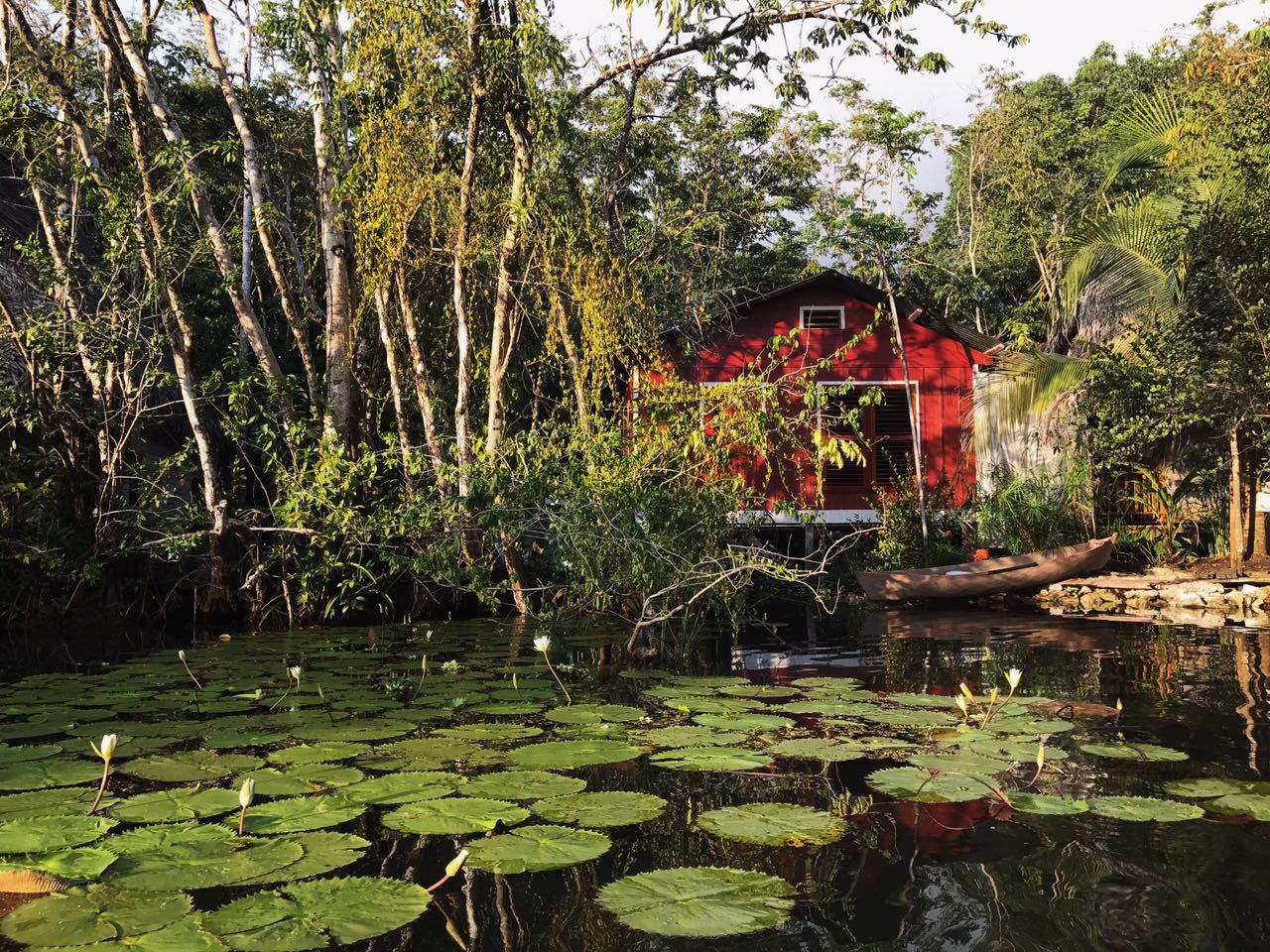
One of the most beautiful destinations in Guatemala, Río Dulce is often overlooked. This area overflows with beautiful nature, colonial history, unique culture, and fantastic food. This quick guide to Rio Dulce covers the best things to do, where to stay, and what to eat.

Through her writing, Paula helps travelers discover Guatemala beyond the typical tourist route with practical advice, local recommendations, and authentic experiences that connect visitors with the country’s people, culture, and traditions.
Planning a trip to Guatemala? Paula offers personalized Guatemala itinerary planning and trip consultation services tailored to your interests, travel style, and budget. Contact her at [email protected] to learn more.
- Hotels on Lake Atitlán: the Best Hotels and Vacation Rentals From a Local - June 3, 2026
- 5-Day Guatemala Itinerary: Atitlán and Antigua - June 2, 2026
- Best Guatemala Itinerary: Every Route for Every Trip Length - June 2, 2026


Dear Paula, I definitely love the photos in your posts! I have several times looked through your adventures
and I ask you to find a minute and drop me a mail at gvozdik at dctology dot com , I would welcome your participation in photoaggregation project (named Carde app) I run! Cheers and happy travels! Daria
BEAUTIFUL POST AND BEAUTIFUL PICTURES